
How to Structure a Weight Loss Coaching Online Program That Sells
Published on March 27, 2026 · Reading time: 18 min
Let’s be honest, the old way of chasing one-off clients is a recipe for burnout. The most successful weight loss coaching online today isn't built on isolated sessions. It’s built on group accountability, recurring memberships, and a powerful sense of community—all happening on platforms your clients already use, like WhatsApp or Discord.
From Isolated Sessions to Group Accountability
If you feel like you’re stuck on a hamster wheel, constantly trading your hours for dollars, you’re not alone. Many coaches build their entire business on individual client sessions, a model that puts a hard cap on your income and how many lives you can truly impact.
But there’s a much smarter, more sustainable way to grow. The future of coaching is all about creating group programs built around recurring memberships.
This community-first model solves two massive problems at once. For your clients, it delivers the powerful one-two punch of your expert guidance combined with crucial peer accountability—the very thing that's often missing when they try to go it alone. And for you? It creates a scalable business with predictable, recurring revenue, finally freeing you from the constant hunt for new 1:1 clients.
A Community-First Mentality
Weight loss is just as much a mental and emotional journey as it is a physical one. When clients are surrounded by a group of peers who get it, who share the same goals, they tap into an instant support system. You simply can't bottle that kind of collective energy in a one-on-one call.
Think about how it plays out in real-time:
- A member shares a "non-scale victory" in the group chat, and it instantly inspires three others who were having a tough day.
- Someone asks a question about a tricky recipe, and another member jumps in with the perfect tweak before you even see the message.
- A friendly step challenge gets everyone moving and buzzing with a sense of teamwork.
That’s the real power of community. It transforms a lonely struggle into a shared, motivating experience, which is a game-changer for long-term results and sticking with the program. This is the very heart of effective weight loss coaching online.
The secret to a scalable coaching business isn’t just about what you teach; it’s about the environment you create. A supportive community becomes a 24/7 accountability engine, driving results and retention that one-on-one coaching alone can never match.
The Opportunity Is Massive
The demand for digital health support is exploding. Market research shows the global online weight loss program space is booming, projected to hit a staggering USD 105,365.2 million by 2026.
This isn't just some passing fad; it's a fundamental shift in how people want to manage their health. They are actively looking for convenient, personalized guidance they can access from anywhere.
As a coach, you are perfectly positioned to meet this demand. By building a strong personal brand, you can attract the exact clients who connect with your unique methods and message. If you want to stand out from the crowd, our personal branding tips for coaches will help you build a magnetic presence. This guide will give you the blueprint to structure a program that not only gets incredible results but also builds a sustainable business you actually love running.
Designing an Effective Group Weight Loss Program
A great online weight loss program is a clear roadmap to transformation, not just a random folder of meal plans and workout PDFs. Your clients are paying for a repeatable system that delivers results, and the design of your program is what will get them there, keeping them engaged long enough to see real change.
Your first job is to nail down your program's core promise. What specific transformation are you selling? Is it "Lose your first 10 pounds in 8 weeks with a community of supportive moms"? Or maybe "Build sustainable eating habits without giving up pizza night"? This promise is your North Star—it guides every piece of content you create and every message you send.
Once you have that promise, you can map out the member journey with clear milestones. Stop thinking just in terms of weeks. Start thinking in terms of achievements. This reframes the process from a long, painful grind into a series of rewarding accomplishments.
This modern coaching process hinges on three key elements: building a strong community, using smart automation, and driving consistent engagement.
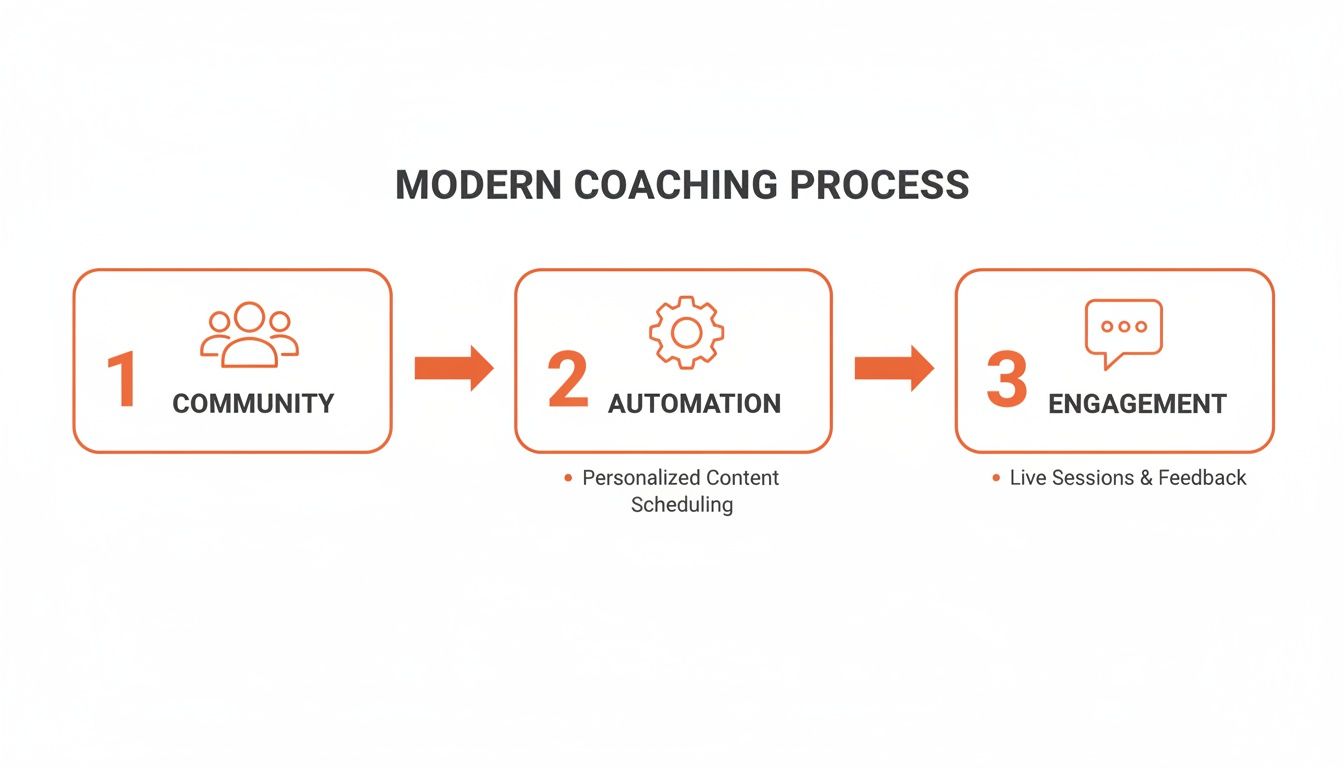
When you get this right, the community foundation, supported by clever automation, creates a cycle of meaningful engagement. That cycle is the engine that will drive your entire group program forward.
Building Your Program Pillars
Your curriculum needs a solid foundation built on a few core pillars that you hammer home week after week. This gives your program structure and stops you from overwhelming your members with too much information at once. For most weight loss coaching online programs, these pillars are essential.
- Nutrition Fundamentals: Teach the 'why' behind the 'what.' Don't just hand out meal plans. Educate members on macronutrients, mindful eating, and how to actually read a food label in the real world.
- Progressive Exercise: Design workouts that can be scaled up or down. You need to offer beginner, intermediate, and advanced versions of each exercise so everyone feels challenged but no one feels left behind.
- Habit Formation: Focus on small, consistent wins. A simple weekly habit challenge, like "drink a glass of water before every meal," is way more powerful than a drastic, unsustainable overhaul.
- Peer Accountability: This is your secret weapon in a group setting. You have to intentionally design opportunities for members to check in and support each other.
A well-designed program doesn't just tell people what to do; it empowers them with the knowledge and habits to make their own smart choices. The goal is independence, not indefinite dependence on you.
Creating a Content and Engagement Calendar
With your pillars in place, you can build out a content calendar that delivers a steady stream of value. This is what your members are actually paying for—consistent guidance and support. If you're running a recurring membership, this continuous value is non-negotiable.
Think about how you can use different formats to keep things fresh. Your content isn't just a weekly email. It's about daily touchpoints that make the experience feel personal and high-touch, even in a group.
Here's an example of what an 8-week program structure could look like, built around a weekly theme to keep members focused and moving forward together.
Sample 8-Week Group Weight Loss Program Structure
| Week | Weekly Theme | Content & Resources | Group Engagement Activity |
|---|---|---|---|
| 1 | Kickstart & Foundations | Welcome Kit, Goal-Setting Worksheet, Video: "Pantry Cleanout Guide" | "Introduce Yourself" thread & share one health goal for the program. |
| 2 | Mastering Macronutrients | Guide: "Macros Made Simple," Video: "How to Build a Balanced Plate" | Post a photo of one balanced meal you made this week in the group chat. |
| 3 | Mindful Eating | Audio: "Guided Mindful Eating Exercise," PDF: "Hunger & Fullness Scale" | Weekly Challenge: Eat one meal a day with zero distractions (no phone, no TV). |
| 4 | Fueling with Fitness | 3x new scalable workout videos (Beginner/Intermediate/Advanced) | "Workout Wednesday" check-in: Share which workout you did and how it felt. |
| 5 | Conquering Cravings | Video: "Healthy Swaps for Common Cravings," Recipe Pack: "Guilt-Free Snacks" | "Foodie Friday" Q&A: Ask the coach anything about managing cravings. |
| 6 | The Power of Habits | Guide: "Habit Stacking for Success," Template: "Weekly Habit Tracker" | Share one new healthy habit you've successfully integrated this month. |
| 7 | Navigating Social Events | Guide: "Eating Out Without Giving Up," Video: "Tips for Healthy Weekends" | Share your plan for one upcoming social event or weekend challenge. |
| 8 | Sustaining Your Success | Video: "Building a Long-Term Plan," Live Q&A: "Your Next 90 Days" | Share your biggest non-scale victory from the past 8 weeks. |
This kind of structure gives your members a clear path from start to finish, with each week building on the last to create real, lasting momentum.
High-Touch Activities in a Group Setting
Making a group program feel personal is what separates good programs from great ones—and it's the key to keeping members around. Small, thoughtful actions can have a huge impact on how connected a member feels to you and the community.
For example, instead of just celebrating pounds lost, create a dedicated channel in your Discord server called #non-scale-victories. This is where members can share wins like fitting into old jeans, having more energy to play with their kids, or saying no to dessert without feeling deprived. These are the moments that truly fuel long-term motivation.
Another powerful tool is audio. Sending a quick, 60-second "Mindful Eating Moment" audio clip via WhatsApp right before lunchtime can be a simple, intimate reminder that helps members stay on track. It feels incredibly personal but takes you almost no time to produce.
By blending your structured content with these spontaneous, human touchpoints, you create a program that is not only effective but also deeply supportive—and something your members will find very hard to leave.
Choosing Your Tech for Simplicity and Automation
Let's talk tech. The right tools should work for you, not the other way around. When you're building an online weight-loss coaching business, your tech stack is what keeps the whole thing from turning into an administrative nightmare. The goal is to set up a system that feels slick and professional for your members but runs on autopilot for you.
This isn’t about becoming a tech wizard. It’s about picking a few smart, simple tools that automate the boring stuff—like payments and member access—so you can pour your energy into what you actually do best: coaching.

Where to Host Your Community: WhatsApp vs. Discord
Your first big decision is choosing where your community will live. The best move is to meet your clients where they already are, which makes WhatsApp and Discord the clear frontrunners. They're familiar, easy to get to, and perfect for the daily chats that keep clients on track.
WhatsApp is a fantastic choice if you want to keep things simple and direct.
- Pros: Just about everyone on the planet has it. The group chat function is dead simple and works perfectly for daily check-ins, quick questions, and sending out motivational messages.
- Cons: It can get messy, fast. Important info or resources can easily get buried in a single, fast-moving conversation stream.
Discord brings a lot more structure to the table, which is a huge plus for larger programs or if you just like to keep things tidy.
- Pros: You can create different channels for specific topics (like
#weekly-wins,#meal-ideas, or#workout-questions), which keeps conversations organized. The voice channels are also brilliant for hosting impromptu "office hours" or live Q&A sessions. - Cons: There’s a bit of a learning curve for clients who’ve never used it. You might have to do some initial hand-holding.
Your coaching style is the deciding factor here. If you’re all about one simple, flowing conversation, go with WhatsApp. If you need dedicated spaces for different topics and resources, Discord is your winner.
The Engine of Your Business: Payment and Access Automation
This is where the real magic happens. Manually tracking who’s paid, chasing down late invoices, and adding or removing people from your chat group is a one-way ticket to burnout. For a scalable coaching business, automation isn’t a luxury—it’s non-negotiable.
Here’s what a smooth, automated workflow looks like in practice:
- A Clean Sign-Up Page: A potential client finds a simple, professional page where they can pick a subscription plan.
- Secure Payment: They pop in their card details through a trusted service like Stripe.
- Instant Access: The second their payment goes through, they automatically get an invite link to your private WhatsApp group or Discord server.
- Smart Management: If a member cancels or their payment fails, the system automatically and gracefully removes them from the group. No awkward conversations needed.
This kind of setup gives your members a seamless experience and takes you completely out of the tedious admin loop. And you don’t need to be a developer to make it happen. Platforms now exist specifically to be the bridge between your payment processor and your chat app.
The opportunity here is massive. The online coaching market is projected to skyrocket from USD 2 billion in 2020 to an incredible USD 11.7 billion by 2032, all powered by digital tools that make remote coaching a breeze.
By putting these key back-end tasks on autopilot, you instantly professionalize your business and make sure you get paid on time, every single time. It frees you up to deliver an incredible client experience, which is the real key to a successful weight loss coaching online program. To streamline things even further, be sure to check out our guide on the best freelance tools.
How to Price Your Program for Recurring Revenue
Let's be honest, figuring out what to charge is one of the toughest parts of building a coaching business. If you price too low, you're not just leaving money on the table; you're sending a signal that your coaching isn't all that valuable. Price too high, and you might scare off the very people you want to help.
The real key is to get out of the old "trading hours for dollars" mindset. Your path to a stable, predictable income lies in a subscription model. Instead of one-time payments for a set period, you offer ongoing access to your content and community for a simple monthly or yearly fee. This creates a reliable income stream for you and, more importantly, encourages the long-term commitment your clients need to see lasting results.
And the market for this is booming. In the U.S. alone, the digital health coaching space hit USD 3,138.1 million in 2024. It’s expected to climb to USD 5,564.2 million by 2030, with nutrition and fitness coaching leading the charge. The demand for well-priced, value-packed online programs is undeniable. You can get more details on the growth of the digital health coaching market here.
Moving Beyond Hourly Rates
First thing's first: stop thinking about your hourly worth. The price of your program has nothing to do with how many hours you spend in the WhatsApp group each day. It’s based on the transformation you deliver.
What's the real outcome your clients are paying for? It's not just a number on the scale. It's confidence. It's energy. It's learning to have a healthy relationship with food and their own body. That transformation is infinitely more valuable than a 60-minute call, and your pricing needs to reflect the massive value of that result.
Structuring Your Tiers for Maximum Appeal
A tiered subscription model is one of the most powerful ways to price your group coaching. It lets you meet clients where they are, catering to different budgets and needs. A classic—and very effective—setup uses two or three distinct tiers.
Here’s a practical example of how you could break it down:
- The Foundation Plan ($59/month): This is your entry-level, community-focused tier. It gives members full access to the WhatsApp or Discord group, all your core content like workouts and recipes, and group accountability challenges. It’s perfect for self-starters who just need that community push.
- The Accelerator Plan ($249/month): This is your premium, high-touch offer. It includes everything from the Foundation Plan, plus a much higher level of personal access. This could mean a monthly 15-minute 1:1 check-in call, personalized video feedback on their food log, or access to an exclusive sub-group for more advanced coaching.
This approach creates a natural upsell path and lets you serve a much bigger audience without hitting an income ceiling. Clients get to pick the level of support that feels right for them.
Don't undervalue your base community tier. For many clients, the group accountability and shared journey are the most valuable parts of the program. Price it confidently as the core of your offering, not just a cheap add-on.
Calculating Your Price Points
So, you've got your tiers. How do you actually land on the right numbers? While there’s no magic formula, you can get pretty close by looking at a few key factors.
Start by working backward from your income goals. How much do you need to earn each month to run your business and live comfortably? Let's say your goal is $6,000/month. You could get there with:
- 102 members on your $59/month Foundation Plan.
- Or, you could have just 20 members on the $249/month Accelerator Plan and 30 members on the Foundation Plan.
That simple math shows the power of a tiered system. You can also mix in a "bootcamp" model with a one-time fee for a fixed-length program (like $399 for an 8-week challenge), which is fantastic for pulling in new members who aren't quite ready for a monthly subscription.
Ultimately, your pricing is a core part of your business strategy. To get a deeper look at building out a recurring revenue stream, check out our complete guide on creating a sports coaching subscription model. When you structure your pricing around the value of the transformation you provide, you build a sustainable business that truly rewards you for the results you deliver.
Launching and Scaling Your Coaching Community

You’ve got the program blueprint and your tech is all lined up. Now for the exciting part—bringing in your very first members. This is where your vision for a chat-based weight loss community finally comes to life.
Forget the idea that you need expensive ads or complicated sales funnels. The launch is all about smart, authentic strategies that actually fit into your life as a busy coach. Your goal isn't just to get sign-ups; it's to build momentum from day one by creating an environment people won't want to leave.
Organic Marketing That Actually Works
Your most powerful marketing tool is your own expertise. The secret is to give potential members a real taste of the value you offer before they ever have to pull out their credit card.
These organic strategies are perfect for attracting clients naturally:
- Run a Free 5-Day Challenge: Host something like a "Healthy Habit Kickstart" in a free, temporary WhatsApp or Discord group. This gives people a direct look at your coaching style and the energy of group support. At the end, you simply offer them the chance to continue the journey in your paid community.
- Leverage "Behind-the-Scenes" Content: Use your Instagram or TikTok Stories to show snippets of the community in action (with permission, of course). Post a screenshot of a "Weekly Win" or share a quick tip you just gave your members. This creates powerful social proof and a bit of FOMO.
- Team Up with Your Peers: Partner with a yoga instructor or a mindset coach for a joint live session on social media. You can cross-promote to each other's followers, instantly doubling your reach with a perfectly relevant audience.
Your best marketing is just showing up and being a great coach. When you consistently share valuable, free content, you build trust and make your paid program the obvious next step for anyone serious about getting results.
The First Impression Is Everything
Once a new member signs up, the clock is ticking. The first 72 hours are absolutely critical for making them feel welcomed, seen, and confident they made the right choice. A clunky or confusing onboarding process is one of the fastest ways to lose someone.
Your onboarding should be automated but feel deeply personal. The moment a member’s payment goes through, they should get a welcome email with a single, crystal-clear call to action: "Click here to join the community chat."
Once they’re in, your job is to guide them. Here’s a simple but effective flow:
- A Pinned Welcome Message: Pin a message at the top of your group that explains the "rules of the road," where to find resources, and what to expect in their first week.
- The "Introduce Yourself" Prompt: Immediately encourage them to post a brief intro. When they do, welcome them by name and maybe even tag another member who shares a similar goal. This creates an instant connection.
- A First-Week Checklist: Give them a few simple tasks to complete, like "Set your profile picture," "Review the Week 1 content," and "Share one goal in the #goals channel." This gets them engaged right away.
Building a Community People Never Want to Leave
Getting a new member is great, but keeping them is how you build a sustainable business. The whole point of your weight loss coaching online program is to create a community so valuable that the monthly fee feels like a bargain.
Retention isn't about fancy tricks. It's about consistently delivering value and fostering genuine human connection.
Here are a few powerful tactics you can implement right away:
- Celebrate Anniversaries: Publicly congratulate members on their 1-month, 3-month, and 1-year anniversaries in the group. This small gesture shows you're paying attention.
- Introduce Fun Group Challenges: Beyond your core content, run spontaneous mini-challenges like a "Hydration Hero" week or a "Plank-a-Day" month. These keep the energy high and build camaraderie.
- Act on Feedback: Regularly ask your members what they love and what they want more of. When you implement a suggestion and credit the member who proposed it, you create a powerful sense of ownership.
By combining authentic marketing with a killer onboarding process and a laser focus on retention, you shift from just selling a program to leading a thriving, long-term community. This is how you scale your impact and your income without burning out.
Your Weight Loss Coaching Questions Answered
Alright, you've got the vision for your online weight loss group. But let's be honest, even the best plans come with a dose of "what if?" I get it. I've been there.
Let’s walk through some of the biggest questions that pop up for coaches, with some straight-up, practical answers to clear the fog.
How Do I Keep Members Motivated in a Group Setting
Keeping a group motivated isn't just about you being a cheerleader 24/7. While your daily video check-ins and voice notes are important, the real secret is getting members to root for each other.
When the community starts motivating itself, that’s when the magic happens. Here are a few things I’ve found that really work:
- A ‘Weekly Wins’ Channel: Set up a dedicated space in Discord or a daily thread in WhatsApp where people can share any kind of progress. Non-scale victories, hitting a new personal best, whatever. It builds incredible momentum.
- Friendly Competition: Keep it light and fun. Simple step challenges or workout consistency leaderboards work wonders. The goal is participation, not a cutthroat contest.
- Public Shout-Outs: When someone hits a milestone—their first month, a weight goal, or just consistently showing up—celebrate them in the main chat. It makes them feel seen and motivates everyone else.
Honestly, peer-to-peer encouragement is a game-changer. A high-five from someone else in the trenches who gets it often means more than anything you can say as a coach. It builds an accountability loop that just works.
What Legal Considerations Should I Be Aware Of
This is the boring but essential stuff. Running a professional coaching business means covering your bases to protect both yourself and your clients. First and foremost: stay in your lane. Your scope of practice is everything.
If you’re a fitness coach, you can give general nutritional advice. But you can't prescribe a specific meal plan to treat a medical condition unless you're also a registered dietitian. Always use clear disclaimers that your advice is for educational purposes and that clients need to chat with their doctor before starting something new.
And please, get liability insurance that specifically covers online coaching. For privacy, use a secure payment system and have every single client agree to your terms of service before they pay. Those terms should spell out your refund policy, cancellation rules, and how you handle their data.
Can I Really Build a Full-Time Income with This Model
One hundred percent, yes. The reason this model works so well comes down to two things: scalability and recurring revenue. Traditional 1-on-1 coaching is great, but you’re always trading your time for money. You eventually hit a ceiling because there are only so many hours in the day.
A group model completely shatters that ceiling. It takes roughly the same amount of effort to manage a group of 100 members as it does to manage 20.
Just do the math:
- 100 members paying a pretty modest $59/month brings in $5,900 in monthly recurring revenue.
That kind of predictable income is a world away from the feast-or-famine cycle of constantly trying to fill 1-on-1 client spots. By plugging in a simple automation tool to handle payments and group access, your admin work doesn't balloon as your community grows. That frees you up to do what you do best—coach—which is how you turn this from a side hustle into a full-time career.
How Should I Securely Deliver My Program Content
Just dumping your PDFs, videos, and guides into the main group chat is a bad idea. It instantly devalues your content and makes it incredibly easy for people to share your hard work with non-paying friends.
The smart way to do this is to use a platform that connects secure content delivery directly to membership status. That means you host your resources in a protected space where only active, paying subscribers can get to them.
When a member’s subscription ends or their payment fails, their access to both the community and your content library should be cut off automatically. This isn't just about protecting your IP; it reinforces the premium, exclusive feel of your program, which is exactly what justifies your subscription fee in the first place.
Ready to turn your WhatsApp or Discord group into a professional, automated business? With Join My Coach, you can create a beautiful subscription page, connect your Stripe account, and automate payments and member access in minutes. Stop chasing invoices and start building your community. Create your free account today.