
How to Start Your Online Coaching Business From Scratch
Published on April 1, 2026 · Reading time: 17 min
If you're a coach, trainer, or instructor, you know the grind. Trading time for money—one client, one session at a time—is rewarding, but it has a ceiling. Starting an online coaching business is your path to breaking through that ceiling, turning your expertise into a real business that generates recurring income.
Why Launch Your Online Coaching Business Now?

Let's get one thing straight. When we say "online coaching business," we aren't talking about building a massive, university-style platform with hundreds of videos and complex software. That’s not the goal here.
For a coach like you, an online business is simply a dedicated space where you deliver your unique value to a community of paying members. It can be as simple as a paid WhatsApp group where you share daily workout tips or a Discord server for your nutrition clients.
The barrier to entry has never been lower. More importantly, the demand for specialized, independent coaching has never been higher. People are actively searching for authentic experts to guide them—not faceless corporations.
The Market is Ready for You
The shift to digital learning isn't just a trend; it's a fundamental change in how people seek out self-improvement. The numbers paint a clear picture of the opportunity in front of you.
The online education market exploded by around 900% between 2000 and 2020. That wasn't a fluke. By 2025, the market had already hit $82.81 billion, with forecasts showing it soaring past $225 billion by 2030. You can dig into the future of online learning and its growth on Calmu.edu.
This growth is driven by the exact kind of skill-based, supportive learning that coaches provide. Your future clients are already out there, looking for what you offer.
- Clients want direct access: They crave genuine connection and real-time support, something you can easily provide in a community setting.
- Flexibility is non-negotiable: Modern learners need programs that fit their messy lives, whether it's a quick check-in from their phone or a weekend Q&A session.
- Niche expertise is in demand: People are tired of generic advice. They will happily pay a premium for a coach who understands their specific problem, like a yoga instructor focused on prenatal wellness or a trainer helping cyclists improve their climbing power.
Your online coaching business is the perfect way to meet these needs. It allows you to build a focused community, deliver your coaching in a modern way, and create a sustainable income stream based on the value you provide—not just the hours you work.
Step 1: Define Your Niche to Attract the Right Clients

Before you design a single workout plan or create a single piece of content, you have to know exactly who you're helping. This is the most critical step, and it’s where most new coaches go wrong. They try to help everyone, and in doing so, they end up connecting with no one.
When you’re for everyone, you’re for no one.
The magic happens when you get specific. A generic "fitness coach" is just noise. But a "strength coach for runners over 40"? That immediately cuts through and speaks directly to a specific person with a specific problem.
This isn't about shrinking your audience; it's about focusing your impact. Your goal is to become the go-to expert for a particular group of people.
Finding Your Unique Coaching Angle
To uncover your niche, find the sweet spot where your skills, your passions, and a real market need collide. You don’t need a fancy business plan for this—just some honest self-reflection.
- What problem do you love solving? Think about the topics that light you up. Is it high-intensity training, restorative yoga, or nutrition for marathoners? Your genuine enthusiasm is contagious and will attract people who share that passion.
- Where do you get the best results? Beyond what you love, where do you consistently deliver for people? Maybe you have a knack for helping new moms rebuild their core strength or for helping busy professionals lose their first 10 pounds. This is your "secret sauce."
- Who do you enjoy helping most? Think about the people you naturally understand. Do you get the struggles of a busy professional trying to squeeze in a workout, or do you excel at motivating beginners who feel intimidated by the gym?
Now, combine these elements. For example, if you love yoga, are great at teaching modifications, and enjoy working with older adults, your niche could be "Gentle Yoga & Mobility for Seniors." That immediately tells a potential client exactly what you do and who you do it for.
Niche Discovery Framework for Coaches
| Your Passion/Expertise (e.g., Yoga, Nutrition) | Specific Audience (e.g., Busy professionals, Athletes over 40) | Their Core Problem (e.g., Lack of time, Injury prevention) | Your Niche Solution (e.g., 30-min desk yoga, Mobility for senior athletes) |
|---|---|---|---|
| Nutrition Coaching | Busy Professionals | No time for healthy meals | Simple Meal Prep for High-Energy Days |
| Yoga | New Moms | Postpartum recovery, low energy | Core Restore Yoga for Postnatal Moms |
| Fitness Training | Men over 50 | Losing muscle, joint pain | Low-Impact Strength for Lifelong Fitness |
By filling this out, you start to see a clear, unique solution emerge from the combination of your skills and your audience's needs.
The most successful online coaches solve a specific problem for a specific community. Your niche isn’t just a marketing tactic; it’s the foundation of your entire business. It dictates your content, your communication style, and how you deliver results.
Create Your Ideal Client Avatar
Once you have a niche, bring it to life by creating a "client avatar." This is a detailed profile of the one ideal person you're trying to help. Give them a name, an age, a job, and a story. This exercise turns a vague "target audience" into a real person, making every decision about your coaching business ten times clearer.
Let's say you're a nutrition coach. Your avatar might be "Stressed Steve."
- Who is he? Steve is a 45-year-old project manager.
- What’s his biggest goal? He wants to lose 20 pounds and get enough energy to keep up with his kids, but his demanding job leaves him totally drained.
- What are his daily struggles? He skips breakfast, grabs unhealthy takeout for lunch, and struggles with late-night snacking. All the conflicting diet advice online just makes him feel overwhelmed.
- What does he need from you? He doesn't need a complicated, rigid meal plan. He needs simple, quick recipes, accountability check-ins via text, and real strategies to manage stress eating.
See the difference? Now, you're not just another "nutrition coach." You're a coach who helps busy professionals like Steve build sustainable, high-energy eating habits without the overwhelm. Everything from your marketing copy to your coaching program is now designed specifically for him.
If you want to find more coaching niches with low competition, you can dive deeper into this topic and find some great opportunities that are still wide open.
Step 2: Build a Simple Program That Delivers Real Results
So, you've nailed down exactly who you're serving. The very next question is always the same: what should you actually teach them?
The thought of building a program from scratch can feel totally overwhelming. It’s easy to imagine you need a university-level library of content before you can even think about launching. Let's get that idea out of your head right now.
Your goal isn't to just dump information on your clients; it’s to guide them to a real, tangible transformation.
The best advice is to start small and laser-focused. Instead of disappearing for six months to build some giant, all-encompassing program, launch with what’s known as a Minimum Viable Product (MVP). This could be a 4-week challenge, a 14-day kickstart, or a foundational course that solves one specific, urgent problem for your ideal client.
The most powerful coaching programs are designed to produce a clear, tangible outcome. A successful program isn't measured by how many videos you have, but by how many clients achieve their goals.
By starting with an MVP, you can get to market fast, start generating income, and—most importantly—get real-world feedback from your first batch of clients. This lets you build out your coaching business brick by brick, based on what your community actually needs, not just what you think they need.
Structuring Your Content for Transformation
The secret to a great program is logical progression. You’re taking your clients on a journey, and each step has to build on the last. A simple and incredibly effective way to map this out is with a weekly or modular format. This breaks a huge goal down into manageable, week-by-week actions.
Let's say you're a nutrition coach building a "28-Day Healthy Habits Reset" for busy professionals. You could structure it like this:
- Week 1: Mindset and Foundation: Focus on setting goals, cleaning out the kitchen, and understanding basic nutrition. The whole point is to build momentum and score some small, early wins.
- Week 2: Core Habits: Introduce simple meal prep strategies, recipes for quick lunches, and techniques to crush that afternoon energy slump.
- Week 3: Navigating Real Life: This is where you tackle common roadblocks like eating out, handling social events, and managing stress-related snacking.
- Week 4: Sustaining Your Success: Teach clients how to build a long-term plan, listen to their bodies, and make their new habits stick for good.
This kind of structure provides a crystal-clear path from A to B. It prevents overwhelm and keeps people engaged because they can see and feel their progress every single step of the way.
Making this decision—choosing the right path for your program—is one of the most vital steps to getting started. This flowchart can help you visualize the process.
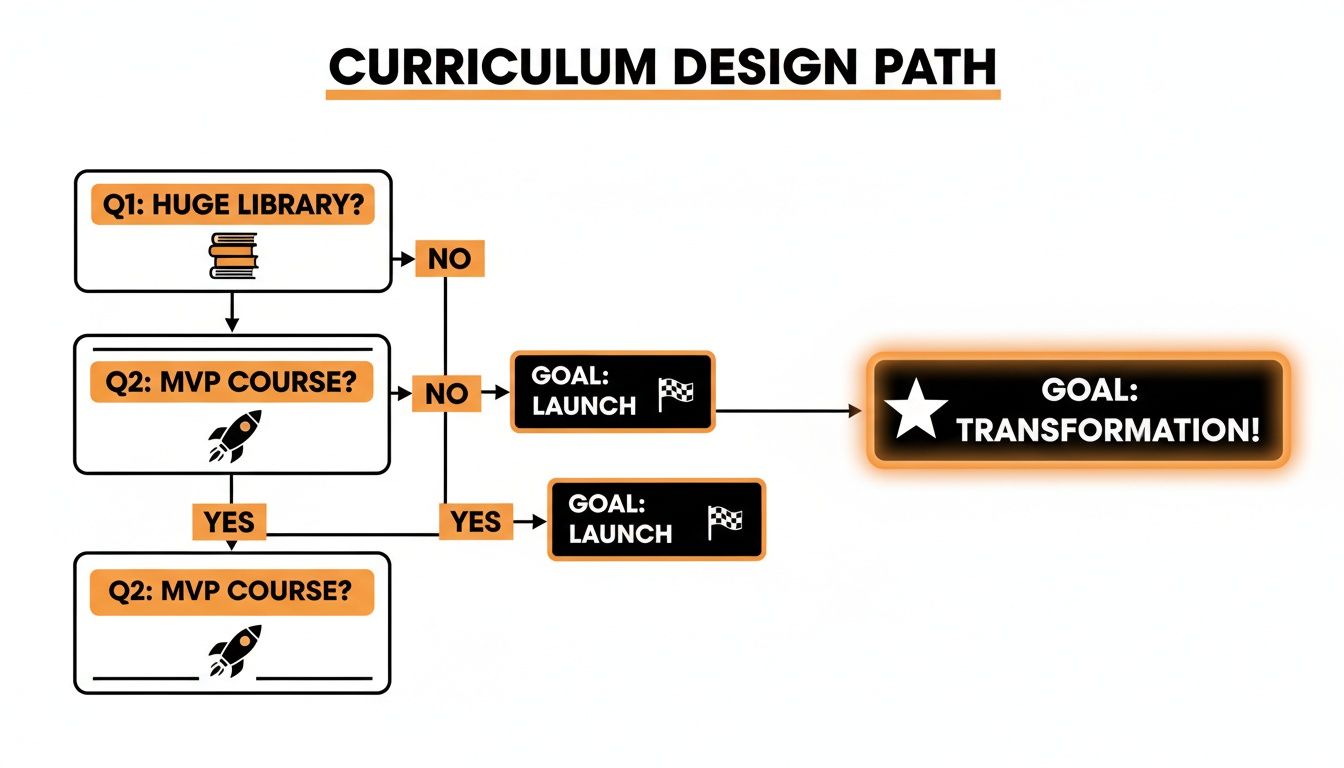
As you can see, the smartest path is clear: avoid the trap of building a massive content library upfront. Instead, pour your energy into a focused MVP program that’s engineered for transformation.
How to Deliver Your Coaching Simply
You also don't need some complex, expensive platform to deliver this content, especially at the start. The delivery method should match the program's simplicity. If you're running a 28-day challenge, you can deliver everything right where your community already lives.
- Daily Tips: A short, actionable tip sent to your paid WhatsApp or Discord group each morning.
- Weekly Check-ins: A live Q&A session over the weekend or a simple check-in post in the group to keep accountability high.
- Resource Drops: A weekly PDF with recipes or a short video demonstrating a key technique, shared directly in the chat.
This approach keeps the tech barrier incredibly low for both you and your clients. A yoga teacher could run a "30-Day Flexibility Challenge" entirely within a private WhatsApp group, sharing a new 15-minute stretching video each day and answering questions in the evening. It’s simple, direct, and unbelievably effective at getting results.
Step 3: Choose Your Tech Without the Headache
Let’s be honest—this is the part that makes most coaches want to give up before they even start. The word "technology" conjures up images of complicated software, coding nightmares, and a mountain of subscription fees. But building the engine for your online coaching business is much, much simpler than you think.
You do not need a massive, expensive, all-in-one platform to get started. In fact, for most coaches, that's the absolute wrong approach. The secret is to boil it down to three simple needs:
- A place to build your community and deliver your coaching.
- A system to get paid automatically and securely.
- A simple way for clients to sign up.
That's it. You can nail all three with tools that are simple, familiar, and incredibly effective.
Community Where Your Clients Already Are
The heart and soul of your online coaching is the community. It’s where you deliver daily value, answer questions, and build real relationships. While some coaches get lost in complex course platforms with clunky built-in forums, there's a much more direct and powerful way.
Use the apps your clients already have open on their phones all day: WhatsApp and Discord.
The power of a chat-based community is its immediacy. There are no new platforms to learn, no passwords to forget, and zero barriers to engagement. When you share a new workout, a nutrition tip, or a motivational message, it lands directly in their pocket. This creates a level of direct access and constant connection that traditional course platforms just can't touch.
Your coaching lives or dies by engagement. A simple WhatsApp group with 20 active, paying members is infinitely more valuable than a fancy course platform with 200 members who never log in. Meet them where they already are.
Comparing Tech Setups for Your Coaching Business
When you're figuring out how to build your business, you have three main paths. You can go big with a complex platform, get your hands dirty with a DIY setup, or choose a leaner, more direct approach.
Let’s break down what those options actually look like.
| Tech Setup | Best For | Pros | Cons |
|---|---|---|---|
| All-in-One Course Platform (e.g., Kajabi, Teachable) | Coaches with a massive library of video content and a large budget. | Has every feature imaginable, from email marketing to website building. | Expensive monthly fees, complex to set up, and can feel impersonal to students. |
| DIY WordPress Site with Plugins | Tech-savvy coaches who want total control and don't mind managing updates and security. | Infinitely customizable and potentially lower long-term cost if you build it yourself. | High initial learning curve, requires constant maintenance, and can break easily. |
| Simple Chat-Based Automation (e.g., WhatsApp/Discord + an automation tool) | Coaches focused on community, direct access, and recurring revenue without the tech headache. | Extremely low barrier to entry, fosters high engagement, and simple for you and your students. | Requires a separate tool to handle automated payments and member management. |
For most coaches just starting out, the chat-based model is a clear winner. It allows you to focus 100% on coaching, not on becoming a web developer. The simplicity lets you launch faster and build a tighter, more connected community from day one. There's a whole world of helpful apps out there, and you can explore some of the best freelance tools to supercharge your business to see what fits your style.
The Missing Piece: The Automated Paywall
Here's the magic that makes a chat-based coaching business work: automating payments and access. Manually tracking who paid, sending bank transfer details, and adding or removing people from a group is an administrative nightmare that will burn you out, fast.
This is where a simple automation tool becomes your best friend. Picture this workflow:
- A potential client lands on a clean, simple sign-up page.
- They choose a subscription plan (say, $49/month for your fitness group).
- They pay securely with their credit card through a trusted processor like Stripe.
- The moment their payment is confirmed, they are automatically sent a link to join your private WhatsApp or Discord group.
If a member cancels their subscription or a payment fails, the system automatically removes them from the group. No awkward conversations, no chasing invoices.
This simple piece of automation is what transforms your coaching from a side hustle into a predictable, recurring-income business. It frees you from admin work and lets you focus on what you actually love—coaching your clients to get incredible results.
Step 4: Price Your Coaching for Value, Not Time
Let's talk about getting paid. This is where so many talented coaches get it wrong, turning what could be a real business into a time-consuming hobby. The biggest mistake is pricing based on the hours you log instead of the transformation you deliver. We have to flip that script.
You're not selling workout videos or a few weekly check-ins. You’re selling confidence, health, accountability, and a clear path to results. Your pricing needs to reflect that value, not your stopwatch.
Choosing Your Pricing Model
The beauty of running your own online business is breaking free from the old "per session" fee. You get to build a model that creates recurring revenue—the absolute key to stability and scaling your business without burning out.
For most community-based coaching, two models work exceptionally well:
- Recurring Subscriptions: This is the gold standard. Members pay a recurring fee (monthly, quarterly, or yearly) for ongoing access to your content, community, and coaching. This creates predictable cash flow for you and keeps your members committed. A wellness coach, for instance, might offer a $59/month subscription for mindset coaching and group accountability.
- One-Time Fees: This is perfect for fixed-length programs, like a "4-Week Strength Challenge" or a "90-Day Nutrition Reset." A client pays a single fee for access to that specific program. It's a fantastic way to introduce people to your coaching style before they commit to an ongoing membership.
The goal is to build a system where you aren't constantly chasing the next invoice. Automated, recurring revenue frees you from endless admin work and gives you the financial stability to focus 100% on your members' success.
Creating Pricing Tiers to Serve More Clients
Not every potential client has the same needs or the same budget, and your pricing should reflect that. Offering a couple of simple pricing tiers is a brilliant way to make your coaching accessible to more people while creating a premium option for those who want more of your direct attention.
This strategy lets you capture a much wider slice of the market. For a personal trainer running a fitness community, this could look like this:
- Basic Tier ($29/month): Access to the core community group on Discord, daily workout posts, and weekly group Q&A sessions. It’s perfect for self-motivated members who thrive on structure and community support.
- Premium Tier ($99/month): Includes everything in the Basic Tier, plus a monthly 1-on-1 check-in call and personalized feedback on their workout form via video submission. This higher-touch option provides immense value for those wanting extra accountability.
This tiered approach is how you scale your impact without scaling your workload linearly. Your core content serves the many, while your direct time—your most valuable asset—is reserved for your highest-paying members.
Using a system that automates payments isn't just a nice-to-have; it's non-negotiable for building a real, sustainable business.
Step 5: Launch and Find Your First Paying Clients
Alright, this is where it all comes together. You’ve done the work: you’ve carved out your niche, built a simple program packed with value, and chosen your tech. Now for the exciting part—enrolling your very first paying clients.
Forget needing massive, expensive marketing campaigns. The goal here isn't to throw money at ads and hope for the best. It's about building real momentum through authentic connections and smart, low-cost strategies.
A great launch isn’t about perfection on day one. It’s about building momentum. Your first clients are your founding members—treat them like gold, and they'll become your most passionate advocates.
Your launch begins with the audience you already have, no matter how small you think it is.
Start with a Founder's Launch
Your very first launch should be a special, exclusive event for a small group of "founding members." This is a strategic way to test your program, get invaluable feedback, and build a core group of incredible success stories.
A powerful tactic is to run a "Founder's Launch" exclusively for your existing network. This means reaching out to your social media followers, your email list (if you have one), and even friends and family who might know people in your niche. Offer a significant discount in exchange for them being your first "beta" group.
To drum up excitement, try hosting a free workshop or challenge. A 3-day challenge or a 60-minute live workshop is a fantastic way to give potential clients a real taste of your coaching style. Deliver a ton of value for free, and at the end, make a natural transition by inviting them to join your paid program to continue their journey with you.
Don’t underestimate the power of your personal network. Let people in your life know what you're building and who you're trying to help. You’d be amazed at how many referrals can come from these genuine, real-world connections.
The whole thing works because it’s authentic. You're not selling a flawless, finished product. You're inviting people to join you on a journey to build something amazing together. You can discover more practical ways to sell online courses in our detailed guide on the topic.
Thinking About Your Next Wave of Growth
Once you have your first members and are gaining confidence, it’s smart to think about where the next wave of clients might come from. While North America has been a huge force in online education, the global picture is shifting.
Looking at the market, while North America held the largest share in recent years, the Asia-Pacific region is set to become the fastest-growing market. For instance, India's eLearning market is projected to hit an incredible $7.57 billion while growing at a 25.76% CAGR—the highest in the world. For coaches ready to scale, these global market trends on The Business Research Company provide a clear roadmap for future growth.
Create a Simple and Clear Landing Page
Even for a simple launch, you need a single, central place to send everyone who's interested. This doesn't need to be a complex, multi-page website. A single, clear landing page is all you need.
This page has one job: communicate the value of your program and get people to sign up.
Make sure it clearly answers these questions:
- Who it's for: (e.g., "For busy moms who want to get back into running...")
- What it is: (e.g., "A 12-week program to build strength and confidence...")
- The transformation it delivers: (e.g., "...so you can run your first 10k without injury.")
- A clear call-to-action: A big, can't-miss button that says something like "Join the Program Now."
This focused approach strips away all distractions and guides your potential client directly to the sign-up.
Common Questions About Starting an Online Coaching Business
Got questions? You’re not alone. When you’re starting your own online coaching business, a few common worries always seem to pop up. Let's tackle them head-on.
How Much Content Do I Actually Need to Launch?
You need way less than you think. Many coaches fall into the trap of trying to build a massive library of content before they have a single client.
Don't do it. Instead, start small and focused. Launch with a tight, 4 to 6-week program or even a "beta" version of your course for a small group of founding members. The goal is to deliver a clear transformation. This lean approach lets you start earning revenue immediately while gathering priceless feedback. You can (and should) build out more content later, based on what your members actually want and need.
Do I Have to Be a Tech Expert?
Absolutely not. In fact, some of the most successful online coaching businesses are built on surprisingly simple tech. You can run an incredibly effective business using tools your clients are already comfortable with, like WhatsApp or Discord, for your community and content delivery.
The key isn't becoming a tech wizard. It’s about choosing a system that automates the hard parts—like payments and member access—so you can stay in your zone of genius: coaching.
How Do I Handle Payments and Subscriptions Securely?
The most reliable way is to use a trusted payment processor like Stripe and connect it to a platform built specifically for coaches. This setup completely removes the headache of sending manual invoices, tracking who has paid, and chasing late fees.
Modern tools connect directly to your Stripe account, automating the entire subscription process for your WhatsApp or Discord groups. When a member subscribes, they’re automatically added. If their payment fails or they cancel, they’re automatically removed. It’s a clean, simple system that keeps your income secure and predictable.
Ready to turn your coaching community into a recurring income stream without the tech headaches? Join My Coach automates payments and access for your WhatsApp and Discord groups, so you can focus on coaching. Start for free on Join My Coach.