
A Guide for Female Coaches to Build Thriving Paid Communities
Published on April 2, 2026 · Reading time: 15 min
Something powerful is happening in the world of online coaching, and as a female coach in fitness, wellness, or sports, you're standing right at the center of it. The old, top-down model of coaching is on its way out. Clients aren't looking for a distant guru anymore; they're searching for genuine connection, understanding, and a community that gets them.
Your Moment to Lead Is Now

This shift plays directly to your strengths. The very qualities that likely drew you to coaching—empathy, intuition, and a natural ability to create safe, supportive spaces—are exactly what people are paying for in 2026.
You don't just hand out workout plans or nutrition guides. You build environments where your clients can connect, grow together, and feel supported. That's the future of coaching.
The Power of Community and Connection
Think about the incredible energy that sparks when people gather to lift each other up. There’s a unique sense of safety and shared drive that’s almost impossible to replicate in a standard one-on-one session.
This is the real magic behind building a paid coaching community on a simple app like WhatsApp or Discord.
Your members aren't just buying your time; they're investing in a circle of peers who are on the same journey. They're paying for access to a tribe that cheers them on, holds them accountable, and reminds them they aren't alone.
The desire to reach for the stars is ambitious. The desire to reach hearts is wise. – Maya Angelou
This isn't just a feeling; the industry data confirms it. Women are a major force in coaching, making up a massive 72% of all coaches in North America. It’s no surprise that this dynamic industry is projected to be worth $5.8 billion globally by 2026. Your community-focused approach is what the market is demanding.
Turning Your Expertise into Recurring Income
Let's be practical: this is also about building a business that actually supports you. The old client-by-client hustle is a recipe for unstable income and burnout. A paid community on WhatsApp or Discord flips that script, opening the door to predictable, recurring revenue.
This model lets you:
- Serve More People: Instead of being capped by the hours in your day, you can guide dozens, even hundreds, of clients at the same time.
- Create Deeper Impact: Daily check-ins, group discussions, and a shared resource library create constant touchpoints that lead to incredible results for your members.
- Build a Sustainable Business: A steady, reliable income stream gives you the financial security and peace of mind to focus on what you do best—changing lives.
This guide is your playbook for turning those natural strengths into a thriving paid community. We’ll walk through how to structure a program that feels authentic, delivers huge value, and builds a profitable business you love. You can also read more about how creators can build a stable income with recurring revenue . It’s time to step into your power and lead this change.
Defining Your Niche and Powerful Value Proposition
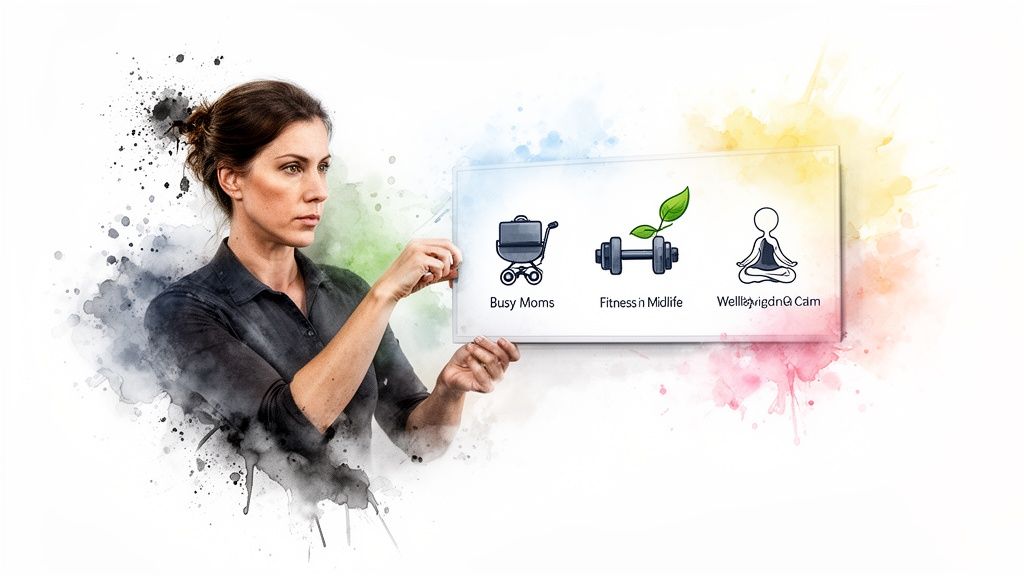
The secret to a paid community that people are lining up to join isn’t trying to appeal to everyone. Honestly, it’s the exact opposite. The most successful coaches are the ones who build communities that feel magnetic because they speak directly to someone specific.
Picture this: a potential client is scrolling online, feeling completely overwhelmed by her fitness goals. When she lands on your page and has that "Wow, she's talking directly to me" moment, you've forged a connection that generic "get fit fast" coaching just can't touch. That's the power of niching down.
This isn’t about shrinking your audience; it’s about deepening your impact. You instantly become the go-to expert for a very specific group of people whose problems you are uniquely wired to solve.
Moving from General to Specific
Let's get practical. "Wellness coach" is too broad. But a wellness coach for new moms navigating postpartum recovery? Or a nutrition coach for women over 40 who are battling hormonal changes? Now that is powerful. These niches zero in on a distinct pain point and promise a specialized solution.
Think about the difference here:
- Broad: A fitness coach for women.
- Niche: A fitness coach helping women rebuild strength and confidence after an injury.
- Broad: A personal trainer.
- Niche: A personal trainer for female founders who want to build energy and resilience without spending hours in the gym.
That level of specificity makes your ideal client feel instantly understood. She knows you get her struggles in a way a generalist coach never could.
Crafting Your Unique Value Proposition
Once you know exactly who you're serving, you have to be crystal clear about what you uniquely offer them. This is your value proposition. It’s a compelling, can't-ignore-it promise of the transformation you deliver. It answers the question: "Why should I join your community instead of the thousand others out there?"
A strong value proposition isn't about the features, like "daily check-ins." It's about the outcome and the feeling your members will walk away with. It’s the "after" picture they're dreaming of.
Your value proposition is your unique magic, spelled out. It's the promise that you see your client's struggle and have a clear, supportive path forward just for them.
For instance, instead of saying, "I offer a paid WhatsApp group with daily prompts," your value proposition should sound more like this: "I help busy working moms build consistent, energizing morning workout routines in just 15 minutes a day, so they can start their day feeling strong and in control, not chaotic and behind."
See the difference? The first is a feature; the second is a full-blown transformation. It paints a vivid picture of a future she desperately wants, making your community an irresistible solution.
To lock in your own, ask yourself these four questions:
- Who is my ideal client? Get super specific. What are her daily challenges, her secret fitness or wellness goals, her frustrations?
- What is her biggest pain point right now? What's the one thing that keeps her from reaching her goals?
- What is the specific transformation I provide? What will her life actually look and feel like after training with me in my community?
- Why am I the right person to guide her? What part of your story, your style, or your experience makes you the perfect guide for her journey?
Answering these will give you the clarity to build a value proposition that hits home. You're not just selling access to a group chat; you're offering the key to unlock the healthy, strong life your ideal client wants to live. That clarity is the foundation of a community people are genuinely excited to pay for and stay in for the long haul.
How to Structure Your Paid WhatsApp or Discord Group
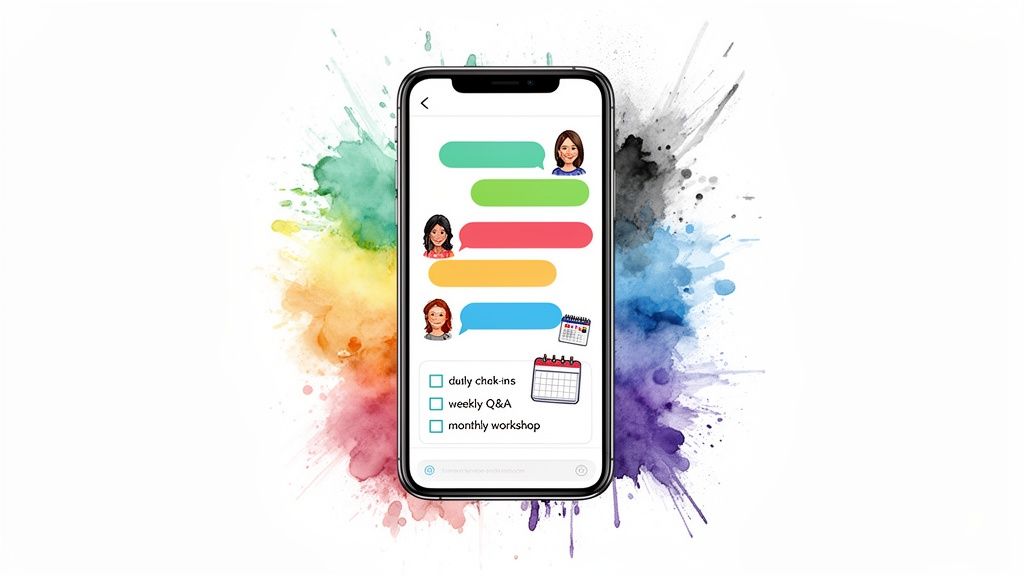
Turning a simple chat group into a premium, high-value experience is all about creating a sense of rhythm and structure. Your members aren’t just paying for access; they’re investing in a system that offers support, accountability, and real connection. The secret is to build a predictable flow of content that feels both nourishing and exciting.
A successful group doesn't mean you have to be available 24/7. Not at all. It’s about creating consistent, meaningful touchpoints that your members can actually rely on. That's what builds trust and keeps them engaged for the long haul.
Choosing Your Platform: WhatsApp vs. Discord
Before you dive into structuring content, you need to pick the right home for your community. Both WhatsApp and Discord are fantastic, but they serve different needs. WhatsApp is all about simplicity and directness, while Discord offers a more robust, customizable experience.
Choosing the right platform is critical because it shapes the entire member experience. Here’s a quick breakdown to help you decide which one aligns best with your coaching style and the community you want to build.
| Feature | Discord | |
|---|---|---|
| Community Structure | Single chat thread (or multiple groups). Can get chaotic. | Highly organized with categories and channels for different topics. |
| User Experience | Extremely simple and familiar to almost everyone. Low learning curve. | More features mean a steeper learning curve for non-gamers. |
| Content Organization | Files and links get buried in the chat history. Hard to find later. | Dedicated channels for resources, videos, and links. Easy to organize. |
| Engagement Tools | Basic chat, polls, and status updates. | Voice/video channels, stage events, threads, bots for automation. |
| Monetization | Requires a third-party tool (like Join My Coach) to manage access. | Can be monetized with bots and third-party tools. Role management is key. |
| Best For | Smaller, intimate groups focused on daily accountability and direct chat. (e.g., fitness challenges, nutrition tracking) | Larger communities, online courses, and multi-topic coaching programs. |
Ultimately, there's no single "best" choice—only the best choice for your program. If you want simplicity and direct accountability, WhatsApp is perfect. If you need a more organized, feature-rich "digital home" for your members, Discord is the way to go.
Establishing a Daily Rhythm for Accountability
Daily check-ins are the heartbeat of a thriving coaching community. They create a simple yet powerful habit of accountability that makes your members feel seen and supported every single day. This is an absolute game-changer for fitness, nutrition, and wellness coaches where consistency is everything.
You don't need to write an essay. A simple, thought-provoking prompt is more than enough to spark reflection and sharing. The goal is to make it incredibly easy for members to participate, even on their busiest days.
Here are a few daily prompts that work wonders:
- Mindset Monday: "What's one small win you're aiming for this week to set a positive tone?"
- Tackle-It Tuesday: "What's one obstacle you're facing, and what's your first step to overcome it?"
- Win Wednesday: "Share a win from the past 24 hours, no matter how small! Let's celebrate each other."
- Thoughtful Thursday: "What's one thing you're grateful for today that you might usually overlook?"
- Forward Friday: "What’s one healthy choice you'll make this weekend to stay on track?"
This kind of rhythm creates a predictable and safe environment. Your members know exactly what to expect and begin to look forward to these daily moments of connection. It's this consistent engagement that makes a chat group feel like a true community.
Creating Weekly and Monthly Engagement Anchors
While daily check-ins build consistency, your weekly and monthly events are what create deep value and connection. These are your "anchor" content pieces that give members something substantial to look forward to. Frankly, they are what justify the subscription fee and keep the group from feeling like just another noisy chat.
A great strategy is to host a themed Q&A session each week. For example, a nutrition coach could run a "Meal Prep Power Hour" Q&A every Tuesday, where members submit their questions in advance. This creates a reliable space for them to get expert guidance on their specific challenges.
Think of your content rhythm as a program for your members. Daily prompts are the consistent check-ins, weekly sessions are the engaging classes, and monthly workshops are the deep-dive seminars that tie everything together.
Beyond weekly events, monthly workshops or masterclasses can provide a huge value boost. These can be pre-recorded videos, live audio sessions in Discord, or even just a beautifully designed PDF guide released on the first of the month.
- Example for a Fitness Coach: A monthly workshop on "Mastering the Perfect Squat Form" with a video tutorial and a printable checklist.
- Example for a Wellness Coach: A monthly guided meditation audio file focused on a theme like "Reducing Anxiety" or "Cultivating Self-Love."
This blend of daily, weekly, and monthly content creates a rich, multi-layered experience. It ensures there’s always something valuable happening in your group, which is the key to keeping members sticking around. For those wanting a more detailed plan, you can find some great inspiration in our guide on building a profitable community with a Discord server template .
Securely Sharing Your Valuable Resources
A huge part of your value as a coach comes from the incredible resources you create—workout plans, recipe books, guided meditations, and journaling prompts. You need a way to share these materials that is both dead simple for members to access and completely secure for your business.
Just dropping files into a chat gets messy fast and makes it way too easy for non-paying members to access your hard work if they aren't removed properly. Using a platform that ties payment directly to access solves this problem automatically.
When a member subscribes, they should get immediate, easy access to your resource library. This could be a dedicated channel in Discord or a link to a private cloud folder sent in WhatsApp. When their subscription ends, their access should be revoked automatically, protecting your intellectual property.
This automation is absolutely crucial for coaches who want to spend their time coaching, not doing manual admin. It keeps your community exclusive and ensures your premium content is reserved for paying members only.
Smart Pricing for Your Coaching Community
Deciding what to charge can feel like the most paralyzing part of launching your community. But it doesn't have to be. Your price is more than just a number; it’s a powerful statement about the value of your expertise and the transformation you deliver.
The goal here is to land on a price that feels empowering to you, attracts your dream clients, and builds a predictable income stream. This isn't just about covering your software costs. It's about building a sustainable business that lets you focus on what you actually love—coaching.
And you’re in the right space to do it. The life coaching market is on track to hit $7.44 billion by 2030, with a huge portion of that driven by female coaches, who make up 72% of the profession. With average U.S. incomes for coaches already sitting at $71,719, it’s clear that clients are more than willing to invest in quality coaching. You can explore the full research on the life coaching market to see the data for yourself.
Three Core Pricing Models for Recurring Revenue
Instead of pulling a number out of thin air, let's walk through three practical models that are proven to work for coaches building chat-based communities. Your pricing model should line up perfectly with the kind of access and support you’re offering.
- The Foundational Flat Rate: This is the simplest path. You offer one price for all-inclusive access to your group. It’s a fantastic choice if you want to cultivate a single, unified community where everyone gets the same daily prompts and weekly Q&As. A wellness coach, for example, might charge $49/month for access to her WhatsApp group, daily check-ins, and weekly recipes. Simple and effective.
- The Value-Based Tiered Model: This is where you create different levels of access at different price points. It’s an incredibly smart way to serve a wider range of clients, from those who just want light-touch community support to those craving more personalized attention. It lets members self-select the investment level that feels right for them.
- The Hybrid Project-Based Fee: This model is a powerful blend of a one-time fee and a recurring subscription. It's ideal for a program with a set curriculum, like a "90-Day Confidence Reboot." Members might pay a one-time fee of $497 for the initial 90-day program, which then includes an option to subscribe for $29/month to stay in an alumni community for ongoing support.
Designing Your Coaching Tiers with Confidence
A tiered structure is one of the most effective ways to maximize your income while making your value crystal clear. The key is to make each tier a distinct and compelling offer. Think of it as a staircase, where every step up provides a significant and obvious increase in access and support.
Let's imagine a fitness coach for busy moms. Here’s a brilliant way she could structure her tiers:
- Tier 1: Foundational ($39/month): This is the welcoming front door to her community. It grants access to the main WhatsApp group, daily accountability prompts, and the weekly group Q&A. It's the perfect fit for moms who need that light-touch support and a sense of belonging.
- Tier 2: Mid-Level ($99/month): This tier includes everything from Foundational, but adds a live 30-minute group workout via Zoom each week and access to a library of pre-recorded workout videos. This is for the mom who’s ready for more structured guidance.
- Tier 3: Premium ($199/month): This is the highest level of support. It includes all lower-tier benefits, plus personalized weekly feedback on food journals via voice notes and one 15-minute 1:1 check-in call per month. This is for the mom who wants dedicated, high-touch accountability to guarantee she hits her goals.
A well-structured tiered model does more than just increase your revenue; it clarifies your value proposition. It shows clients exactly what kind of transformation they can expect at each level of investment, making their decision to join so much easier.
When you're setting your prices, don't just peek at what others are charging and copy them. Start by calculating a price that honors your time, your energy, and the unique results you provide for your clients. Your pricing should make you feel excited and respected, not resentful.
For a deeper look into a variety of strategies, you might want to check out our complete guide to coaching community monetization . At the end of the day, remember this: confident pricing attracts committed clients.
Automating Payments and Member Management
Let’s be real. Your time and energy are your most precious assets. As a coach, every minute you spend chasing down a late payment, manually adding someone to a WhatsApp group, or tracking a cancellation is a minute you aren't spending on what you do best: coaching.
Putting your member management on autopilot isn’t a luxury—it’s a strategic move to protect your focus. Think of it this way: your coaching is the engine of your business. All that tedious admin work is just friction slowing you down. The goal is to eliminate as much of that friction as possible so your engine can run at full throttle.
Your Professional Onboarding Front Door
The client experience starts the second they decide to join you. A clunky, confusing sign-up process can plant seeds of doubt before they’ve even started. You want a single, clean, and professional landing page where a new member can subscribe in just a few clicks.
This page needs to clearly lay out your tiers, the value of each, and have a simple, secure payment form. This isn't just about looking pro; it's about making the decision to invest in themselves (and you) completely seamless. No more awkward DMs asking for payment details or manually sending bank transfer info.
From the client's side, a smooth onboarding process inspires confidence. It signals that they’re joining a well-run program led by a coach who values their time. That first impression is a powerful step in building a lasting member relationship.
Seamless Integration with Stripe for Secure Payments
When it comes to money, trust is everything. Using a globally recognized and secure payment processor like Stripe is non-negotiable. It gives your clients the assurance that their financial information is safe and handled professionally.
The real magic, though, is connecting your payment system directly to your community platform. This is where automation takes over.
- A client subscribes on your landing page.
- The payment is processed instantly and securely through Stripe.
- The system automatically adds them to the right WhatsApp group or Discord server.
There's no manual work for you. You could be coaching another client, taking a walk, or even sleeping, and your community can keep growing on its own.
This kind of automation positions you as a serious business owner. Female coaches are a powerhouse, making up 72% of coaching roles in a massive $16 billion U.S. industry. By implementing streamlined systems, you claim your piece of this market with total professionalism. To go deeper on these trends, you can discover more insights about the professional coaching market on blog.marketresearch.com .
Protecting the Value of Your Community
Now for the part that will save you the biggest headaches: automated offboarding. What happens when a member's payment fails or they cancel their subscription? The awkwardness of manually removing someone or chasing them for a missed payment is draining.
Automation isn't about being impersonal; it’s about being professional. It creates clear boundaries and ensures that access to your valuable community is always tied to an active, paid subscription, protecting your hard work.
With an automated system, the process is clean and immediate. If a payment fails, the member is automatically removed from the group. If they cancel, their access is revoked at the end of their billing cycle.
This visual shows how you can structure your services into a clear, three-tiered model, guiding clients from foundational community access all the way to premium, high-touch support.
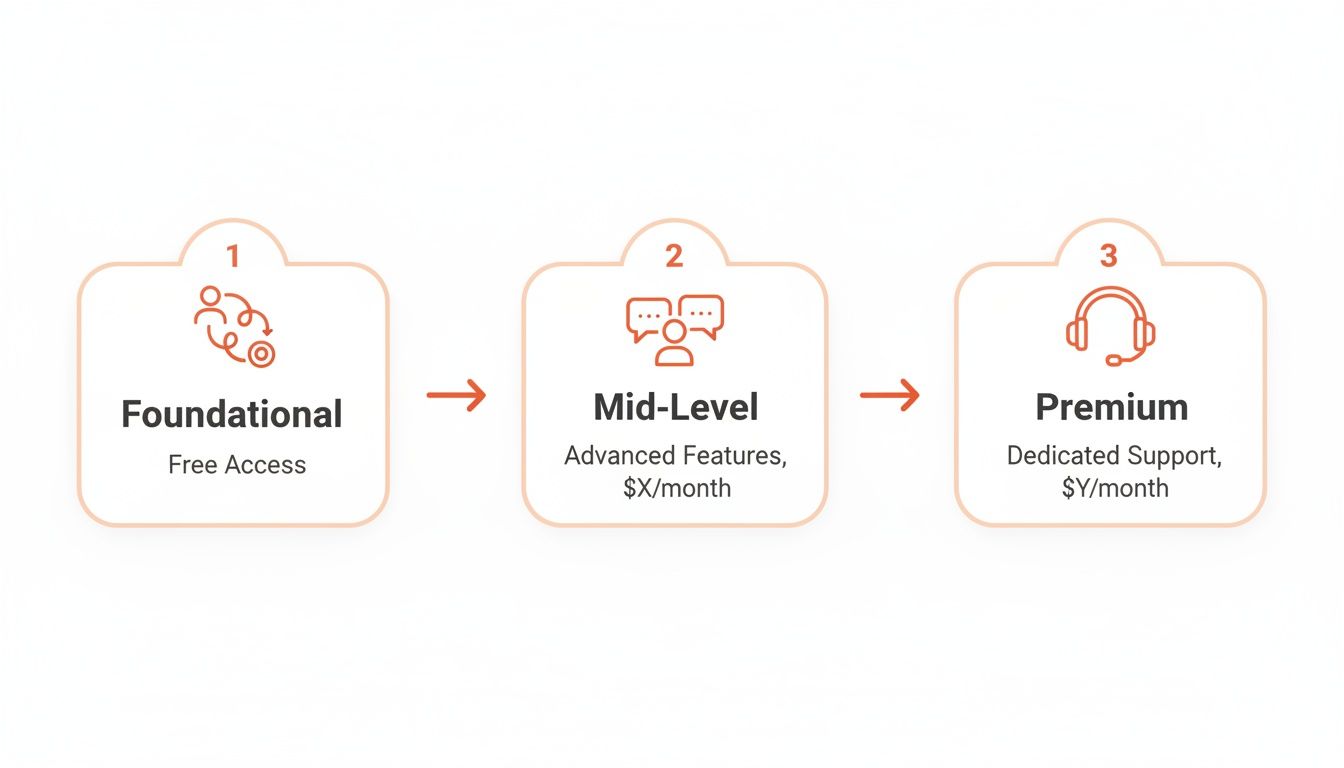
Tiered pricing isn't just about money; it’s a strategic pathway that lets you serve clients at different commitment levels while scaling your impact and your income.
This hands-off process removes all emotion and awkwardness from the equation. It upholds the value of your community by ensuring only paying members are present, which in turn fosters a greater sense of commitment among those who are part of it. This frees you up to pour all your energy back where it belongs: into coaching and changing lives.
The Big Questions Every Coach Asks Before Launching a Paid Community
Stepping into this new way of coaching always brings up a few butterflies. It’s that mix of excitement about the potential and a little bit of "Can I really do this?" Let's clear up those nagging questions so you can move forward with total confidence.
How Much Time Does This Really Take to Run?
Let’s be real—your time is everything. The great news is that a thriving paid community isn't about being chained to your phone 24/7. It’s all about smart, focused connection.
After the initial setup, which honestly takes an hour or two to get your payment page live and link your group, your daily commitment is surprisingly small. We're talking 20-30 minutes a day for genuine, high-quality engagement. That's enough time to post your daily prompt, reply to a handful of key comments, and cheer on your members.
Your goal isn't constant availability; it's consistent presence. A little bit of focused, daily interaction builds far more momentum and connection than sporadic, hours-long sessions.
The real game-changer is letting automation handle the admin. When payments, new member access, and cancellations are all done for you, your energy is completely freed up. You get to focus on what you love—coaching and connecting—not chasing down logistics.
What if I’m Not Tech-Savvy at All?
This is the number one fear I hear, and I completely get it. But here’s the honest truth: the tools we have in 2026 are built for creators like you, not for developers. If you can use WhatsApp or write an email, you have all the technical skills you need.
Platforms today are designed to be incredibly intuitive. You can create a professional-looking payment page, set up your subscription plans, and connect your chat group in minutes, usually with just a few clicks. There’s no code, no complicated software to install, and no confusing jargon to wrestle with.
This whole model is built to make your coaching shine. The tech is just the quiet, invisible bridge that connects your gift to the people who need it.
How Do I Keep Members Engaged So They Actually Stay?
Retention really boils down to two things: connection and value. When members feel seen, supported, and are getting real results, renewing their subscription is a no-brainer. High churn almost always happens when a group feels stagnant or impersonal.
Here are a few simple but powerful ways to create a "sticky" community that members never want to leave:
- A Warm Welcome: Don't just let new members wander in. Have a pinned message or an automated welcome that introduces them, explains the group’s rhythm, and encourages them to share a bit about themselves. First impressions matter.
- A Predictable Rhythm: As we've talked about, having themed days like ‘Mindset Mondays’ or ‘Win Wednesdays’ creates a reliable structure members can look forward to. They know what to expect and when.
- Spark Member-to-Member Connection: You don't have to be the source of all engagement! Actively encourage members to support each other. You can do this by tagging people ("Great question, Sarah! Jane was just asking about this too.") or by creating prompts that invite peer-to-peer sharing.
When your community becomes a place where members build real friendships and find a genuine support system, it stops being a simple service and becomes an essential part of their lives.
Should I Use WhatsApp or Discord for My Coaching?
This is a fantastic question, and the best choice really comes down to your coaching style and how complex your program is. There's no right or wrong answer, only what's right for you and your clients.
Think of it like this:
- WhatsApp is like a cozy, intimate coffee shop. It’s perfect for simplicity, directness, and daily accountability. This is brilliant for fitness, nutrition, or wellness coaches whose programs are built around frequent, straightforward check-ins. The fact that everyone already knows how to use it means there’s zero learning curve for your members.
- Discord is like a well-organized digital campus. It shines when you need more structure. With separate channels for different topics (e.g., #meal-plans, #workout-videos, #mindset-prompts), you can keep resources tidy and conversations focused. The built-in voice and video channels are also amazing for hosting live group calls or Q&A sessions right inside the app.
So, take a look at your program. If you're all about daily, direct conversation, WhatsApp is a fantastic choice. If you're planning a larger community with a library of resources and multiple conversation streams, Discord gives you the organizational muscle you'll need.
Ready to turn your coaching expertise into a thriving, automated business? With Join My Coach, you can create a professional subscription page in minutes, connect it to your WhatsApp or Discord, and let the platform handle the rest.