
Your Guide to Building a Thriving Meditation Coaching Business
Published on April 3, 2026 · Reading time: 18 min
Let's get one thing straight: meditation coaching isn't about chanting in a remote monastery. Think of yourself as a mental fitness trainer. It's a powerful shift that takes meditation from an abstract concept and turns it into a practical, results-driven service for your clients.
What Is Meditation Coaching and Why Is It Booming?

If you're already a fitness coach, sports trainer, or yoga teacher, you know the mind-body connection isn't just a catchy phrase—it's everything. You see it every single day when a client’s self-doubt derails their workout or an athlete’s pre-game anxiety tanks their performance.
Meditation coaching is simply the formal practice of training the mind, just as you already train the body. It’s not about achieving some mystical state of enlightenment. It's about giving people practical tools—like simple breathwork, body scans, and focus exercises—to build real mental resilience.
Think of it as adding a game-changing set of tools to your coaching arsenal. These are the tools that get to the root cause of so many of the physical and performance roadblocks your clients face.
To give you a clearer picture, here's a quick breakdown of what this looks like in practice.
Meditation Coaching at a Glance
This table sums up the core components and what they mean for your coaching business.
| Component | What It Means for Your Coaching Business |
|---|---|
| Focus | Moves from abstract spirituality to tangible skills like stress reduction and improved focus. |
| Analogy | Mental Fitness Training. This framing makes it instantly understandable and desirable for your clients. |
| Tools | Practical exercises like breathwork, visualization, and guided mindfulness sessions. |
| Client Goals | Enhancing performance, managing anxiety, improving sleep, and building mental resilience. |
| Your Role | A supportive guide who provides structure, accountability, and personalized feedback. |
As you can see, this isn't about reinventing your business. It's about deepening the value you already provide.
The Exploding Demand for Mental Fitness
The massive cultural shift toward prioritizing mental wellness is impossible to ignore, and the numbers back it up. The global meditation market hit a jaw-dropping $5.3 billion in 2022 and is projected to grow at an incredible 18.5% annually through 2030. This boom is directly feeding the demand for skilled meditation coaches.
In the United States alone, meditation is now the second most popular complementary health practice. The number of adults using it has more than doubled, jumping from just 7.5% in 2002 to a solid 17.3% in 2022. You can dive deeper into these meditation industry statistics to see just how big this opportunity is.
What does this mean for you? It means you have a massive, ready-made audience—and many of them are probably your existing clients—actively looking for structured, credible ways to handle the stress of modern life.
Key Insight: Framing meditation as "mental fitness training" makes it instantly relatable. It repositions the practice from something vague into a concrete service that delivers measurable results like better focus, less anxiety, and faster recovery.
How Meditation Coaching Complements Your Business
The best part is, you don't have to start a brand-new business from scratch. Integrating meditation coaching is a natural and highly profitable extension of what you already do. Your clients already trust you with their bodies; extending that trust to their mental game is a seamless next step.
Here’s exactly how it plugs into your current offerings:
- For Athletes: Help them crush performance anxiety, sharpen their focus during a competition, and speed up their mental recovery after a tough loss.
- For Fitness Clients: Guide them through motivation slumps, build the discipline to stick with their program, and develop a much healthier relationship with their body.
- For Your Community: Create a supportive space where members can manage daily stress, sleep better, and feel more balanced—all of which skyrockets their loyalty to you and your brand.
By adding meditation coaching, you’re not just tacking on a new service. You're offering a more complete, holistic solution that solves your clients' problems on a much deeper level. And in doing so, you're opening the door to a powerful and sustainable new recurring income stream.
Identifying Your Ideal Meditation Coaching Clients

When you hear “meditation client,” if you’re picturing someone sitting cross-legged on a remote mountaintop, it’s time for an update. The truth is, your ideal clients are already in your fitness community, quietly struggling with the exact mental hurdles that are holding them back.
You don't need to find a whole new audience. You just need to start seeing the unmet needs of the people you already work with. These are the same clients who would happily pay to train their minds, especially when you frame it as the performance edge they've been looking for.
And the demand is definitely there. Mindfulness and meditation coaching have exploded across workplaces, healthcare, and athletics. Today, over 75 countries have recognized mindfulness certifications, supporting more than 9,000 certified trainers. The number of online meditation sessions skyrocketed by 250% back in 2020, and that momentum hasn't slowed down. You can dig into more stats about this rising demand on mindfulnessexercises.com.
The Athlete Crippled by Pre-Game Nerves
We all know this person. They’re a star in practice but completely fall apart under the pressure of competition. Their physical training is flawless, but their mental game is what’s costing them the win.
- Their struggle: It's a toxic mix of performance anxiety, crippling negative self-talk, and an inability to focus when it matters most. They overthink every tiny mistake, which just leads to more mistakes.
- How you help: You can teach them visualization to mentally rehearse a perfect performance, breathwork to hijack their nervous system at the starting line, and mindfulness to stay locked in the present moment instead of spiraling about the outcome.
The Fitness Client Hitting a Plateau
This client came out of the gates strong, full of motivation and seeing amazing results. But now, progress has ground to a halt. They’re getting frustrated, their discipline is starting to crack, and they're beginning to think they just don’t have what it takes.
Their problem isn't their workout plan—it's their mental endurance.
Key Insight: Your clients' biggest roadblocks are often mental, not physical. Meditation coaching provides the tools to break through plateaus caused by self-doubt, inconsistency, and a negative mindset, directly complementing their physical training.
The Overwhelmed Parent at Your Gym
You see this person all the time. They’re juggling a demanding career, family life, and just trying to squeeze in a workout. They show up to your classes looking exhausted and leave feeling just as stressed, struggling to find even five minutes of peace.
- Their struggle: It’s a battle against chronic stress, poor sleep, and the constant feeling of being overwhelmed. They can't be present with their families and feel like they’re always running on an empty tank.
- How you help: You can offer short, 5-minute guided meditations they can do in their car or before bed. Teach them simple grounding techniques to manage chaotic moments. A dedicated chat-based group can also provide a lifeline—a supportive space where they can connect with others who get it, building incredible loyalty to you and your brand.
Once you start identifying these very real, tangible problems, meditation coaching stops being some vague, abstract concept. It becomes an essential service. It’s the missing piece that helps your existing clients finally get the results they’ve been chasing, creating a completely natural and valuable new income stream for your business.
Designing Your Signature Meditation Programs
Alright, you know who you’re serving. Now comes the fun part: building the actual programs you'll sell. The real key here is to shift away from selling one-off sessions and move toward structured, recurring programs. This approach doesn't just create predictable income for you; it gives your clients a much deeper, more valuable experience.
Think of your programs as different training camps for the mind. You wouldn't ask a beginner to run a marathon on day one, and the same idea applies to meditation. By creating a few distinct offers, you can meet clients exactly where they are on their mindfulness journey.
This is your chance to package your unique expertise into clear, marketable solutions. Forget trying to be everything to everyone. Instead, let's design a few signature programs that are simple for you to run and incredibly easy for your clients to understand and buy.
Model 1: The 21-Day Mindfulness Kickstart
This program is the perfect entry point. It’s designed for total beginners or for anyone in your audience who’s curious but still a bit skeptical about meditation. It’s a short, focused challenge built to deliver quick wins and build foundational habits.
The goal is simple: prove the power of meditation in just three weeks. Its straightforward structure makes it perfect for delivery in a WhatsApp or Discord group. You’re guiding a whole cohort of clients through a shared experience, which builds fantastic momentum and accountability.
Sample Weekly Structure:
- Week 1 Focus: The Foundation of Awareness. Here, you'll introduce basic concepts like mindful breathing and the body scan. The whole point is just to get clients comfortable with sitting in stillness for a few minutes.
- Week 2 Focus: Working with Thoughts & Emotions. This is where you teach clients how to observe their thoughts without getting swept away by them. You can introduce practices for managing stress and navigating difficult emotions.
- Week 3 Focus: Integrating Mindfulness into Daily Life. Now you show clients how to take their new skills off the cushion. Topics could include mindful eating, mindful walking, or using simple breathwork before a stressful meeting.
Key Insight: A short, structured challenge like a 21-day program is one of the most effective ways to launch a new service. It has a clear start and end, making it a low-commitment "yes" for new clients and a perfect funnel into your longer-term offerings.
Model 2: The Mental Resilience Membership
Once clients finish your kickstart challenge, many will be asking, "What's next?" This is where an ongoing membership model absolutely shines. It provides the community and structure people need for long-term consistency, turning your coaching into a stable, recurring revenue stream.
This model is less about teaching brand new concepts every week and more about holding a supportive space for sustained practice. Think of it as the "open gym" for the mind.
What to Include in Your Membership:
- A Library of Guided Meditations: Build a collection of audio files (5, 10, and 20 minutes long) that members can access anytime. Cover themes they care about, like focus, sleep, stress relief, and even pre-workout visualization.
- Weekly Live or Pre-Recorded Session: Host one guided session per week focused on a specific theme. This becomes the anchor for your community and a great reason for them to log in.
- Daily Prompts or Reflections: Post a simple question or journal prompt in your chat group each day. This encourages daily engagement and keeps mindfulness top-of-mind.
Model 3: The High-Ticket Peak Performance Program
This is your premium, high-touch offer. It’s designed for serious clients like competitive athletes or executives who need to master their mental game for high-stakes situations. It combines group work with personalized one-on-one support and, naturally, carries a much higher price point.
This program isn't about general stress reduction; it’s about targeted mental training designed to achieve a specific, measurable outcome.
- Who It's For: Competitive athletes, founders, public speakers, or anyone facing intense performance pressure.
- What It Includes: Everything in the membership, plus weekly one-on-one check-in calls, personalized meditation plans tailored to their goals (like overcoming a mental block in their golf swing), and on-demand support before key events.
- Structure: This is often delivered as an 8- or 12-week intensive, preparing the client for a specific competitive season, product launch, or major presentation.
By starting with these proven templates, you can get your meditation coaching services off the ground quickly. You don’t need to reinvent the wheel. Just pick a model, adapt it to your ideal clients, and start building the community that will become the heart of your new business.
Creating Content That Keeps Clients Engaged

Let's get one thing straight: delivering powerful meditation coaching doesn't require a Hollywood production budget or a professional recording studio. In fact, some of the most effective content is created with the tools you already carry in your pocket.
The real secret isn’t fancy gear; it’s a solid structure and a genuine connection with your clients. They are looking for your guidance and support, not a flawless blockbuster. By focusing on creating simple, valuable content consistently, you’ll build a library of resources that keeps them subscribed and showing up.
A Simple Structure for Every Session
To avoid that feeling of being completely overwhelmed by content creation, you need a repeatable structure. A simple, four-part framework gives you a reliable rhythm for your daily or weekly sessions, whether they're live, pre-recorded, or delivered as text in a chat group.
This approach makes planning a breeze for you and creates a familiar, comforting routine for your clients.
Let's break down this powerful four-part session structure:
- 1. The Anchor: Begin every single session with a brief grounding exercise. This could be a 2-minute mindful breathing practice or a simple body scan to help clients arrive and transition out of their busy day. It’s the signal that the session has officially begun.
- 2. The Theme: Introduce the focus for the day. This could be anything from “managing pre-meeting anxiety” to “finding patience during a stressful commute.” Stating the theme gives the practice a clear and immediate purpose.
- 3. The Practice: This is the core of your session—the guided meditation itself. This can be a pre-recorded audio file you share or even a script you post directly in the chat. The length can vary depending on your program's goals.
- 4. The Reflection: End with a gentle prompt for journaling or self-reflection. Ask a simple, open-ended question like, “What did you notice during that practice?” or “Where can you bring this sense of calm into your day?” This encourages clients to integrate the lesson.
Key Takeaway: You don't need to reinvent the wheel for every session. Using a consistent four-part structure (Anchor, Theme, Practice, Reflection) simplifies your content creation and provides a predictable, comforting experience for your clients.
Recording Quality Meditations on a Budget
One of the biggest hurdles I see new meditation coaches face is the belief that they need expensive gear to record guided meditations. The truth is, your smartphone is more than capable of producing high-quality audio.
The key isn't the microphone itself, but how you use it. Here are some practical tips to get clean, professional-sounding recordings with just your phone:
- Find a Quiet, Soft Space: Record in a small room with lots of soft surfaces, like a walk-in closet or even your parked car. These spaces absorb sound beautifully and kill that echo.
- Use the Right Mic: Your phone's built-in mic is surprisingly good, but the small microphone on your earbuds is often even better for voice clarity. Give it a try.
- Positioning is Everything: Don’t hold the microphone right up to your mouth. Position it about 6-8 inches away and slightly to the side to avoid those harsh "p" and "s" sounds (plosives).
- Write a Simple Script: Even a few bullet points can help you stay on track, maintain a calm pace, and ensure you cover your key points without rambling.
Sparking Interaction with Engaging Prompts
In a chat-based community, interaction is everything. Your role isn't just to be a content provider; you're a facilitator of connection and conversation. The best way to do this is with thoughtful, open-ended prompts.
Avoid questions that can be shut down with a simple "yes" or "no." Instead, design prompts that genuinely encourage sharing and reflection.
Examples of Engaging Prompts:
- "What was one small moment of peace you found today?"
- "Share one word that describes how you feel after that meditation."
- "When was a time this week you could have used this breathing technique?"
These kinds of prompts create a space for vulnerability and shared experience, transforming a group of passive listeners into an active, supportive community. That engagement is what keeps clients feeling connected and subscribed month after month.
A Sample Weekly Content Schedule
To keep your community lively without burning yourself out, you need a plan. A simple weekly content schedule provides structure and ensures your members receive consistent value. This also takes the guesswork out of what to post each day.
Here is an example of what a content plan could look like for a chat-based group on WhatsApp or Discord.
| Day | Content Type | Example |
|---|---|---|
| Monday | Weekly Theme & Anchor | "This week, we'll focus on cultivating patience. Let's start with a 3-minute breath awareness practice to settle in." |
| Tuesday | Guided Practice | A 10-minute pre-recorded audio meditation on the theme of patience, shared as a file. |
| Wednesday | Reflection Prompt | "Share a time this week when your patience was tested. How did it feel in your body?" |
| Thursday | Live Q&A / Check-in | "Going live in 30 mins for an informal check-in. Bring your questions about this week's practice or anything else on your mind." |
| Friday | Integration Tip | "This weekend, try to notice the small gap between a trigger and your reaction. See if you can consciously choose patience in one small moment." |
| Saturday | Community Share | "What’s one thing you’re grateful for today? Share a picture or a few words." |
| Sunday | Gentle Reminder | A simple, inspiring quote about rest or a reminder to take a few deep breaths before the week begins. |
This kind of rhythm makes it easy for you to batch-create content and helps your members build a consistent practice. Remember, the goal is sustainable support, not daily fireworks.
How to Price Your Meditation Coaching Services
Pricing is where so many amazing coaches get stuck. Instead of charging by the hour, which ties your income directly to your time and leads to burnout, focus on a tiered, recurring revenue model. This approach creates predictable income for you and a clear pathway for your clients, making your coaching accessible at different price points.
Tier 1: The Community Access
This is your front door—a low-cost, high-value entry point perfect for anyone curious about meditation but not ready for a big investment. Think of it as your community's welcome mat.
- What It Includes: Access to a private chat group (like WhatsApp or Discord), a daily meditation prompt or affirmation, and one pre-recorded guided meditation a week. The real value is the community connection and the gentle, daily nudge to practice.
- Suggested Price: $15 - $25 per month. This price is a no-brainer for most, but high enough to ensure members are invested.
This tier is also a powerful lead generator for your more premium offerings.
Tier 2: The Guided Program
Here's your mid-tier, perfect for clients who crave more structure and a tangible outcome. This is where you can run a signature program, like a "21-Day Mindfulness Kickstart." It has a clear start and finish, offering a more hands-on coaching experience. Members get everything from Tier 1, plus exclusive access to the structured program content.
Key Takeaway: A tiered pricing model lets you meet your clients where they are. The goal is to build a "value ladder" that allows people to deepen their practice—and their engagement with you—as their needs and budgets evolve.
If you're looking to dive deeper into building and monetizing groups like these, our coaching community monetization guide breaks down even more strategies.
Tier 3: The Premium Hybrid
This is your top-tier, high-ticket offer. It’s for clients who need personalized, direct support and serious accountability, like executives or competitive athletes.
- What It Includes: Everything from the first two tiers, plus one or two private 30-minute coaching calls per month, personalized meditation recordings, and direct message access for quick check-ins.
- Suggested Price:$199 - $499+ per month. The price reflects direct access to your time and expertise, allowing you to dramatically increase your revenue while serving a smaller group of dedicated clients.
By putting this three-tiered structure into practice, you build a balanced and profitable business. You can nurture a large community, guide focused groups, and offer premium support—all while creating a reliable, scalable income stream.
Launching Your Business with Chat-Based Coaching
Alright, let's connect all the dots. You’ve designed your programs and planned your content; now it’s time to bring your meditation coaching business to life using the simple chat apps you and your clients already have on your phones. The secret is to ditch the manual, time-sucking tasks and set up a smooth, automated workflow from the start.
Imagine this: a new client sees your meditation program on social media, clicks a link, subscribes, and is instantly dropped into your private WhatsApp or Discord group. All of this happens without you lifting a finger. This isn't some far-off dream; it's exactly how smart coaches are building scalable, recurring income streams right now.
This hands-off approach to member management is an absolute game-changer. It frees you from the administrative nightmare of chasing payments, juggling spreadsheets, and manually adding or removing people from your groups. Instead of playing gatekeeper, you get to do what you love: coach.
The Automated Workflow Explained
Setting this system up is surprisingly simple. It’s all about connecting a few modern tools to create a seamless pipeline that handles everything from the sign-up to managing access. This lets you focus 100% of your energy on delivering incredible value and building a vibrant community.
Here’s a step-by-step breakdown of how it actually works:
- Create Your Subscription Page: You start by building a simple, clean sign-up page. This is your digital storefront, where you’ll list your program tiers—like the 'Community' or 'Premium' tiers we talked about—and set your prices.
- Connect Your Payment Processor: Next, you integrate a trusted payment processor like Stripe. This workhorse handles all the secure payment transactions, whether it’s a one-time fee for a 30-day challenge or a recurring monthly subscription for your membership.
- Link Your Chat App: This is where the magic happens. You link your subscription page directly to your chosen chat platform, whether that’s WhatsApp, Discord, or Telegram. You can create different private groups for each of your program tiers, keeping everything perfectly organized.
- Launch and Let Automation Take Over: Once you share the link to your subscription page, the system runs on its own. When someone subscribes, the tool automatically adds them to the right private group. If their payment fails or they cancel, it automatically removes them. No drama, no manual work.
This flow shows how a tiered pricing model can be put on autopilot, guiding clients from a simple community group to more structured programs and premium offerings.
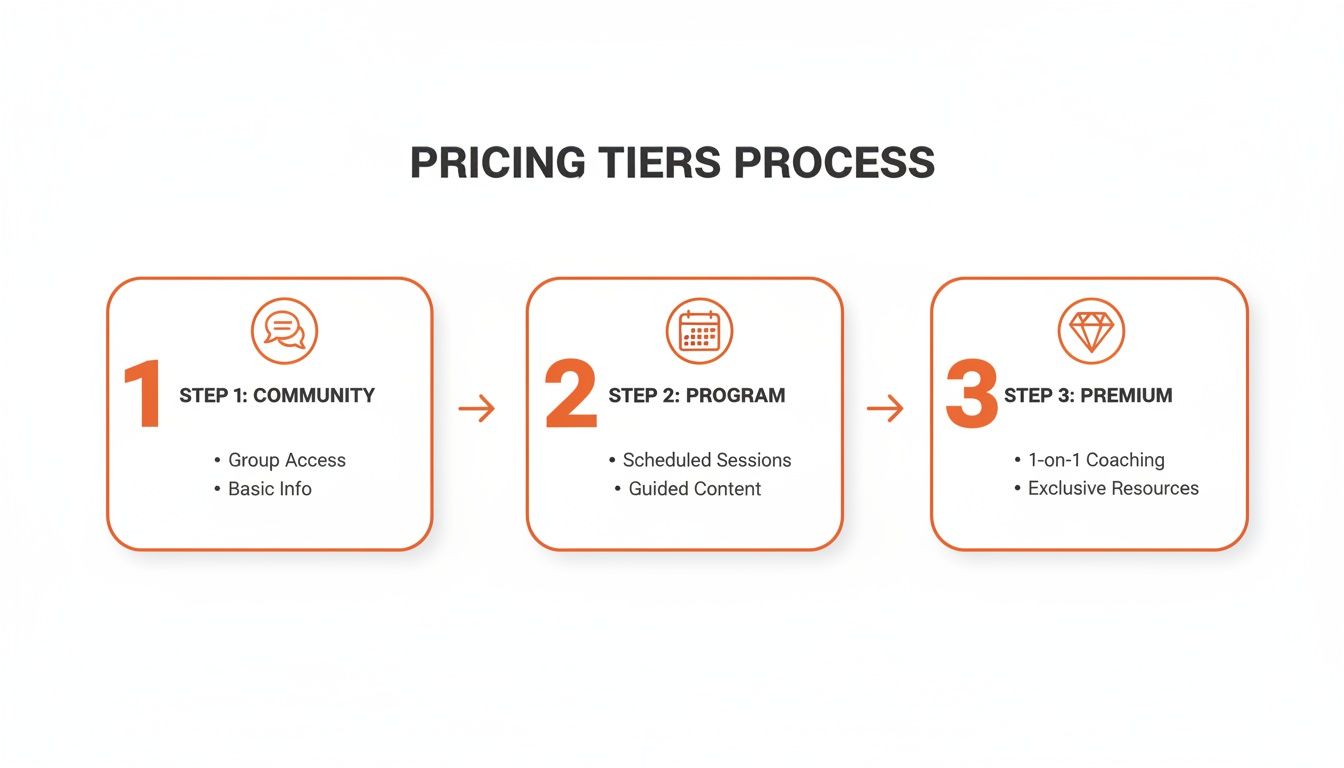
The key insight here is the seamless progression. It allows you to scale your offerings and your revenue without scaling your admin workload.
Choosing the Right Chat Platform
The beauty of this model is its flexibility. You can build your paid community on the platforms where your clients are already comfortable and active. Both WhatsApp and Telegram are fantastic for building engaged groups, but they have some key differences.
If you're weighing your options, our guide comparing Telegram vs. WhatsApp for paid communities is a great place to start. It will help you figure out which one is the best fit for your specific coaching style and community goals.
Key Takeaway: The goal is to automate the business side of coaching so you can double down on the human side. By using a simple, streamlined workflow, you eliminate the admin friction and create a professional, seamless experience for your members from the very first click.
This automated setup is what makes chat-based meditation coaching so powerful and scalable. It allows you to serve a much larger community and generate predictable, recurring income without getting bogged down in repetitive tasks. You’re finally free to do what you love most: helping your clients find their center.
Answering Your Top Meditation Coaching Questions
Even with a solid game plan, stepping into something new like meditation coaching can stir up some last-minute questions. It’s totally normal to have a few doubts. Let's tackle the most common ones I hear, so you can see just how straightforward it is to get started.
Do I Need a Special Certification to Offer Meditation Coaching?
This is a big one. The short answer is no, a formal certification is not a mandatory requirement to start weaving mindfulness into the work you already do. You can begin today.
Think about it. You could guide an athlete through a simple breathwork exercise you know from your own practice, or teach a client struggling with sleep a basic body scan. Many of the most successful coaches I know started exactly this way, building experience before pursuing a certification to go deeper. Don’t let the lack of a certificate stop you from helping your clients right now.
How Much Time Does It Take to Run a Chat-Based Group?
This is where the magic of a chat-based model really kicks in. Once you have your initial content ready—say, a small library of guided audio meditations—your daily time commitment can be as little as 15-30 minutes.
That time is spent posting your daily prompt or evening meditation and then jumping in to reply to comments and questions. Since automation can handle payments and member access, you get to skip the admin headaches and focus entirely on what you do best: coaching your clients and building a real community.
What If My Clients Think Meditation Is Too Woo-Woo?
A completely fair and common concern. The fix is all in the framing. You have to speak your client's language and connect meditation to the practical, science-backed outcomes they're already chasing. Ditch the spiritual jargon.
For an athlete, it's not "finding your inner peace." It's "lowering performance anxiety to nail your game-day focus." For a busy executive, it's not "achieving enlightenment." It's "using a 5-minute breathing tool to crush daily stress and finally sleep through the night."
When you present meditation as a form of "mental training" designed to sharpen focus, speed up recovery, and build resilience, it stops being an abstract concept. It becomes another powerful tool in their performance toolkit—something instantly valuable and desirable for any goal-oriented client.
You have the expertise and the tools to add this incredibly powerful service to your business. With a platform like Join My Coach, you can automate the entire workflow—from payments to group access—making it almost effortless to launch your first paid meditation community on WhatsApp or Discord.
Ready to build your first recurring revenue stream? Get started for free with Join My Coach.