
How to Make Money with Telegram: A Coach's Playbook
Published on April 16, 2026 · Reading time: 20 min
You post every day. You answer questions in the group. You share voice notes, routines, meal ideas, mindset tips, and reminders people use.
And then you look at the time you've spent inside Telegram and realize the uncomfortable part. The community is valuable, but the business around it still feels loose.
That’s where most coaches get stuck with how to make money with Telegram. Not because the audience isn’t there, and not because people won’t pay. The primary problem is operational. Telegram is excellent for delivery and engagement, but on its own it doesn’t give coaches a simple built-in system for recurring payments, subscription management, or automatic access control.
The good news is that monetizing your Telegram community doesn’t need to feel technical or pushy. If people already trust your coaching, charging for deeper access is often the most natural next step. You’re not “ruining” a free community. You’re creating layers of support. Free content brings people in. Paid access gives structure, accountability, and better outcomes.
A coach with a Telegram group can build income in a few practical ways. You can charge for premium channels or private groups, sell digital products, use affiliate offers that match your niche, and if you run a public channel, Telegram’s own ad tools can add a passive layer too. The key is choosing one model first, then setting up the workflow so you’re not manually chasing payments every week.
From Free Community to Recurring Revenue Stream
A free Telegram group often starts as a simple way to stay close to clients. Then it grows.
People invite friends. New members react to your posts. Questions come in every day. Before long, you’ve built something that looks a lot like a real coaching asset, except it still runs like a favor.
That’s usually the moment to shift your thinking. A free community is not the final business model. It’s the top of the funnel, the trust-building layer, and the place where people get a taste of your coaching style.
What changes when you start charging
Charging changes the promise.
Inside a free group, people expect general help and occasional guidance. Inside a paid space, they expect structure, consistency, and a clearer result. That’s a good thing. It forces you to define what members are buying.
A paid Telegram offer works best when it gives one of these:
- More access: direct Q&A, feedback, accountability, or coach interaction
- More structure: follow-along programs, weekly plans, guided challenges
- More specificity: support for fat loss, strength, mobility, yoga progression, nutrition habits, or sport performance
- More convenience: everything delivered in one place, without logins, clutter, or long onboarding
If you're still shaping your offer, this guide on Telegram channel monetization is useful because it helps frame Telegram as a business channel, not just a messaging app.
Practical rule: Don’t charge for access alone. Charge for a better coaching experience.
Why this doesn’t need to feel salesy
Most coaches hesitate because they think monetization means aggressive promotion. It doesn’t.
If your free content already helps people, a paid tier is just the next level of support. Some people want occasional tips. Others want a real plan, a committed group, and a reason to stay consistent. Those members are usually relieved when you finally offer a paid option.
The cleanest way to approach it is simple. Keep the free layer generous. Make the paid layer more guided, more accountable, and easier to follow. When the difference is clear, selling feels natural.
Build Your Foundation for a Profitable Community
Before you charge anyone, pick the right container.
Telegram gives coaches two main environments. Channels are better for controlled content delivery. Groups are better for conversation and accountability. A lot of monetization problems start because the coach chooses the wrong format and then tries to force the offer into it.

Choose a channel when delivery matters most
A Telegram channel is usually the better fit when you want members to consume content in a clean order.
That’s ideal for:
- Daily coaching drops: workout of the day, mobility drills, meal prompts, habit tasks
- Structured programs: a 4-week fat-loss reset, a beginner yoga progression, a running build-up plan
- Resource libraries: pinned PDFs, videos, voice notes, checklists
- Low-friction premium content: members join, consume, and stay focused without chat noise
A channel gives you more control. Members don’t distract each other. Your posts remain easy to find. For coaches who want a polished premium experience, that matters.
A nutrition coach, for example, might use a paid channel to deliver weekly meal planning templates, shopping guidance, and voice-note coaching. A yoga teacher might use it to post a short morning practice every day.
Choose a group when accountability is the product
A group works better when the value comes from participation.
That fits offers like:
- Accountability memberships
- High-touch coaching communities
- Challenge groups
- Paid masterminds for coaches or athletes
- Peer support spaces with direct access to you
If your members need check-ins, wins, questions, shared progress, or community energy, a group is stronger than a channel. The group becomes part of the result. People stay not only for your coaching, but because they don’t want to lose the environment.
A silent group is usually a sign of a badly designed offer, not a bad audience.
A simple decision framework
Use this table when you’re unsure.
| Format | Best when you want | Less ideal when |
|---|---|---|
| Channel | Clear delivery, structured content, less noise, strong control | You want members talking daily |
| Group | Accountability, interaction, support, discussion | You need a tidy library of lessons |
| Both together | A premium setup with one place for delivery and another for conversation | You’re still trying to keep things simple |
Match the format to the coaching promise
Here’s the easiest way to decide.
If your offer sounds like “I’ll give you a plan,” start with a channel.
If your offer sounds like “I’ll coach you through it,” start with a group.
Some coaches eventually run both. They use a channel for the core program and a private group for discussion. That setup can work very well, but beginners often do better with one clear offer first.
What matters is alignment. Don’t build a high-interaction coaching membership inside a one-way channel and then wonder why members feel distant. Don’t build a resource-heavy premium library inside a busy chat and then wonder why no one can find anything.
Select Your Telegram Monetization Model
A coach can build a solid Telegram community and still get stuck at the same point. People want to join, but the offer is fuzzy, the payment flow is unclear, and access depends on manual admin work. The monetization model you choose affects all three.
Pick the model that matches how you already coach. That keeps delivery simple and makes automation much easier later.
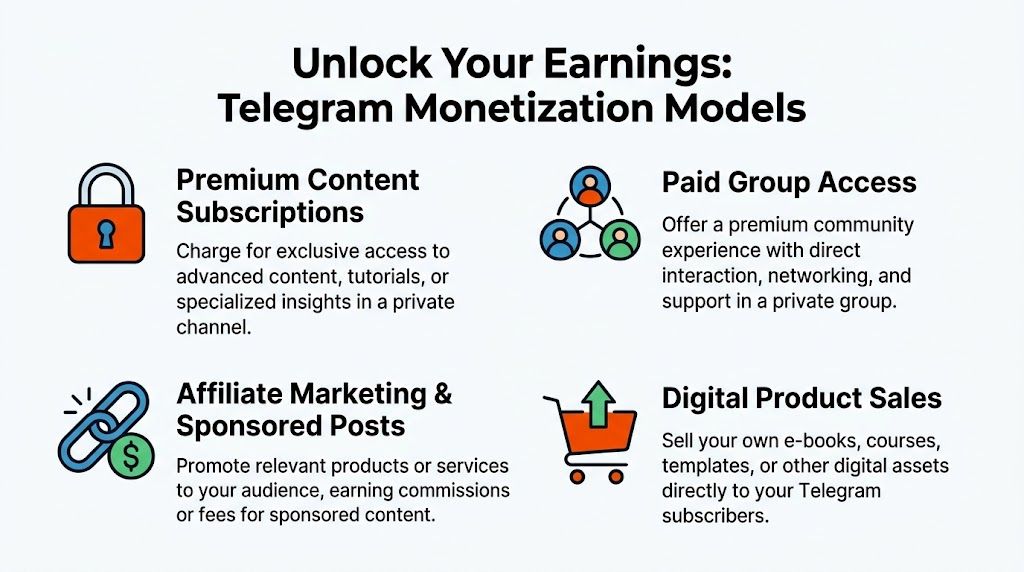
The four models that matter most
| Model | Best for | Operational reality | Income pattern |
|---|---|---|---|
| Paid subscriptions | Ongoing coaching, accountability, member communities | Needs recurring billing and automatic access control | Recurring revenue |
| Digital product sales | Plans, guides, templates, mini-courses | Easier delivery, simpler access setup | One-time sales, with upsell potential |
| Affiliate marketing | Coaches who already recommend trusted tools or products | Light setup, depends on audience trust | Supplemental income |
| Telegram ads | Public channels with reach | Minimal management once active | Supplemental income |
Paid subscriptions fit coaching best
For many coaches, this is the strongest starting point.
People rarely join a paid Telegram because it is private. They join because they want structure, accountability, proximity, or regular guidance. Subscription offers match that behavior well. You can deliver weekly prompts, voice notes, check-ins, habit tracking, office hours, or community support inside one place.
This model also gives you the clearest path to stable revenue. One-time sales create spikes. Subscriptions create a base.
The trade-off is consistency. Members expect you to show up. They also expect billing and access to work without confusion. That is why subscriptions are attractive, but only if the back end is handled properly. For non-technical coaches, the main challenge is not posting content. It is making sure paid members get in fast, expired members lose access cleanly, and nobody has to message you for a private link every month.
Subscriptions are a strong fit for:
- Fitness coaches running daily or weekly accountability
- Weight loss coaches leading habit-based programs
- Yoga teachers sharing calendars, class drops, and Q&A
- Sports coaches offering film review, drills, or ongoing support
Digital products are simpler to run
If you want revenue without a heavy support promise, digital products are often the cleanest model.
A product can be a workout plan, recipe pack, challenge kit, recovery guide, template bundle, or recorded mini-course. Delivery is more straightforward because access usually happens once. That means fewer moving parts and fewer support messages from buyers.
This is a good option for coaches who repeat the same advice over and over. If new clients keep asking the same starter questions, turn that into a paid resource.
The limitation is retention. A buyer can purchase once, download the asset, and disappear. That is why many coaches use products as an entry offer, then invite buyers into a paid Telegram membership later.
Affiliate income works only if it matches your coaching
Affiliate income can sit nicely beside a coaching business, but it should stay in a supporting role.
Telegram makes link sharing easy, so the temptation is to post a lot of recommendations. That usually weakens trust. Affiliate offers work best when they come from your real workflow and solve a clear problem for your audience. A strength coach recommending training software makes sense. A travel coach recommending retreat booking tools makes sense. Random offers usually fall flat.
Use affiliate links if your audience already asks what you use, what you recommend, or what you buy yourself. If they are not asking, affiliate income should not be your first monetization plan.
Ads are background income
Telegram ads can add extra revenue if you run a public channel with meaningful reach.
For most coaches, ads are not the business. They are background income attached to audience attention. Private coaching communities usually make more from paid access, programs, and member support than from ad views.
That matters because ads also change the feel of a community. If your brand is built on trust and closeness, too much promotion can make the space feel less focused.
Choose the model that is easiest to operate well
A simple model run properly beats a clever model held together by manual fixes.
Use this lens:
- Choose subscriptions if your promise depends on ongoing support, accountability, or community
- Choose digital products if your promise is a repeatable plan or resource
- Add affiliate offers if they naturally fit what you already recommend
- Turn on ads if you have a public audience and want extra income in the background
If you are still deciding whether Telegram is the right place to build this kind of offer, compare Telegram vs WhatsApp for paid communities before you set up your payment and access flow.
Design Your Content and Pricing Tiers
Coaches often make pricing harder than it needs to be.
They stare at other creators’ monthly fees, guess a number, and hope it feels reasonable. That usually leads to underpricing, vague offers, and members who aren’t sure what they’re paying for.

A better approach is to build a value ladder. Start with free content, then create paid levels that increase in specificity, access, and support.
What people actually pay for
Members rarely pay because your Telegram is private.
They pay because the paid version helps them do something they haven’t managed on their own. That could be consistency, confidence, technique, accountability, education, or speed.
Here’s what usually strengthens a paid offer:
- Exclusive delivery: content that isn’t posted anywhere else
- Useful structure: routines, calendars, checklists, weekly plans
- Coach presence: replies, feedback, office hours, voice notes
- Community support: shared progress, challenge energy, social proof
- Clear outcomes: better habits, better training consistency, better decisions
A simple ladder for coaches
You don’t need a huge menu. Three layers are enough for most coaches.
| Tier | What it includes | Best fit |
|---|---|---|
| Free | tips, education, occasional lives, general motivation | audience growth and trust |
| Core paid tier | structured content, premium resources, challenge access, accountability | most members |
| Higher tier | feedback, priority support, personal review, small-group access | members who want closeness |
A fitness coach might offer free workout tips publicly, then a paid membership for daily training prompts and accountability, then a higher tier with form review or direct guidance.
A yoga teacher might use free mobility content to build interest, then a paid channel for class sequences and calendars, then a premium tier with feedback or live sessions.
A nutrition coach might keep free habit tips open to all, then charge for meal structure, weekly planning, and Q&A.
One useful framework for packaging this well is in this guide on coaching community monetization, especially if you’re trying to move from one-off coaching into recurring revenue.
Price the promise, not the file format
A PDF alone usually isn’t worth much. A guided result is.
That’s why a simple meal plan may struggle as a standalone product, while the same plan inside a community with check-ins and feedback feels far more valuable. The transformation increases because the support increases.
If members can consume your offer in ten minutes and never need to come back, you’ve built a product. If they keep showing up because the experience helps them stay on track, you’ve built recurring value.
When pricing, ask:
- What result am I helping them move toward?
- How often will they use this?
- How much support is included?
- Does this save them time, confusion, or inconsistency?
Those questions usually produce better pricing than comparing yourself to random creators in other niches.
Automate Your Payments and Member Access
A coach launches a paid Telegram group on Monday, gets five payments by Tuesday, and spends the rest of the week manually checking screenshots, sending invite links, and answering, “I paid. Can you add me?” By month two, the problem is no longer demand. It is operations.

This is the part Telegram does not solve well on its own. It gives you the audience experience. It does not give you a reliable recurring billing system, automatic member removal after failed payments, or a clean way to manage tiers without extra work.
That matters because a paid community breaks faster from admin friction than from lack of content. If access is slow, billing is confusing, or canceled members stay inside paid spaces, trust drops quickly.
What Telegram handles well, and where it stops
Telegram is strong for delivery and engagement. Posts are easy to publish. Groups feel active. Channels are simple to organize. Bots can extend what the app can do.
But coaching subscriptions need a second layer. Someone has to collect payment, confirm it, grant the right access, and remove access when the subscription ends. If that “someone” is you every single time, the business gets heavier with each new member.
For non-technical coaches, that is the primary hurdle. The challenge is not creating another content tier. The challenge is building a payment-to-access flow that runs without constant supervision.
Build the flow before you start promoting hard
The clean setup is simple:
- A person clicks your paid offer.
- They reach a checkout page.
- Payment goes through a processor such as Stripe.
- The system adds them to the right Telegram channel or group.
- If payment fails, expires, or gets canceled, access updates automatically.
That flow protects time, but it also protects the customer experience. People who are ready to buy should not have to wait for a manual message, wonder whether they are in the right group, or chase you for access.
A short walkthrough helps make that easier to visualize:
Manual access works briefly, then becomes expensive
Early on, manual management feels harmless. A few payments come in. You copy an invite link, check your DMs, and move on.
Then the edge cases start stacking up. One member pays twice. Another cancels but still has access. Someone joins the wrong tier. A failed renewal goes unnoticed for two weeks. You spend your attention on admin instead of coaching.
I have seen coaches blame Telegram for this when the actual problem was the missing system behind it. Telegram works well as the front-end community space. The business side needs structure around it.
What to automate first
Keep the setup boring and dependable.
Start with these pieces:
- Payment processing: use a trusted checkout tool that handles subscriptions and failed payments properly
- Access rules: members should be added to the correct Telegram space automatically
- Removal rules: canceled or unpaid members should lose access without you chasing the list manually
- Tier mapping: each plan should connect to the right channel, group, or bundle of resources
- Delivery: welcome messages, links, and starter resources should go out automatically
This is enough for most coaching offers. You do not need custom code. You need a stack that reduces repeat tasks and lowers the chance of access mistakes.
Keep ad income in perspective
If you also run a public Telegram channel, ads can add a small secondary income stream, as noted earlier in the article. Treat that as support revenue, not the foundation.
For coaches, subscriptions, paid access, and structured offers usually matter more because they are controllable. You decide the promise, pricing, member experience, and retention system. Ads depend on audience size and platform rules. Automation around payments and access affects revenue much more directly.
What to look for in a tool stack
Choose tools that make the business easier to run on an ordinary week, not just on launch week.
Look for:
- Stripe or another secure payment processor
- automatic access updates
- support for more than one membership tier
- clear onboarding after purchase
- basic reporting so you can see active members and failed payments
- a setup you can maintain without hiring a developer
The test is simple. If ten new members join tonight, the system should handle it while you sleep. That is when a Telegram community starts feeling like a real recurring revenue business instead of a side project held together by DMs.
Grow and Retain Your Paid Community
Most coaches focus hard on getting members in. Fewer focus on why members stay.
That’s where lucrative business resides. Paid communities become sustainable when joining feels easy and staying feels worthwhile.
Growth starts with a clear gap between free and paid
A free Telegram audience shouldn’t feel neglected. It should feel helpful enough to build trust, but incomplete enough that serious people want more.
A good pattern looks like this:
- your free channel shares education, quick wins, and proof of your coaching style
- your paid space gives structure, accountability, and closer support
- your promotion shows the difference without turning every post into a pitch
That means teasing the paid experience in a useful way. Share a small win from a challenge. Mention the kind of check-in you’re running. Preview one piece of the weekly structure. Show what members are doing, not just what they’re buying.
Retention is mostly about delivery rhythm
People cancel when the promise feels fuzzy, the energy drops, or the space becomes forgettable.
That’s why retention often comes down to simple habits:
- Post consistently: members should know the community is alive
- Create recurring touchpoints: Monday plans, midweek check-ins, Friday reflections
- Give members a reason to participate: prompts, streaks, challenges, progress threads
- Make wins visible: celebrate consistency, not just dramatic transformations
- Stay present: not constantly, but predictably
Coaching channels can face 40-60% monthly churn without proper systems, while automated access management and consistent high-value delivery can improve retention by up to 70% and lead to a 5x higher lifetime value per member (GetAFollower).
That stat matters because it points to the underlying issue. Churn is not only a pricing problem. It’s usually a systems-and-value problem.
Members don’t stay because they paid. They stay because the space keeps helping them act differently each week.
A practical retention playbook
A lot of paid Telegram communities get stale because the coach relies only on content drops. Content matters, but community rhythm matters just as much.
Try a mix like this:
Weekly anchors
Give your members predictable moments.
For example:
- Monday: training or habit focus
- Wednesday: coaching Q&A or obstacle-solving thread
- Friday: wins post or progress recap
- Weekend: reset message, prep checklist, or bonus resource
That rhythm gives people a reason to open the group even when motivation is low.
Seasonal energy
Challenges and short sprints create momentum.
A fitness coach might run a consistency challenge. A nutrition coach might run a simple meal-prep week. A yoga teacher might run a mobility streak. The point isn’t complexity. The point is giving the community a shared mission.
Surprise value
Planned content keeps trust stable. Unexpected extras build loyalty.
That could be a bonus voice note, a downloadable tracker, an expert guest, a live session, or a short review thread. Small additions often make members feel that the subscription keeps paying off.
Don’t overcomplicate the sales loop
The best growth channel is often the free audience you already have.
When paid members get results, your job is to make the difference visible. Not through hype, but through examples. If the paid space is more organized, more active, and more outcome-focused, free members will notice.
A weak paid community needs more marketing. A strong one creates its own pull.
Measure What Matters and Stay Protected
A Telegram group can look active and still underperform as a business.
I see this all the time with coaches who focus on comments, reactions, and views, but cannot answer simpler questions like: Which offer brings in the best members? Where are cancellations coming from? How many paid members renew after month one? Telegram gives you conversation. It does not give you clean business visibility. You have to build that layer yourself.
The core numbers to track
Keep the scoreboard small.
A practical dashboard usually includes:
- Monthly recurring revenue: the subscription income you can expect this month
- Churn rate: how many paying members cancel in a given period
- Lifetime value: how much revenue the average member brings in before leaving
- Conversion path: where paid members first found you
- Offer mix: which tier, add-on, or promo sells
These numbers shape better decisions.
If churn climbs, fix delivery before touching price. If conversions are weak, revisit the promise and entry point. If members buy the lower tier and ignore the upgrade, the higher tier probably needs a clearer outcome, not more content.
Track what people do before they pay
Revenue gets easier to grow when you know what led to the sale.
That does not require advanced analytics. For a non-technical coach, a simple source tag or note is often enough at the start. Mark whether someone joined from Instagram, email, your free Telegram channel, a challenge, a webinar, or a direct message. After a month or two, patterns usually show up.
This matters even more if you sell more than one thing inside Telegram. Paid channels, group coaching, one-off workshops, and affiliate recommendations behave differently. Some bring quick sales but weaker retention. Others convert slower and keep members longer. If you do not track the path, you end up guessing which part of your business deserves attention.
Affiliate income can work as a secondary stream if the offer fits your audience, as noted earlier in the article. The mistake is treating every recommendation like easy money. Poor-fit offers reduce trust fast, and trust is the asset that keeps subscriptions renewing.
Protect the business as you grow
Protection is mostly operational discipline.
Use clear terms. Tell members what they get, how billing works, when payments renew, and what happens if they cancel. Keep your data practices simple and honest. Collect only what you need. Respect Telegram's rules and the policies of any payment provider or affiliate program you use.
The bigger risk for many coaches is messy admin. Paid members end up spread across chat threads, screenshots, manual reminders, and private DMs. Then someone cancels and keeps access. Someone else pays and waits hours to be added. That is usually the point where the business starts feeling heavier than the revenue justifies.
A clean setup fixes that. One payment record. One access rule. One place to check who is active, who canceled, and who needs support.
A professional coaching community feels safe before it feels premium.
The coaches who keep Telegram profitable long term are not always the loudest marketers. They run a tighter operation. They know what drives revenue, they catch retention problems early, and they remove manual access work before it becomes a daily drain.
If you want to turn Telegram into a paid coaching space without juggling payments, cancellations, and manual access, Join My Coach gives sports and fitness coaches a simple way to automate subscriptions, connect Stripe, and manage member access across Telegram, WhatsApp, and Discord. It’s a practical option when you’re ready to monetize your community without building a technical system yourself.