
From One-Off Sessions to Stable Income: A Guide to Recurring Income Sport Coaching in 2026
Published on June 1, 2026 · Reading time: 16 min
If you're a coach, you've felt the grind. One month, you’re fully booked and flying high. The next, you’re scrambling to fill empty slots, your income dropping unexpectedly. This “feast or famine” cycle is exhausting, and it keeps you stuck spending half your time as a salesperson instead of a coach.
But what if you could build a business that provides a steady, predictable paycheck every single month?
This is the power of recurring income sport coaching. It’s a shift from selling one-off sessions to offering ongoing subscriptions. Instead of constantly hunting for new clients, you build a loyal community that pays for continuous access to your expertise. This isn't just about more money; it's about creating financial stability so you can focus on what you truly love—helping people achieve their goals.
The Problem with One-Time Sales
The traditional coaching model is built on transactions. A client pays for a session, you deliver it, and the relationship often ends there. This forces you into a constant hustle. You’re always on the lookout for the next client, the next sale, the next paycheck.
This transactional approach has major downsides:
- Unpredictable Income: Your monthly revenue can swing wildly, making it hard to plan your finances or invest in your business.
- Shallow Client Relationships: One-off sessions don't leave much room for building deep, long-term connections.
- Limited Impact: You only get to guide a client for an hour at a time, missing the chance to support them through their entire journey.
Recurring income flips this model on its head. It’s about building relationships, not just completing transactions.

Let's quickly compare the two worlds. The difference in stability and scalability is massive.
One-Time Coaching vs Recurring Income Models
| Aspect | One-Time Session Model | Recurring Income Model |
|---|---|---|
| Income Stability | Unpredictable, volatile month-to-month | Predictable and stable monthly revenue |
| Client Relationship | Transactional; ends after the session | Relational; built over the long term |
| Time Investment | High time-for-money trade | Scalable; serve many clients at once |
| Business Focus | Constant client acquisition | Client retention and delivering value |
As you can see, the recurring model is built for sustainable growth, not just surviving the month.
This shift isn't just about making more money; it's about getting your time and energy back. When you're not constantly stressing about where the next client is coming from, you can finally focus on what actually matters: delivering incredible value and getting life-changing results for your members.
The Power of Predictable Income
Predictability changes everything. Knowing what revenue to expect each month means you can invest back into your business with confidence. You can upgrade your gear, pay for that advanced certification, or simply enjoy the peace of mind that financial stability brings.
This kind of stability is becoming essential. The U.S. sports coaching industry is a massive field, pulling in $15.4 billion in revenue across 196,000 businesses as of 2026. For coaches who get this right, the payoff is huge. Full-time coaches with just 20-30 clients on a subscription can pull in between $100,000 and $140,000 a year after their first year. You can discover more stats about the sports coaching business to see the full picture.
From Transactional to Relational Coaching
One-off sessions are, by nature, transactional. A client pays, you coach, and the relationship often ends right there unless they decide to book again. It's a constant restart.
A subscription, on the other hand, creates a long-term, relational dynamic from day one.
This ongoing connection pays off in a few huge ways:
- Deeper Client Commitment: When clients subscribe, they are making a real investment in their goals. This leads to way more accountability and much better results.
- Stronger Community: Your subscription group quickly becomes a tight-knit community where members cheer each other on, share wins, and build momentum together.
- Greater Impact: You get to guide clients through their entire journey—celebrating the milestones and navigating the rough patches over weeks and months, not just for a single hour.
Ultimately, building a recurring income coaching business is about creating a more sustainable and impactful career. It’s the move away from chasing payments and toward building a thriving community that genuinely values your ongoing guidance.
Choosing Your Subscription Coaching Model
Once you’ve decided to move to a recurring revenue model, the next question is: what are you actually selling? A subscription isn’t just a new way to get paid; it’s a promise of continuous value. The model you choose will shape your entire service, from how you interact with clients to the community you build.
Picking the right model is crucial. If you try to offer elite, one-on-one attention at a low price, you’ll burn out fast. On the other hand, if you charge a premium for a service that feels generic and automated, clients will cancel.
The key is to find the perfect balance between your coaching style, your clients' needs, and a price that reflects the value you provide. Let's explore three proven models you can run using simple chat apps like WhatsApp, Discord, or Telegram.
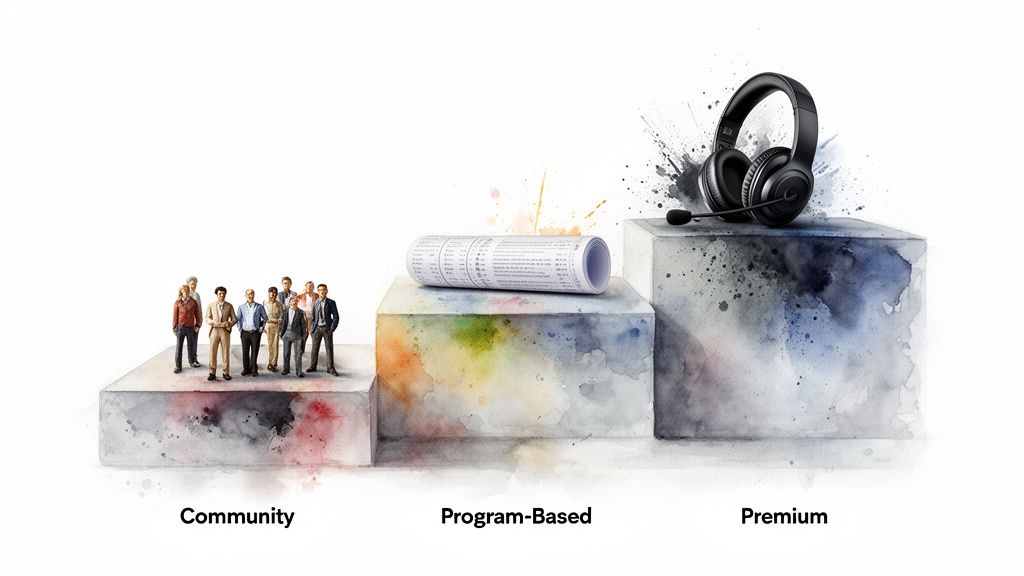
1. The Community Access Model
Think of this as the "all-access pass" of online coaching. For a low monthly fee, members get entry into a private group where you share daily motivation, weekly workout ideas, and foster a supportive community. This model is all about creating an environment of accountability and connection. It’s a low-cost, high-volume approach.
This model is a perfect fit for:
- Yoga or mobility coaches sharing daily flows and quick check-ins.
- Nutrition coaches dropping new recipes and healthy habit prompts.
- Running coaches building a community around a shared goal, like a 5k or a marathon.
The primary value isn't personalized feedback; it’s the community and light-touch guidance. Because this model is highly scalable, you can serve hundreds of members without overwhelming your schedule.
2. The Program-Based Model
This model is more structured, like a multi-week workshop or bootcamp. Clients subscribe to participate in a program with a clear start and end, such as a “6-Week Strength Challenge” or a “90-Day Transformation.”
This structure is ideal for clients who thrive on clear roadmaps and milestones. While there's still a community element, the main draw is the structured content and the shared experience of tackling the program together. You can run these programs live a few times a year, building urgency and focused energy with each launch.
The program-based model creates incredible social proof. As one group finishes and starts sharing their amazing results, it naturally builds a ton of excitement and a waiting list for your next launch.
3. The Premium Hybrid Model
This is your high-touch, highest-value option. It combines the scalability of a group model with the personalization of one-on-one coaching. Members get all the benefits of the community, plus exclusive, direct access to you.
This could look like:
- A monthly 1:1 check-in call.
- Personalized form checks via video submissions.
- A private, dedicated chat channel for your top-tier clients.
This model is perfect for coaches working with athletes or clients who need detailed, custom feedback to achieve specific, high-stakes goals. Because the personal attention is so high, you’ll have fewer clients, but they’ll be paying a premium price for that direct access and tailored guidance. For a deeper look into structuring these offers, you can check out our complete guide on the sports coaching subscription model and how it creates a stable, predictable business.
Picking the right model really comes down to self-awareness. Think about your ideal client, how you genuinely prefer to deliver value, and what kind of business you want to run day-to-day. You can always start with one model and bolt on others as your brand and community grow.
How to Price Your Coaching Subscriptions
After you've picked a model, you’ll hit the next big hurdle: pricing. It’s a step that trips up so many coaches, but it doesn’t have to be complicated. Pricing is about clearly communicating the value you deliver and offering options that fit your clients' goals and budgets.
A good price feels fair. A great price makes your client feel like they're getting a steal for the nonstop support and results you provide. Let's forget the complicated spreadsheets and build your pricing from a place of solid logic and confidence.
Calculate Your Base Rate
The best place to start is your current 1:1 coaching price. This is your anchor—the proven value you already deliver. If you don't do 1:1 coaching, just think about what you’d realistically charge for one dedicated hour of your time.
Let's say you charge $100 an hour for a private session. This becomes your "value anchor." From here, you can build out your recurring income sport coaching tiers. Your community tier, which is low-touch and serves a lot of people, might be priced at 20-30% of that rate, landing around $20-$30/month. Your premium hybrid tier, which offers all the group access plus some 1:1 attention, could be 150-250% of your hourly rate—so, $150-$250/month.
The key is to frame your subscription not as a discount, but as a more effective way to get results. It's continuous access and accountability that a single session can't possibly offer.
Structure Your Tiers for Clear Choices
Most successful coaches use a simple three-tiered approach. This classic "good, better, best" structure makes the decision easy for potential clients. By presenting a few clear options, you guide them toward the level of support that best fits their goals and budget.
- Tier 1: Community Access: Your entry-level offer. It's affordable and gives people a taste of your coaching style within a group setting.
- Tier 2: Program-Based or Core Plan: Your middle tier and, often, your most popular. It might include structured programs, weekly group Q&As, and more direct interaction.
- Tier 3: Premium Hybrid: Your highest-value offer. This tier includes everything from the lower tiers plus exclusive access, like 1:1 check-ins or personalized video feedback.
This tiered structure is a powerful engine for predictable cash flow. With client retention in the coaching space hovering around 65%, even a small group of dedicated members creates serious stability. A simple playbook could be ten retainer clients at $250/month, which creates $2,500 in monthly recurring revenue.
Since 2020, remote coaching on platforms like WhatsApp and Discord has absolutely exploded. We're seeing coaches run tiered subscriptions from $10-$49/month for groups, while hitting an average revenue per client (ARPC) of $300+ for elite, year-round programs. You can explore more about the sports coaching market growth to see just how big this opportunity has become.
To make this practical, here is a sample structure you can steal and adapt for your own coaching business.
Sample Recurring Income Pricing Tiers
This table shows a straightforward way to package your services. Think of it as a template to build from, not a rigid set of rules.
| Tier Name | Example Price | What's Included | Ideal for... |
|---|---|---|---|
| Community | $29/month | Private group access, daily prompts, and weekly challenges. | Athletes seeking motivation and accountability on a budget. |
| Accelerator | $99/month | All Community features, plus a weekly live Q&A and a resource library. | Athletes who want more structure and direct access to your expertise. |
| Premium | $249/month | All features, plus a monthly 1:1 check-in call and personalized video feedback. | Athletes with specific, high-stakes goals needing personalized support. |
Remember, your pricing isn't set in stone. A great tactic is to start with a "Founder's Launch" at a lower price for your first members. This helps you build momentum, gather powerful testimonials, and fine-tune your offer before you raise the price for the general public. The goal is to find that sweet spot where your clients feel incredibly supported and you feel fairly compensated for your hard-earned expertise.
Build Your Coaching Hub on WhatsApp, Discord, or Telegram
Once you’ve got your subscription model and pricing locked in, it's time to build the actual home for your community. And here’s the best part: you don't need some expensive, complicated platform to run a profitable recurring revenue coaching business. The most powerful tools are the ones your clients already use every day.
You can build an incredibly vibrant and profitable coaching hub right inside WhatsApp, Discord, or Telegram. The key is picking the platform that fits your coaching style and the experience you want to create. This is where your subscription comes to life.
Choose Your Platform Wisely
Each of these apps has its own strengths. Your choice will define how you communicate with members, deliver content, and build community. There is no single "best" option—only what's best for you and your clients.
Let’s break down the big three:
- WhatsApp: Its power is its simplicity. Almost everyone has it and knows how to use it, meaning zero learning curve for your clients. It’s perfect for creating a close-knit, personal group chat. If you're curious about the details, we've got a fantastic article on how to make money with WhatsApp that goes way deeper.
- Discord: If you need serious organization, Discord is your champion. Originally built for gamers, it excels at creating multiple, topic-specific channels. This lets you build a structured hub with separate spaces for
#announcements,#daily-wins, and#q-and-a, preventing key content from getting lost in a chaotic chat. - Telegram: Think of Telegram as a hybrid of WhatsApp’s simplicity and Discord's power. Its "Channels" feature is a game-changer for one-way communication, allowing you to deliver workouts or tips without them getting lost in conversation. It also supports much larger group sizes than WhatsApp.
Think of it like this: WhatsApp is a friendly coffee shop chat, Discord is a perfectly organized library with different sections, and Telegram is a powerful radio station where you can broadcast to your whole audience at once.
Set Up Your Paid Group for Success
Just creating a group and inviting people won't work. A successful coaching hub is a well-managed space that feels professional and valuable from the moment a new member joins. Your setup process is what separates a thriving community from just another messy group chat.
Here’s a straightforward guide to getting your hub ready:
- Create Your Group or Server: First, make your private space on your chosen platform (a Group on WhatsApp/Telegram or a Server on Discord). Give it a clear, motivating name like "The 5K Finisher's Club" or "Peak Performance Squad."
- Define Your Channels (Especially for Discord): If you're on Discord, this is your most critical step. A logical structure is everything. A great starting point usually includes:
- #welcome-and-rules: The first stop for every new member.
- #announcements: For your most important, can't-miss updates.
- #weekly-workouts: Where you'll post your core programming.
- #q-and-a: A dedicated space for members to get help.
- #progress-and-wins: A spot for members to share their successes and fire each other up.
- Establish Clear Community Rules: This is non-negotiable. You have to create a safe and supportive environment. Pin a message or create a dedicated #rules channel with simple guidelines. Cover your expectations for behavior, rules on self-promotion (usually a hard "no"), and how to get the most out of the community.
- Craft a Welcome Message: Put together a warm, informative welcome message that every new member receives. It should orient them to the group, point them straight to the rules, and give them a clear first step—like introducing themselves.
By getting this setup right from the start, you create a seamless and engaging experience. This structure is what makes your community feel like a premium service—a place clients are happy to pay for month after month.
Automate Payments and Access to Scale Your Business
Building your coaching hub is a great start. But the secret to a business that grows without burning you out is automation. This is how you escape the administrative busywork that kills your momentum.
The biggest headache for any subscription-based coach? Manually managing who pays and who gets access.
Chasing late payments, adding new clients one by one, and remembering to remove people who cancel is a recipe for exhaustion. It’s also where a professional business can quickly feel disorganized.
The goal is to build a hands-off system that handles all of that for you. Imagine a new client finding your subscription page, choosing a tier, paying, and instantly receiving an invite to your private WhatsApp or Discord group—all without you lifting a finger.
The Ideal Automated Workflow
A seamless system is the foundation of any successful recurring income sport coaching business. It ensures every client has a smooth, professional experience from the moment they sign up.
Here’s what that ideal, automated workflow looks like:
- Step 1: Client Subscribes: A client lands on your sign-up page, chooses their tier (like Community or Premium), and enters their payment details.
- Step 2: Payment is Processed: The system securely handles the payment through a trusted processor like Stripe.
- Step 3: Access is Granted Instantly: The second the payment goes through, an invite is automatically sent to the client, adding them to your private WhatsApp, Discord, or Telegram group.
- Step 4: Ongoing Management is Handled: The system automatically manages recurring payments. If a payment fails or a client cancels, their access to the group is automatically revoked.
This infographic breaks down the initial setup for your coaching hub, which is the very first piece of this automated puzzle.
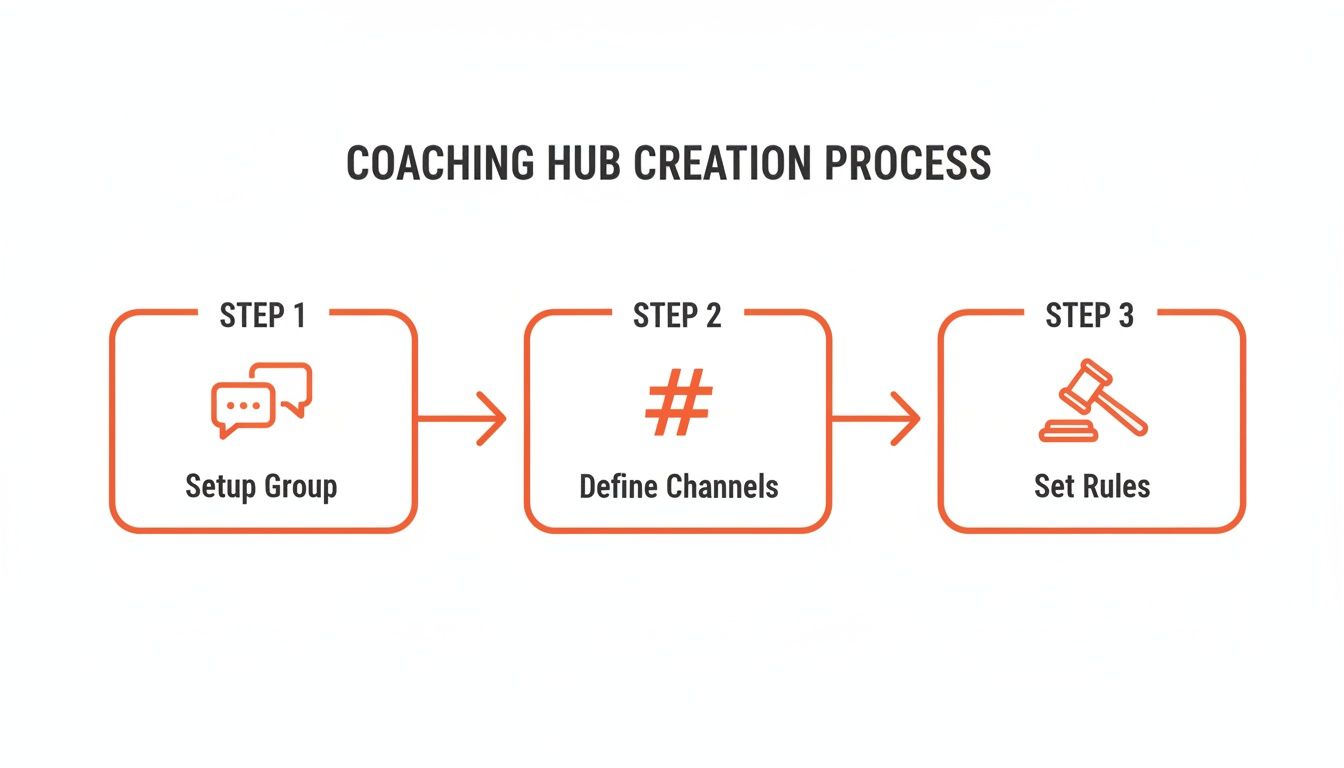
This process—setting up the group, defining its structure, and establishing rules—creates the organized space that your automation will fill with new, paying members.
Why Automation Is Non-Negotiable
This automated approach isn't just a "nice-to-have"; it's essential if you're serious about scaling. It saves you from awkward conversations about failed payments and eliminates the risk of human error, like forgetting to remove someone who canceled.
Automation transforms you from a stressed-out administrator into a focused coach. You get to spend your valuable time delivering incredible results for your clients, not wrestling with spreadsheets and sending payment reminders.
This shift is powering enormous growth in the coaching world. The global sports coaching platform market hit a massive $8.0 billion in 2023 and is projected to skyrocket to $17.7 billion by 2030, growing at a blistering 12.0% each year. For coaches using modern platforms, the formula is simple: create your tiers, connect Stripe, and watch as members auto-join your chat groups while retention stays high. You can read the full research about recurring revenue in sports tech to see the full picture of this market explosion.
Ultimately, automation is about buying back your time so you can invest it where it truly matters—in your coaching and in your own life. It’s the final piece of the puzzle that makes your recurring income business not just profitable, but sustainable.
Launching and Growing Your Subscription Community
You have your model, pricing, and tech ready to go. Now for the exciting part—getting your first paying members.
Forget a big, stressful launch event. The goal is steady, sustainable growth, starting with a small, dedicated group of clients to prove your concept.
This is where your recurring income sport coaching business truly comes to life. Let's walk through a simple blueprint to launch, grow, and keep your members engaged for the long haul.
Start with a Founder's Launch
Your first launch should be a low-pressure offer to your warmest audience—the people who already know, like, and trust you. This could be your social media followers, past clients, or email list.
The strategy is simple: offer a special "Founder's Rate" to a limited number of people. This works for a few key reasons:
- Builds Instant Social Proof: Getting those first members in the door gives you immediate testimonials and success stories to share.
- Gathers Priceless Feedback: These founding members will give you honest feedback to help you refine your program before opening it to the public.
- Reduces Launch Anxiety: Selling to a friendly audience at a special price is far less intimidating than a cold launch.
Frame this as an exclusive opportunity. Make it clear they're getting in on the ground floor and will have a real hand in shaping the community's future.
Simple Tactics for Sustainable Growth
Once you have your founding members, it's time to build a steady flow of new clients. You don't need a huge marketing budget. Just focus on simple, consistent actions that deliver real value.
- Run Free Challenges: Host a free 5-day or 7-day challenge on social media or in a temporary chat group. Give people a quick win. At the end, it's a natural transition to invite them to continue their journey in your paid subscription.
- Showcase Client Wins: Your clients' results are your best marketing asset. Regularly share testimonials, progress updates, and success stories from your members (with their permission, of course). This tangible proof is more convincing than any sales pitch.
- Encourage Word-of-Mouth: Happy clients are your best salespeople. Set up a simple referral program where current members get a discount or a small bonus for bringing a friend into the community.
The key to growth isn't a complicated funnel; it's consistency. Show up every day, provide value, and genuinely celebrate your clients' progress. The rest will follow.
Keep Your Community Engaged and Reduce Churn
Getting members is only half the battle. Keeping them is what makes your recurring income stable. High churn (your cancellation rate) will kill a subscription business.
The antidote is a vibrant, engaged community where every member feels seen, heard, and supported.
Here are a few proven ways to keep engagement high:
- Weekly Live Q&As: Dedicate an hour a week to answering questions live. This provides massive value and strengthens your connection with members.
- Member Spotlights: Feature a different member each week. Celebrate their journey and make them feel like a core part of the community.
- Daily Check-in Prompts: Start the day with a simple question to spark conversation and drive accountability.
Finally, remember that the right tools make this whole process feel almost effortless. Platforms designed specifically for coaches can handle everything from creating beautiful payment pages to automating access management for your WhatsApp or Discord groups. This frees you up to focus completely on what you do best: launching, growing, and coaching your community.
A Few Common Questions About Recurring Income
Thinking about a subscription model brings up a lot of questions. I get it. It feels like a huge shift, but moving to recurring income is way more straightforward than most coaches think. Let's tackle some of the most common hurdles I see coaches get stuck on.
How Much Content Do I Need to Create?
This is the biggest myth out there. Success here isn’t about burying your clients under a mountain of new content every single day. It’s all about consistency and engagement, not sheer volume.
Focus on delivering high-impact value. A weekly live Q&A session, a daily check-in prompt in the chat, and maybe one core piece of content per week—like a new drill or a mindset tip—is often more than enough to deliver incredible results. Consistency will always beat quantity.
What If My Clients Prefer Paying for Single Sessions?
You don't have to choose, especially not at first. A great way to start is to offer both models. You can make the subscription the new standard for all incoming clients while letting your existing ones stick with one-off sessions if they prefer.
A powerful move for transitioning your most loyal clients is offering them an exclusive "Founder's Rate." Frame it as what it is—an upgrade to a more committed and supportive path for reaching their goals. This rewards their loyalty and gives your subscription model a huge kick-start.
Will I Lose the Personal Connection with Clients?
Not at all. In fact, most coaches I've worked with find the exact opposite is true. A well-run subscription community can actually deepen your impact and build connections in ways a 1:1 session just can't.
A group model creates a powerful support ecosystem. Your clients start motivating each other, celebrating wins, and holding one another accountable. You keep those personal connections through daily interactions in the chat, member shout-outs, and direct messages, all while building a community that has a life of its own.
Is Setting Up Payment Automation Too Technical?
It used to be a massive headache, but not anymore. Modern tools are built specifically for coaches and creators, not tech wizards. You don't need to know a single line of code or have any special technical skills.
The whole point of today's platforms is to make the technology disappear. You can hook up a payment processor like Stripe to your chat group in just a few clicks. It handles everything from sign-ups to cancellations, so you can put 100% of your focus back on coaching.
Ready to stop chasing payments and start building a stable, scalable coaching business? Join My Coach makes it simple. We turn your WhatsApp, Discord, or Telegram group into an automated, recurring-revenue machine so you can focus on what you love—coaching. Get started for free today.