
Profitable Training Plans Running for Coaches
Published on June 5, 2026 · Reading time: 18 min
A lot of running coaches are sitting on good knowledge and a weak delivery system.
They write a PDF, email it out, answer the same questions in DMs, chase late payments, resend files, and wonder why the business still feels fragile. The coaching itself may be solid. The packaging is not.
That gap matters in both directions. Runners do not just need workouts. They need timing, progression, feedback, and accountability. Coaches do not just need clients. They need a repeatable way to deliver training plans running programs without rebuilding the entire service for every new member.
The strongest remote coaching systems solve both problems at once. They combine sound programming with a format people can follow in real life. That means structured phases, adaptable templates, simple communication, and a group environment that keeps athletes engaged between key workouts.
Beyond Generic PDFs: The Power of Periodization
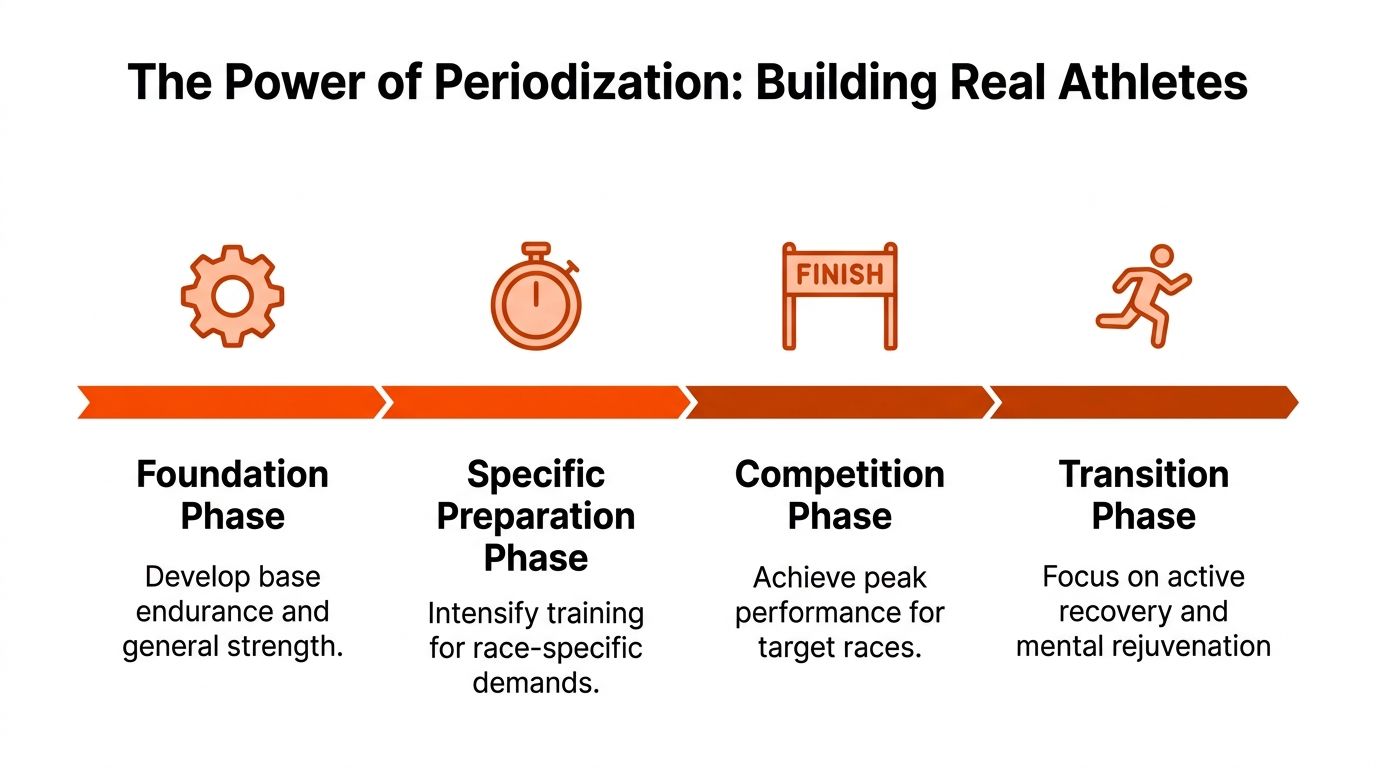
A generic PDF gives runners information. Periodization gives them a path.
In plain terms, periodization means organizing training into phases so the athlete is not trying to build everything at the same time. You develop the aerobic base first, then add more specific work, then sharpen for racing, then recover before the next cycle. That sounds basic. It is also where many remote coaches either build trust fast or lose it.
When coaches skip this structure, plans become random collections of workouts. One hard session gets stacked on another. Long runs drift without purpose. Race-specific work appears too early. The runner feels busy, but not better.
What periodization really protects
The biggest benefit is not sophistication. It is restraint.
A periodized plan stops a coach from chasing short-term excitement at the expense of long-term progress. That matters because running history keeps repeating the same lesson. Over the past 150 years, distance running performances have advanced by 25% ± 8%, and that progress lines up with major developments in training theory, including Arthur Lydiard's linear progression from base-building to intensity phases, as described in this review of performance progression and training evolution.
That history matters for modern coaches selling plans online. The runners in your WhatsApp group may not care about old coaching debates. They do care whether your training helps them improve without burning out. Periodization is how you make that promise credible.
The cautionary tale coaches should not ignore
The cleanest warning came from the 1990s.
American high school distance running dropped sharply when high-intensity, low-volume thinking took over. Only 17 runners broke 9:00 for 2 miles across the entire decade, compared with over 110 in the 2000s when endurance-focused methods returned, as outlined in Steve Magness's history of training philosophy and the 1990s decline.
That is not just an interesting historical footnote. It is a business lesson for coaches.
If your digital offer is built around flashy interval sessions, race-pace workouts every week, and not much aerobic development, it may look attractive on social media. It usually does not hold up over time. Runners feel sharp briefly. Then they plateau, miss sessions, or lose confidence because the plan never built enough support underneath the hard work.
Practical rule: If a runner cannot absorb the workout, the workout was too advanced for the phase, no matter how good it looked on paper.
Four phases that keep plans honest
A useful training plans running system usually moves through four broad phases:
- Foundation phase. Build consistency, aerobic capacity, and general strength. Most runners need more of this than they think.
- Specific preparation. Add workouts that match the demands of the target event. That includes threshold work, hills, or race-pace sessions.
- Competition phase. Reduce unnecessary fatigue and keep the runner sharp.
- Transition. Let the athlete absorb the cycle mentally and physically before the next build.
Not every runner needs a long season map with complicated labels. Most need a coach who knows what each month is supposed to do.
Why static PDFs fail
Static PDFs fail because they freeze a moving target. The athlete gets tired. Work changes. Kids get sick. Travel happens. Motivation dips. A plan that looked good on Sunday can be wrong by Wednesday.
That does not mean templates are useless. It means templates need a live layer on top of them. Coaches who grow remotely learn to separate the architecture from the adjustment. The architecture is periodized. The adjustment happens through check-ins, community prompts, and small weekly edits.
A runner will forgive a hard week. They will not forgive a plan that ignores reality.
The authority runners trust
Runners trust coaches who can explain why the easy week is there, why the volume comes before sharper work, and why not every session should feel heroic.
That is the power of periodization. It keeps the athlete progressing. It keeps the coach from guessing. It turns your service from a document into a system.
Building Your Core Training Plan Templates

Most coaches waste time by building every plan from zero.
A better approach is to create a small library of core templates for your most common outcomes. For most remote running businesses, that means one base template each for the 5K, 10K, and half marathon. Those templates are not finished products. They are frameworks you can adapt quickly.
Start with the weekly rhythm
Before picking workouts, decide the weekly shape.
For remote coaching, simple structure beats clever structure. A runner should be able to understand the flow of the week without opening three files and asking two follow-up questions.
A basic template often includes:
- One quality session focused on threshold, hills, or controlled intervals
- One long run that supports the event
- Easy running days that build durability
- One lighter day or rest day placed where real life makes adherence easier
- Optional strides or strength work added with clear purpose
The reason this works is simple. The runner can remember it. If people cannot remember your structure, they cannot follow it well.
Build phase by phase, not workout by workout
Good templates are built in blocks. The details change by athlete and event, but the logic stays stable.
Base phase
This phase creates the platform for everything that follows. The biggest mistake here is adding too much speed because the coach wants the plan to feel advanced.
The better move is controlled boredom. Let the runner stack weeks. Use easy mileage, steady long runs, strides, and basic strength. If the runner is newer, this phase may also include run-walk structure. If the runner is experienced, it may include one moderate session, but not repeated race-specific work.
Useful base-phase sessions include:
- Easy volume days with pace guided by feel
- Long runs kept conversational
- Short strides after easy runs
- Gentle hill efforts for mechanics and strength
- Simple tempo introductions in small doses for more experienced runners
Build phase
Coaches often get more selective in this phase.
Now the plan starts matching the race. A 5K runner may need more economy and controlled faster work. A half marathon runner needs deeper aerobic strength and longer threshold segments. The point is not to make workouts harder every week. The point is to make them more specific.
Here is a simple comparison table you can use when drafting templates:
| Event | Main focus in build phase | Common mistake |
|---|---|---|
| 5K | Economy, controlled interval work, speed support | Turning every workout into an all-out track session |
| 10K | Threshold strength plus event-specific rhythm | Skipping base and rushing into pace work |
| Half marathon | Aerobic durability, threshold control, long-run progression | Making long runs hard too often |
Peak phase
The peak is where remote coaches often overcoach.
You do not need endless complexity here. You need clarity. Keep the athlete feeling specific and confident. Reduce junk fatigue. Preserve rhythm. A good peak should make the runner feel ready, not trapped under one last heroic week.
Key takeaway: Peak training is not the phase for proving fitness. It is the phase for expressing the fitness already built.
For a 5K athlete, this might mean shorter event-specific sessions with plenty of recovery. For a half marathon runner, it might mean one strong race-specific workout and one long run that is slightly reduced but still purposeful.
Taper phase
Many coaches treat tapering like doing almost nothing. That usually backfires.
A proper taper reduces fatigue while keeping the runner connected to the event. The athlete still runs. The athlete still touches quality. The difference is that volume drops and the sessions become cleaner.
A useful taper checklist:
- Keep frequency familiar so the runner does not feel flat.
- Reduce volume before reducing rhythm.
- Use short race-specific reminders, not exhaustive sessions.
- Clarify race-week decisions such as warm-up, pacing, and recovery expectations.
Create templates that are easy to reuse
The best core templates are boring from an admin point of view and sharp from a coaching point of view.
That means each one should include:
- A short athlete profile it suits
- Weekly training rhythm
- Main goals of each phase
- A menu of interchangeable workouts
- Common regressions and progressions
- Notes for injury history, schedule limitations, and race priorities
When coaches say custom programming takes too much time, the problem is usually that they are customizing from scratch. Build stronger templates and you can personalize with precision instead of panic.
The oldest useful lesson in endurance coaching still applies. Progress comes from sequencing the right work in the right order, not from constantly inventing something new.
The Art of Personalization: Adapting Plans That Work

Templates save time. Personalization gets results.
The runners who stay with a coach are rarely the ones who received a schedule. They are the ones who felt the plan fit their life. That difference is where coaching becomes valuable.
A controlled comparison between individualized and predefined training found that the individualized group improved 10K performance by 6.2%, while the predefined group improved by 2.9%, with nearly 3x higher rates of high-level adaptation in the individualized approach, according to this summary of the individualized training study.
That lines up with what most experienced coaches already see. Two runners can handle the same mileage and the same workout on paper, yet one is thriving and the other is one bad week away from dropping out.
Start with a usable baseline
You do not need a lab to personalize well.
You do need a clean starting point. Before assigning a plan, get the basics:
- Training history. What has the runner handled, not what they wish they handled.
- Current routine. Days available, usual run length, strength habits, sleep pattern.
- Recent race or time trial data. Enough to estimate effort zones and realistic progression.
- Constraints. Travel, shift work, parenting schedule, terrain access, injury background.
- Goal priority. Finish, improve, qualify, compete, rebuild consistency.
Most poor personalization starts with poor intake. Coaches ask for a race goal and shoe size, then wonder why adherence drifts.
Scenario one: the time-crunched parent
One of the highest-value clients in remote coaching is the runner with ambition and very little free time.
This athlete does not need guilt. They need compression. Their program must preserve training intent in a smaller space. For this type of runner, I like a simple decision filter: protect consistency first, then add targeted intensity carefully.
The emerging opportunity here is polarized micro-dosing. Some coaches are already packaging flexible schedules around a week with 3x 45 minute easy runs plus 1x 30 minute high-intensity session, aimed at runners whose average training time has dropped to 4 to 5 hours per week, as discussed in this piece on intermediate and advanced base planning.
That kind of runner often succeeds with rules like these:
- Easy days stay easy so the athlete can recover.
- One focused hard session carries most of the intensity.
- Long run becomes relative, not ideological. If ninety minutes is unrealistic, a shorter but regular long run may be better than a skipped perfect one.
- Strength gets embedded, not treated as a bonus item the athlete never reaches.
Scenario two: the flatland runner chasing hills
This problem shows up constantly in remote coaching. The athlete lives in a flat city and signs up for a mountain race, trail half, or hilly road event. Generic plans often pretend hills are just available.
They are not.
A large share of runners in urban areas may lack access to varied terrain, and a 2025 study cited by TrainRight reported that flatland runners using simulated hill protocols improved downhill economy by 12% and race vertical tolerance by 18%, creating a strong case for specialized programming. The practical context appears in this guide for training for mountainous ultras while living in a flat area.
That athlete needs substitutions, not motivational speeches.
Useful options include treadmill incline work, controlled downhill simulation where available, stair sessions, power hiking practice, and strength that prepares the quads and calves for climbing and descending stress. The key is to tell the runner exactly what each substitute is replacing.
After you explain the logic, show them a visual example they can copy into their week:
Build feedback loops into the plan
Personalization is not a one-time setup. It is an ongoing conversation.
That is why chat-based delivery works so well when it is managed properly. A runner can report fatigue, schedule disruption, or unusual soreness quickly. You can adjust before the week breaks down.
A simple feedback loop might include:
| Check-in area | What to ask | What to change if needed |
|---|---|---|
| Fatigue | How heavy do the legs feel today | Reduce intensity or shorten volume |
| Stress | How messy is work or home this week | Swap hard day or add recovery |
| Motivation | Are they eager, neutral, or resisting runs | Change session style, not just load |
| Logistics | Did travel or weather remove options | Substitute treadmill, time-based, or indoor sessions |
Practical tip: If a runner repeatedly misses the same workout type, do not label them inconsistent first. Check whether the plan is mismatched to their life.
Great personalization is not dramatic. It is quiet, frequent, and specific.
Packaging and Pricing Your Running Plans
A running plan becomes a business offer when the client can understand what they are buying in under a minute.
Many coaches underprice because they sell a document instead of a service. Others overcomplicate the offer by mixing every feature into one package. The cleaner model is a set of tiers built around access, support, and customization.
Sell levels of coaching, not just files
A useful pricing structure for training plans running offers usually has three layers. The first gets people into your ecosystem. The second gives them the actual program. The third adds direct access and adaptation.
Here is a simple example:
| Tier | Price (Example) | What's Included | Best For |
|---|---|---|---|
| Community Access | Entry-level monthly price | Group chat, weekly prompts, motivation, shared wins, basic education | Runners who want accountability and community |
| Training Plan | Mid-tier monthly price | Structured plan, workout explanations, community access, periodic updates | Runners who want guidance without private coaching |
| Premium 1:1 | High-touch monthly price | Personalized adjustments, direct feedback, plan edits, priority support, community access | Runners with specific goals, injury history, or complex schedules |
The exact price depends on your niche, audience, and depth of involvement. What matters more is the separation between tiers. If every tier includes everything, clients choose the cheapest one and your workload rises without control.
Package around real use cases
The strongest offers are built around specific runner situations.
One strong premium angle is the time-crunched athlete. There is a clear gap in the market for flexible polarized plans designed around 4 to 5 hours per week, including formats like 3x 45 minute easy runs plus 1x 30 minute HIIT session, which makes this an easy service to package for busy runners using chat-based support, as noted in the earlier linked Trail Runner discussion.
That kind of offer is easier to sell than "custom endurance coaching." It solves a visible problem. It also lets you build groups around shared constraints, which improves retention because members feel understood.
What to include at each tier
Avoid stuffing every tier with too many deliverables. Focus on what the member will use.
- Community tier can include weekly check-in prompts, general race education, and encouragement inside WhatsApp or Discord.
- Plan tier should include the structured weekly schedule, workout notes, and occasional plan updates.
- Premium tier can add direct messaging access, voice note feedback, form review, and plan modifications after check-ins.
A coach who promises constant availability usually creates a support problem. A coach who defines response windows and adjustment points creates a business.
Use subscriptions, not one-off chaos
One-off PDF sales can work as a lead offer. They rarely build a stable coaching business by themselves.
Subscriptions fit running because training is ongoing. Athletes move from one race to the next. They need consistency, accountability, and progression. If you want ideas for structuring recurring offers, this guide to a sports coaching subscription model is a useful reference point.
Pricing rule: Charge more when your time must increase. Charge less when the community and system carry more of the experience.
The business side of coaching gets easier when your packaging mirrors how you coach. Clear tiers attract the right athletes and protect your calendar from becoming a patchwork of custom promises.
Delivering Plans and Building Community in Chat Apps
A running plan is only as good as its delivery.
Many coaches lose clients for a simple reason. The training might be solid, but the member experience feels scattered. Workouts live in one place, questions in another, payments in another, and accountability nowhere consistent.
Chat apps solve that if you use them like coaching rooms, not casual message threads.
Turn weekly plans into a rhythm members can trust
Good delivery has a cadence.
Members should know when the week's plan arrives, when key explanations are posted, where to ask questions, and how to report issues. That predictability creates calm. It also reduces admin because people stop asking where things are.
A simple flow can look like this:
- Weekend post with the upcoming week's structure
- Daily message highlighting the purpose of that day's session
- Workout thread or channel for questions and results
- Weekly check-in prompt covering fatigue, scheduling, and confidence
- Shared wins post to reinforce progress and community identity
This works especially well when the coach writes like a human. One clear message about the purpose of Tuesday's threshold run is more useful than a complicated spreadsheet nobody opens on their phone.
Build channels around coaching needs
Different platforms suit different styles. WhatsApp is direct and intimate. Discord offers cleaner separation with multiple channels. Telegram can work well for broadcast plus discussion. The important part is choosing a setup that matches your program size and communication style.
If you are comparing structures, this breakdown of Telegram vs WhatsApp for paid communities helps frame the operational trade-offs.
Once the platform is chosen, organize by need:
| Channel or group purpose | What belongs there |
|---|---|
| Announcements | Weekly plans, schedule changes, race-week reminders |
| Questions | Workout clarifications, pacing confusion, logistics |
| Wins | Race results, streaks, comeback stories, consistency milestones |
| Education | Audio notes, technique tips, fueling reminders, mindset prompts |
Community quality comes from structure. Without it, every message competes with every other message and useful coaching gets buried.
Specialized plans create stronger communities
One overlooked advantage of chat delivery is that it lets you group runners by problem, not only by race distance.
That is especially useful for niche services. For example, generic plans often fail flatland runners training for hilly races. Since 60 to 70% of runners in urban areas may lack access to varied terrain, and simulated hill protocols have shown measurable improvements in downhill economy and vertical tolerance in the cited TrainRight context, coaches can build dedicated groups around treadmill hills, stair sessions, and terrain substitutions instead of leaving those athletes to improvise.
That kind of group becomes more than plan delivery. It becomes a shared problem-solving environment.
Coach's lens: Community is not a bonus feature. It is what makes athletes stick with the plan on ordinary days when motivation is low.
Use automation for the boring parts
The tasks worth automating are the ones that do not require your judgment.
That includes access management, recurring payments, onboarding instructions, resource delivery, and routine reminders. Once those pieces run without manual effort, you can use your energy where members feel it: adjusting training, answering questions, and reinforcing accountability.
A strong chat-based coaching system usually includes:
- Automated onboarding so new members know where to start
- Resource delivery for PDFs, videos, or workout libraries
- Clear posting schedule so the community feels alive
- Prompted check-ins to surface fatigue before it becomes attrition
- Coach visibility through voice notes, replies, and occasional live sessions
When all of that works together, your plan no longer feels like purchased content. It feels like ongoing coaching.
From Coach to Community Leader
The shift is bigger than delivery format.
A coach who sells isolated plans trades expertise for one-time transactions. A coach who builds a structured community sells an ongoing experience. That difference changes the business model and the athlete outcome at the same time.
The strongest remote running businesses do not rely on constant reinvention. They run on a repeatable system. Periodized templates create order. Personalization keeps the training relevant. Tiered offers make the service understandable. Chat-based delivery makes support visible and consistent.
That system also changes how athletes see you. You are no longer the person who sends workouts. You are the person who sets direction, interprets setbacks, and keeps the group moving. That leadership is what clients stay for.
There is also a practical benefit for the coach. When admin, access, and recurring delivery are organized well, you spend less time chasing logistics and more time coaching. That protects your energy and makes scale possible without turning your service into low-quality mass programming.
Remote coaching works best when the technology stays in the background. Runners want clarity, responsiveness, and momentum. Coaches want simple operations and reliable recurring income. The right setup gives both sides what they need.
If you want a simple way to turn WhatsApp, Discord, or Telegram into a paid coaching community, Join My Coach helps you automate subscriptions, payments, and member access so you can focus on delivering better coaching instead of managing admin.