
Mobility Training Program: Your Chat-Based Blueprint
Published on June 11, 2026 · Reading time: 18 min
You post a quick ankle drill on Instagram. It gets saved, shared, and praised in the comments.
Then nothing happens.
No one buys. No one commits. A few people DM "can you make me a routine?" and disappear when you reply with details. Meanwhile, you keep giving away useful mobility advice in fragments, hoping content will somehow turn into income.
That gap is where a mobility training program becomes a business instead of a content habit.
Mobility is one of the easiest coaching offers to validate because people already know they feel stiff, restricted, or unstable. The missing piece is rarely information. It is structure, accountability, and progression. That is why a chat-based offer works so well. Clients do not need another saved post. They need a place where the plan lives, where they can ask questions, where they can show you their squat, and where they get reminded to do the work.
A good program delivered through WhatsApp or Discord is simple for clients, light for the coach, and strong on retention when the delivery is organized. You are not selling random drills. You are selling a path from limitation to better movement, backed by coaching.
Your Untapped Income Stream: A Chat-Based Mobility Program
Most coaches already have the raw material for this offer.
They have warm-up clips, mobility correctives, old PDFs, voice notes, exercise demos, and years of seeing the same movement problems over and over. The issue is not a lack of expertise. The issue is that the expertise is scattered across posts, stories, notes, and client chats.
A chat-based mobility training program fixes that by packaging your knowledge into one paid environment.
Why chat beats loose content
Social content is good for discovery. It is bad for delivery.
A saved reel cannot tell a client when to progress from a passive hip opener to loaded end-range work. A YouTube video cannot ask for a form check. A free post cannot sort members by level, remind them what to do today, or create a sense that they are part of something.
The underserved opportunity is not "more exercises." It is structured coaching inside familiar messaging apps.
That gap matters because coaches do better when the delivery system is simple. A source on the missing role of mobility training points to a market gap for structured mobility coaching through chat platforms and reports that a 2025 PT study found 40% better adherence when programs included social accountability, while 72% of personal trainers reported needing simpler tools for structured routines without complex software (The Forgotten Role of Mobility Training).
What clients buy
Clients do not buy "mobility" in the abstract.
They buy outcomes like:
- A better squat pattern: Less collapsing, less heel lift, more confidence under load.
- Less stiffness before training: A routine they can repeat without guessing.
- A plan that matches their level: Beginner, athlete, desk-bound adult, older client, or rehab-adjacent member.
- Coach access: Short feedback loops instead of waiting a week for help.
The offer becomes easier to sell when you stop describing exercises and start describing the coaching experience.
Why this becomes recurring income
A proper mobility offer fits subscription coaching because mobility is not one-and-done.
People need an initial phase, then progressive work, then maintenance, then re-assessment. That gives you a natural path to monthly continuity without making the program feel endless or vague.
A simple example:
- Start members with a guided assessment
- Move them into a focused 4 to 6 week block
- Keep them in a lower-touch maintenance group after the first cycle
- Upsell personalized feedback for members who want faster progress
That is a cleaner business model than selling one PDF and hoping buyers come back later. You stay in their pocket every day through the app they already use.
Designing Your Signature Mobility Program
A strong mobility training program needs more than a folder full of stretches. It needs sequence.
The easiest way to build it is with four layers: Assess, Mobilize, Stabilize, Integrate. That gives you a curriculum you can coach repeatedly without reinventing the plan for every new member.
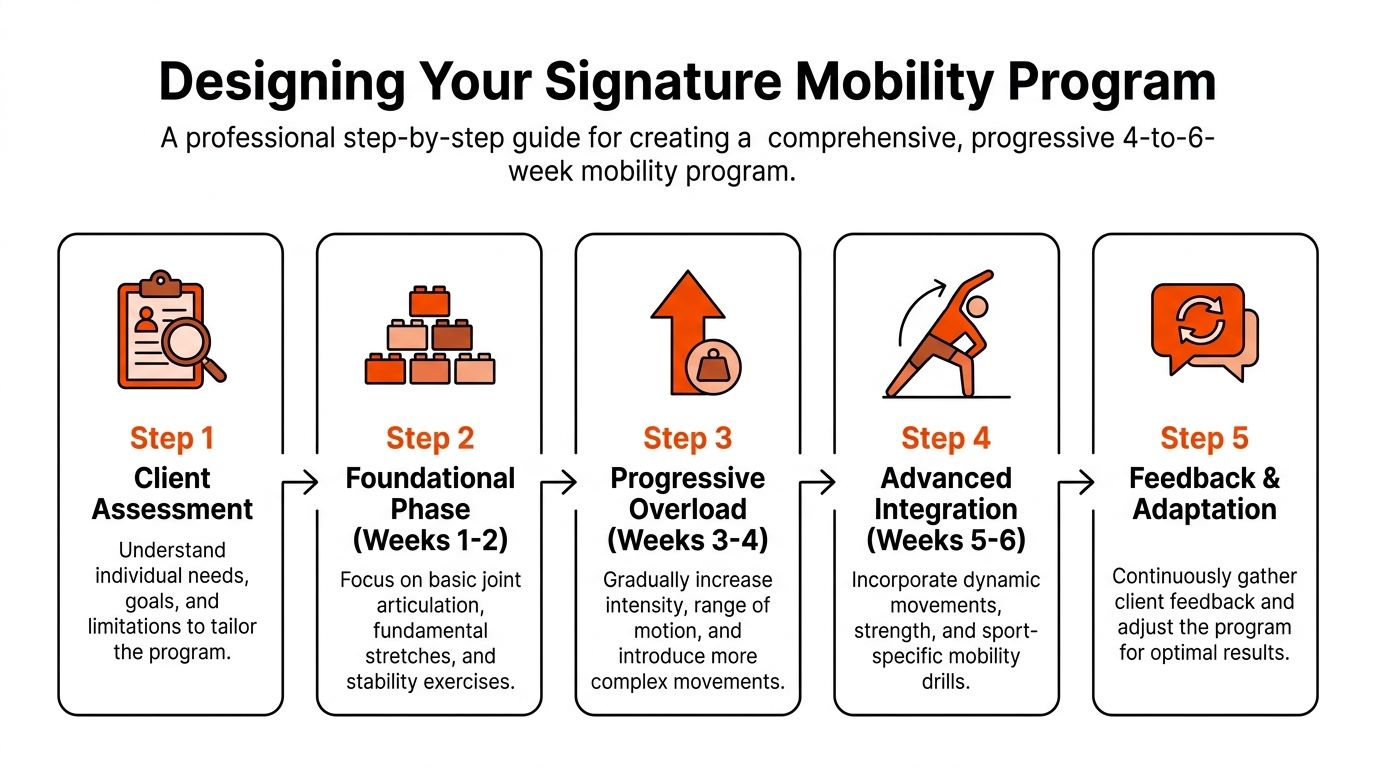
Assess before you prescribe
Most bad mobility programs fail at the start.
They throw the same drills at everyone. Tight hips, do this. Bad shoulders, do that. It feels helpful, but it ignores the underlying restriction. A client who cannot hit depth in a squat might have an ankle issue, a hip issue, a thoracic issue, or a bracing problem that only looks like a mobility problem.
Start with a short intake and a few repeatable movement checks.
Good entry points include:
- A squat screen: Bodyweight squat, front squat hold, or overhead squat if appropriate
- A shoulder screen: Wall slide, overhead reach, or controlled shoulder flexion
- A hip screen: Split stance position, hip rotation check, or simple hinge pattern
- A daily life question set: Where do they feel stiff, when does it show up, what training do they already do?
Ask members to submit short videos. Keep the standard tight. Same angle, same instructions, same length.
Use a fixed cycle, not random uploads
A structured cycle is easier to coach and easier to sell.
The Primal Method mobility training program outline describes a 6-week cyclical program built around five ingredients: foundational assessments, targeted drills, strength integration, dynamic functional movements, and recovery protocols. That framework is useful because it is scalable. It gives beginners enough structure while still leaving room for coaching adjustments.
You do not need to copy someone else's system. You do need the same discipline.
A practical 6 week build
Weeks 1 and 2 build control
This phase is not flashy. It should not be.
Your job is to reduce confusion, improve body awareness, and establish consistent execution. Sessions here often use simple joint work, supported positions, controlled tempo, and low-complexity strength.
Examples:
- ankle dorsiflexion pulses before squat work
- hip 90/90 transitions
- thoracic extension variations
- controlled articular rotations
- split squat isometrics in shortened ranges
Keep the videos short. One demo. One coaching point. One common mistake.
Weeks 3 and 4 expand usable range
Now you earn new motion, with passive work blending into active control. If a member gained range in the hip but still cannot own it under load, you have not solved the problem yet. Add strength in the new range.
That can look like:
- goblet squat holds with breathing
- loaded split squats
- eccentric calf work
- end-range rows for overhead positions
- tempo hinges for hip control
Do not flood the group with options. Give one main track and one regression.
Weeks 5 and 6 integrate it into movement
At this stage, clients feel the program's purpose.
You move from "mobility work" into movement that matters to their sport or training. The runner needs stride-related hip and ankle work. The lifter needs cleaner front rack and squat mechanics. The general population client needs better positions for training and daily life.
Use dynamic patterns and simple challenges:
- warm-up flows tied to the week's target area
- squat or lunge complexes
- overhead integration drills
- rotational patterns for field athletes
- movement prep circuits before strength days
If clients only feel looser on the floor, you are running a stretching club. If they move better in training, you built a coaching program.
Build the assets once
A profitable offer depends on reusable content.
Create these core assets up front:
| Asset | What it does |
|---|---|
| Assessment PDF | standardizes intake and self-screening |
| Demo video library | shows drills clearly and saves explanation time |
| Weekly checklist | tells members exactly what to do |
| Audio cues | helps pacing during holds or breathing work |
| Form check template | keeps feedback short and consistent |
Plan for coaching, not perfection
Members do not need a giant library on day one.
They need a clear first step, a weekly rhythm, and confidence that you will adjust when something is too easy, too hard, or not the right fit. A smaller library with clear progression beats a massive archive that overwhelms people.
What works is a program with a spine. Assessment first. Focused block. Progressive loading. Real-world movement integration. Feedback built in.
What does not work is posting isolated drills and calling it a system.
Packaging and Pricing Your Program for Profit
A lot of coaches undercharge mobility because they frame it as support work.
That is the wrong frame. A structured mobility training program is coaching. It solves restrictions that affect training quality, confidence, and day-to-day movement. If you package it like a serious service, clients will treat it like one.
Price the delivery, not just the drills
A mobility offer has value because of the system around it.
You are not charging for:
- assessment and direction
- progression over time
- access to feedback
- accountability inside a group
- a simpler path than figuring it out alone
The evidence helps you communicate that value without hype. A 2022 Cochrane review of 12 randomized controlled trials involving 1151 older adults found that mobility training programs improved mobility by 8% on the Short Physical Performance Battery, with participants averaging 4.69 points without training and 5.69 points with training. The review reported moderate-certainty evidence for improved physical functioning at the end of the intervention (Cochrane systematic review on mobility training).
That does not mean you promise identical results to every client. It does mean you can confidently say structured mobility work improves function when the program is organized and followed.
Keep the offer ladder simple
Most coaches do well with three tiers.
One low-friction entry tier, one main offer, and one premium tier for people who want more access. If you make six or seven options, members delay the decision.
Here is a simple structure.
| Feature | Tier 1: Community Access | Tier 2: Core Program | Tier 3: Premium Coaching |
|---|---|---|---|
| Chat group access | Yes | Yes | Yes |
| Weekly mobility schedule | Yes | Yes | Yes |
| Demo video library | Limited | Full | Full |
| Assessment materials | No | Yes | Yes |
| Form checks | Group only | Periodic | Priority and personalized |
| Personal adjustments | No | Light | High touch |
| Best for | Beginners, budget buyers | Most clients | Athletes, pain-point buyers, serious members |
What goes in each tier
Community Access
This is your easiest entry point.
Members get access to the group, your weekly prompts, a small exercise library, and the group rhythm. This works well for people who want accountability more than customization.
Use this tier to collect future premium buyers.
Core Program
This should be your main seller.
Include the assessment workflow, your full 4 to 6 week cycle, demo videos, weekly instructions, and some level of form-check opportunity. For many coaches, this becomes the cleanest balance of value and time.
If you want ideas on structuring a digital coaching offer, this breakdown on how to sell a digital sport program is a useful complement to the packaging side.
Premium Coaching
Reserve this for members who want speed, certainty, or personal attention.
Give them direct feedback on submitted videos, more frequent adjustments, and a customized path inside the same curriculum. Do not rebuild the program from scratch for premium clients. Personalize the route through your existing system.
Premium coaching should feel more responsive, not more chaotic.
Common pricing mistakes
A few mistakes show up constantly.
- Selling only one-time access: This removes the accountability layer that makes mobility stick.
- Including too much private support in the middle tier: That can bury your calendar.
- Pricing from insecurity: If you act like mobility is an add-on, buyers will too.
- Overbuilding the library before launch: Members join for guidance, not because you uploaded every drill you know.
The cleanest launch is usually a beta group with a fixed curriculum, one clear promise, and obvious boundaries on feedback.
The profitable mobility training program is not the most complicated one. It is the one clients can understand, join quickly, and stay inside long enough to feel progress.
Building a Seamless Onboarding Workflow
A messy onboarding process makes a good program feel amateur.
Clients should not pay you and then wonder where to go, what to do, or how to begin. The first day needs to feel calm and obvious. Clear steps reduce drop-off and reduce support messages.
Start with one immediate action
As soon as someone joins, give them one task.
Not ten. One.
The best first action is usually an assessment or movement screen because it turns the member from passive buyer into active participant. It also gives you the information you need to coach the right direction.
A professional onboarding sequence can follow a three-step model from NASM: identify limitations via specific tests, apply targeted interventions, and integrate new range of motion into functional patterns. That approach fits well with welcome PDFs and short instruction videos (NASM guide to movement assessments).
What the first 24 hours should look like
After payment
Send a welcome message that includes:
- the group link
- a short explanation of how the program works
- the first task
- when they should expect coach feedback
- where to find the core files
Keep the tone human. Avoid a long policy document.
Inside the group
Pin one message with the essentials:
- start here
- assessment instructions
- weekly schedule
- file library
- group rules
Clients should not need to scroll to understand the system.
Here is a useful movement reference to support the process:
Assessment submission
Ask for simple videos, not perfect videos.
Good instructions are specific: phone at hip height, side angle for squat, front angle for overhead reach, short clip, no filters, plain clothes if possible. The cleaner the input, the better your feedback.
Build templates for speed
Onboarding gets heavy when every reply is custom.
Create repeatable responses for common situations:
| Scenario | Template response focus |
|---|---|
| New member is nervous | reassure, simplify, assign only first step |
| Member submits unclear video | ask for same movement from a better angle |
| Restriction is obvious | assign one drill and one integration movement |
| Member reports pain | advise stopping that drill and narrowing scope |
Your welcome kit should be small
Do not overload new members with every resource on day one.
A clean welcome kit can include:
- One PDF: Basic overview and first-week instructions
- Two to three videos: How to assess, how to submit, how to start
- One checklist: What to do in order
- One message thread: Where to ask questions
The best onboarding feels guided, not impressive.
When members know exactly what to do in the first hour, they are far more likely to do something useful instead of waiting for motivation. That first interaction sets the tone for retention later.
Driving Engagement and Long-Term Retention
Retention in a mobility training program rarely collapses because the drills are bad.
It usually collapses because the group goes quiet, members lose momentum, and no one notices until they stop showing up. Chat-based coaching fixes that only if the coach uses the chat intentionally.
The easiest way to understand this is to look at a typical week.
A week that keeps members involved
Monday is where you set direction.
Post the week's focus with one short video and one plain-language explanation. Example: "This week is about ankle range for cleaner squat depth. Do drill A before training, drill B on off days, and film your squat by Wednesday."
Tuesday works well for reminders and quick wins.
A voice note is often enough. Tell members what the drill should feel like, what mistake to avoid, and how little time they need to get it done. Audio tends to feel more personal than another block of text.
Wednesday is perfect for public accountability.
Ask for one simple check-in: done, not done, or video submitted. That keeps the barrier low. Members who are hesitant to post a full form check will still reply to a one-word prompt.
Thursday is where you teach.
Drop a short lesson on why the week's mobility target matters in a real movement pattern. Connect the drill to squatting, running, overhead pressing, or getting into better start positions in sport.
Friday is feedback day.
Review submitted clips. Keep feedback brief and useful. One correction is usually enough. Clients do not need a biomechanics lecture inside a messaging thread.
Why this rhythm works
A real-world example supports the value of consistency and positive experience. In a 12-week Mobility-Fit program delivered three times per week, adherence reached 77%, and 67% of participants rated the program "very good," while 56% felt it benefited them "very much" (Mobility-Fit clinical trial).
That matters because retention is not only about reminders. It is also about whether members feel the coaching is useful, manageable, and worth staying for.
Content types that reduce drop-off
Not every message should look the same.
Use a mix like this:
- Short demo videos: Best for showing setup and movement quality
- Voice notes: Best for pacing, reassurance, and nuance
- PDF cheat sheets: Best for members who want one screen to reference before training
- Text prompts: Best for quick daily accountability
- Member wins: Best for social proof inside the group
If you want a stronger recurring community model around this, this guide to coaching community monetization fits well with the retention side of delivery.
What to do when engagement dips
Every group has a quiet week.
Do not respond by posting more content. Respond by reducing friction.
Try this sequence:
- Make the ask smaller: "Do one round today and reply done."
- Bring back focus: Repost the week's main drill and remove extra options.
- Feature a member win: Show that progress is happening inside the group.
- Offer a reset thread: Invite silent members to restart without apology.
People stay in coaching groups when participation feels easy to resume.
What usually fails
The patterns that hurt retention are predictable.
Too much complexity
If members need to choose from ten drills, they stall. Choice can feel like freedom to the coach and friction to the client.
Long silent periods
A chat group with no coach presence starts to feel abandoned, even if the program itself is good.
Feedback that is too detailed
Overexplaining makes members self-conscious. Short, precise feedback gets acted on.
No visible progress path
If clients cannot tell where they are in the program, they drift. Label the week, the target area, and the next step.
The coaches who keep members longer are rarely the loudest. They are the ones who make the group feel active, simple, and responsive.
Automating Your Way to a Scalable Coaching Business
A mobility training program becomes a real business when delivery stops depending on memory.
If you are manually sending payment reminders, manually adding members to chats, manually checking who should still have access, and manually digging through old messages for the right PDF, the model will cap your growth fast. You will spend more time managing the container than coaching inside it.
Automation solves that operational drag.
What should run without you
Your best coaching time should go to feedback, programming decisions, and community leadership. The rest should be systemized.
That usually means:
- payments happen on schedule
- access is granted automatically after signup
- members who cancel lose access without awkward admin work
- resources are stored in one place
- tier differences are enforced consistently
When those basics run cleanly, you can coach more members without the business feeling heavier every week.
Build once, improve in cycles
The strongest version of this business is not a huge launch with endless complexity.
It is a simple machine:
- one clear mobility offer
- one structured onboarding flow
- one repeatable content rhythm
- one premium path for clients who want more support
Then you refine the edges.
You improve your welcome message. You tighten your assessment instructions. You turn your most common feedback into reusable videos. You notice which weekly prompts get replies and which ones get ignored. Over time, the program gets sharper and easier to run.
The business upside of simplicity
A lot of coaches chase scale by adding more products.
A better route is often making one offer more reliable.
Mobility fits this well because it can serve several audiences without changing the delivery model. General fitness clients want better movement. Strength clients want better positions. Older adults want independence and confidence. Athletes want cleaner mechanics and fewer movement bottlenecks. The container can stay the same while the coaching inside is customized.
That is what makes the offer durable. You are not building a one-off challenge. You are building an asset that can onboard new members every month, move them through a repeatable path, and keep the admin light enough that the work remains enjoyable.
If you want the chat-based model to stay profitable, protect your energy. Automate the repetitive parts. Standardize the obvious parts. Save your personal attention for moments that effectively change the client experience.
If you want a simple way to run that kind of paid coaching setup, Join My Coach helps coaches turn WhatsApp, Discord, or Telegram groups into subscription-based programs with automated payments, access management, and resource delivery, so you can spend less time on admin and more time coaching.