
Monetize Injury Prevention Programs as a Coach
Published on June 16, 2026 · Reading time: 20 min
A client is doing everything right. They show up, follow the plan, ask smart questions, and still disappear for two weeks because the same shoulder flare-up or knee issue came back again.
Most coaches know that feeling. You write solid training. The client is motivated. But one weak link keeps hijacking the whole process.
That frustration usually gets treated like a programming problem. It is often a delivery problem instead. The client does not just need better exercises. They need a repeatable injury prevention system, built around screening, simple progressions, follow-up, and accountability.
That shift changes more than results. It changes the business model.
When you package prevention well, you stop selling random corrective drills and start selling continuity. Clients stay in the game longer. Parents trust you more. Adult clients see your coaching as protection, not just performance. Teams stop viewing you as the person who sends workouts and start viewing you as the person who keeps athletes available.
That is a premium service.
It also fits remote coaching better than many coaches realize. Prevention work does not require a fancy facility to create value. A phone camera, a structured intake, a clear weekly routine, and consistent chat-based follow-up can go a long way when the system is built properly.
From Frustration to a New Revenue Stream
A common pattern shows up in remote coaching.
A runner joins for strength support. Their training improves for a month. Then shin pain returns. A youth athlete starts moving better, then misses sessions because their ankle still feels unstable. A general fitness client keeps aggravating their low back every time life gets stressful and recovery slips.
The coach reacts each time. Swap an exercise. Reduce volume. Add mobility. Send a check-in message. Hope this version sticks.
That cycle drains time and confidence. It also teaches the client to see coaching as something that happens only after a problem appears.
A better model is to package prevention as a service on its own. Not rehab. Not medical diagnosis. Coaching built around movement quality, load tolerance, recovery habits, and adherence.
That service has real weight. Globally, injuries cause approximately 5.8 million deaths each year, accounting for 10% of all worldwide deaths, and the World Health Organization reports 4.4 million injury-related deaths annually with major contributions from road traffic crashes, suicide, homicide, and conflict, according to the injury prevention review on PubMed Central. Coaches are not solving that whole public health burden, but they do work in the exact place where many preventable problems begin. Daily habits, repeated movement, poor load management, and skipped basics.
Clients feel that. They may not ask for "load tolerance" or "movement control." They ask for fewer setbacks, less pain during training, and a plan they can keep following.
That is where a new revenue stream comes from.
You can sell prevention as a monthly membership, a sport-specific add-on, or a premium support layer inside an existing coaching offer. The value is obvious because the outcome is obvious. Fewer interruptions. Better consistency. More confidence in training.
Clients rarely pay for a band exercise by itself. They pay to stay active, stay selected, stay on the field, or stay out of pain.
Coaches who understand this stop treating corrective work like free bonus content. They package it, systemize it, and build retention around it.
The Shift to Proactive Remote Prevention
Reactive coaching feels busy. Proactive coaching builds better clients.
The reactive coach is a firefighter. They wait for the shoulder complaint, the tight hip, the recurring calf issue, then rush in with a fix. Sometimes that works for a week. Sometimes it works for a session. It almost never creates long-term stability if the client goes right back to the same poor habits.
The proactive coach is an architect. They build a stronger structure before the problem becomes expensive.
That distinction matters even more online.
Why most prevention programs fail remotely
Many coaches know useful injury prevention drills. They have a folder full of warm-ups, mobility flows, glute activation circuits, and return-to-training ideas. The issue is not knowledge alone.
The bigger issue is execution.
Research highlighted in the referenced discussion points to a critical implementation gap. Knowing what prevents injuries does not automatically lead to consistent practice, and this gets harder in remote coaching where compliance is difficult to monitor through chat alone, as noted in this injury prevention implementation discussion.
That lines up with what most remote coaches experience. A PDF gets downloaded and ignored. A video library gets saved and forgotten. Clients mean well, but prevention work gets pushed aside because it does not feel urgent until something hurts.
A remote injury prevention business works when the coach stops asking, "What exercises should I send?" and starts asking, "How will I make this part of the client's weekly behavior?"
What works and what does not
A lot of coaches overbuild the wrong things. They create polished resource libraries before creating a compliance system.
What usually does not work:
- One-time instruction: A single onboarding call and a long list of drills creates information, not habit.
- Generic add-ons: Throwing five corrective exercises at the end of every workout makes prevention feel optional.
- Program overload: If clients need twenty minutes of prep, they skip it on busy days.
- No visible accountability: If nobody checks, many clients stop.
What works better:
- Short repeatable routines: Five to ten minutes done consistently beats a perfect but unrealistic protocol.
- Named weekly habits: "Monday reset," "Wednesday form check," and "Friday recovery report" are easier to follow than vague expectations.
- Simple proof of completion: A check mark, short video, or quick message keeps the routine alive.
- Coach feedback in small doses: Clients do not need a lecture every day. They need timely cues.
Adherence is the product
Remote prevention is not an exercise library. It is a behavior system.
That is why this niche is strong commercially. If you can help people do the basics, you create value that many stronger programmers still miss. Prevention is not glamorous, but it solves one of the biggest trust issues in coaching. Clients want to know you can keep them moving forward without constant interruptions.
An architect thinks in layers. Movement quality. Load exposure. Recovery habits. Communication. Review. Adjustment.
That mindset scales far better than constant troubleshooting.
Your Remote Assessment and Screening Protocol
Remote screening does not need to look clinical to be useful. It needs to be structured.
Most coaches make one of two mistakes. They either skip assessment and guess, or they try to recreate a full in-person evaluation through a phone screen and overwhelm the client.
A better protocol is simple, repeatable, and good enough to guide programming.
Start with an intake that gives you usable context
Your first tool is not a mobility test. It is a smart intake form.
Build it in Google Forms, Typeform, or Notion. Keep the wording plain. You are not trying to impress the client. You are trying to catch patterns.
Ask for:
- Training goal: Fat loss, return to sport, strength, general fitness, movement confidence
- Injury history: Previous pain episodes, surgeries, recurring flare-ups, and what movements usually trigger issues
- Current training load: Days per week, session type, sport practice, and outside activity
- Equipment access: Gym, bands, dumbbells, bodyweight only
- Constraints: Schedule, travel, work demands, stress, sleep quality
- Referral status: Whether they are currently seeing a physician or physical therapist
This intake immediately separates clients who need a broad foundational plan from those who need tighter guardrails.
If a client reports sharp pain, recent trauma, or signs that fall outside coaching scope, refer out. A strong prevention business gets better when you are clear about where coaching ends.
Use video to screen what matters most
The next layer is movement video.
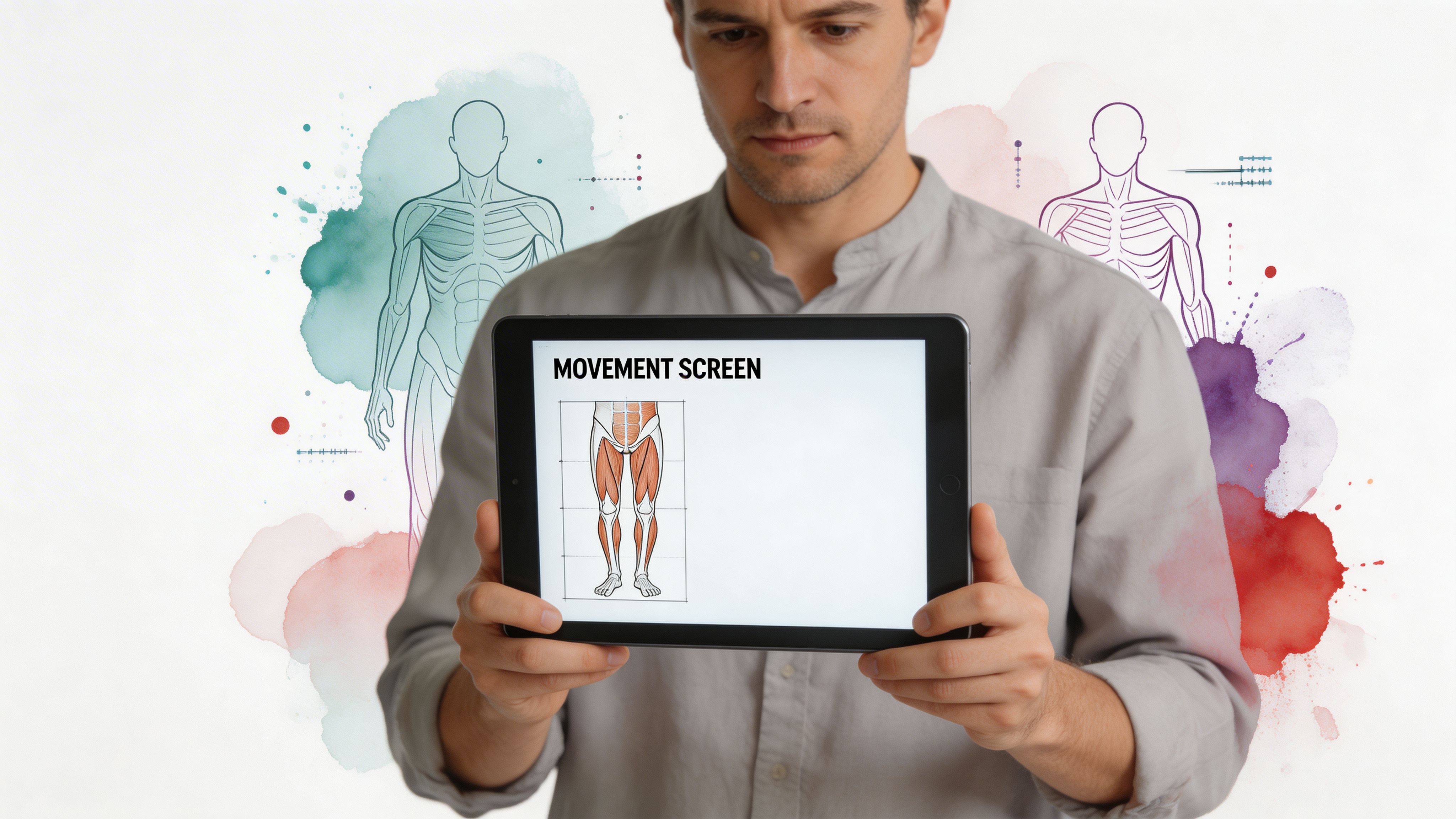
You do not need twenty tests. You need a small set that reveals control, balance, and obvious compensation.
A useful remote screen often includes:
- Bodyweight squat
- Split squat or lunge
- Single-leg balance
- Hip hinge
- Push-up or incline push-up
- Overhead reach or shoulder flexion
- A sport-specific clip if relevant, such as a running stride, jump landing, or overhead press
Ask for front view and side view when possible. Tell the client exactly how to film. Full body in frame, shoes on or off consistently, normal pace, no filters, no music over the recording.
Know what you are looking for
Do not chase tiny imperfections. Look for patterns that affect programming.
Examples:
- Knee collapsing inward during squat or landing
- Excessive trunk shift in split stance
- Loss of foot stability on single-leg tasks
- Poor control at the bottom of a hinge
- Rib flare or lumbar extension during overhead work
- Uneven tempo side to side
This is enough to sort clients into buckets. Not enough to diagnose. Enough to coach.
The value of video-based review is growing well beyond simple visual feedback. According to iMerit, predictive models can forecast injury probabilities with 70-85% accuracy when biomechanical data from video is annotated, and an example they give is identifying ankle inversion greater than 15° under load as a risk marker. The same source also notes that requiring video uploads can be a practical prevention tool for coaches in chat groups through biomechanical data annotation for sports injury prevention.
Most independent coaches are not building custom machine learning pipelines, but the lesson is useful. Video is not just content. It is data.
A remote assessment becomes far more valuable when every video leads to one programming decision. Change the warm-up. Regress the pattern. Reduce range. Add control work. Adjust load.
Turn the screen into a scorecard
A scorecard helps you stay objective.
Use a simple internal rating system such as:
| Pattern | Status | Programming action |
|---|---|---|
| Squat | Good / Needs work / Avoid for now | Keep, modify, or replace |
| Hinge | Good / Needs work / Avoid for now | Add wall hinge, tempo, or lighter variation |
| Single-leg stability | Good / Needs work / Avoid for now | Add balance and foot control work |
| Overhead position | Good / Needs work / Avoid for now | Change pressing angle and add mobility |
The client does not need technical jargon. They need a clear next step.
Package the assessment as part of the offer
Here, many coaches undervalue themselves.
Your assessment is not free admin. It is the first premium feature in the service. It shows professionalism, creates buy-in, and gives the client visible proof that their plan is not generic.
A strong delivery sequence looks like this:
- Day 1: Intake form
- Day 2: Video submission instructions
- Day 3: Screen review with voice note or short Loom video
- Day 4: Personalized prevention priorities and first-week routine
That process feels high-touch without being hard to scale.
Designing Scalable Injury Prevention Templates
Once assessments are done, the next job is not writing a custom masterpiece for every client. The next job is building templates that cover common patterns and let you personalize without starting from zero each time.
That is how an injury prevention offer becomes sustainable.
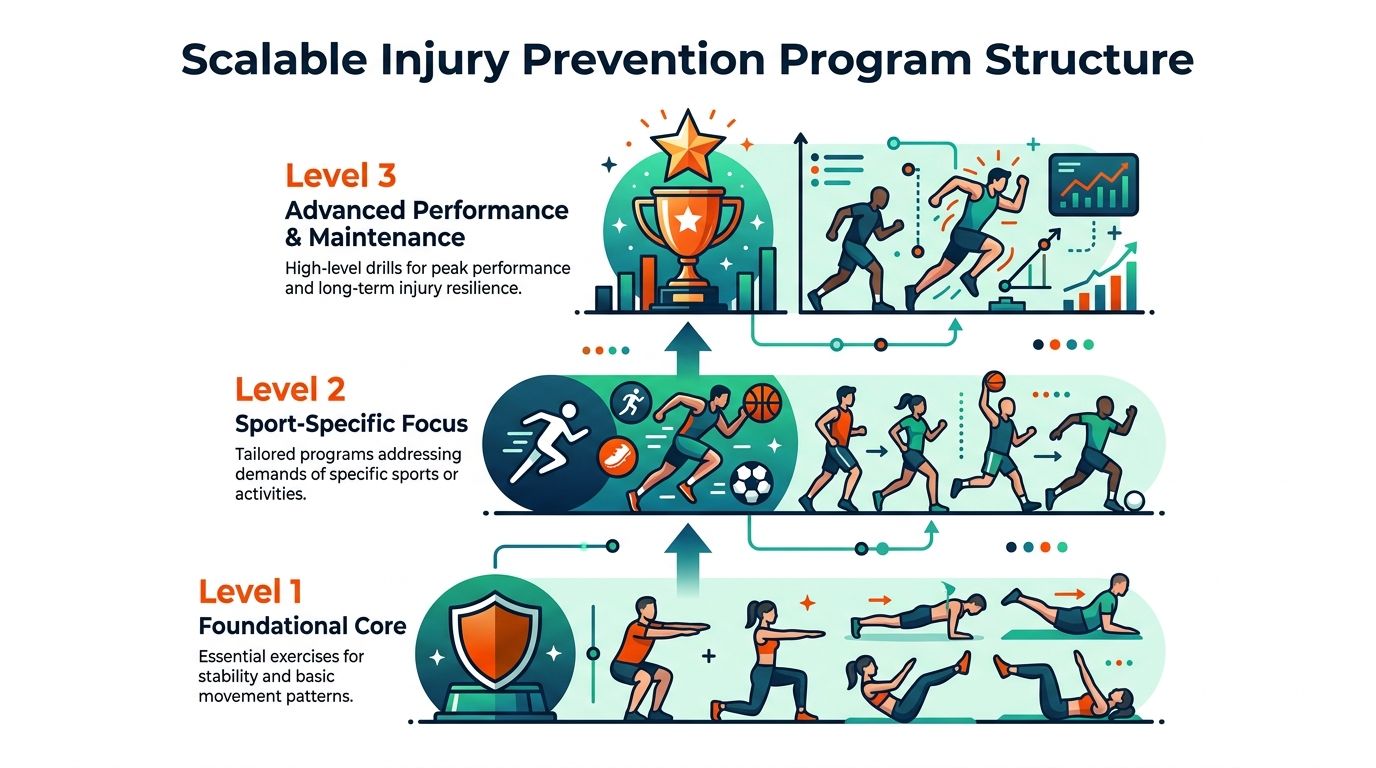
Build one strong base before you build specialties
Every scalable system starts with a foundational core.
This is the template almost every client touches first. It is not flashy. It covers the basics that improve movement quality and prepare the client for higher demand.
A practical foundational template usually includes:
- Breathing and trunk control: dead bug variations, bear holds, supported exhale drills
- Hip control: bridges, split squat isometrics, step-down patterns
- Foot and ankle work: balance holds, calf work, foot tripod drills
- Thoracic and shoulder control: wall slides, scapular upward rotation drills, controlled reaches
- Movement prep: squat patterning, hinge practice, landing mechanics where appropriate
Keep this base short. Clients should be able to complete it regularly without needing a full extra session.
Add expansion packs by goal, sport, or pain pattern
Once the base exists, create targeted modules.
A runner does not need the exact same emphasis as a desk-based weight loss client. A volleyball athlete does not need the same shoulder work as a powerlifter. But they can still share the same foundation.
Think in categories such as:
Lower-body resilience
Use this for runners, field sport athletes, and clients with recurring knee or ankle issues.
Focus on:
- deceleration mechanics
- calf and foot capacity
- single-leg control
- landing quality
Shoulder health
Use this for lifters, swimmers, overhead athletes, and group fitness clients who press often.
Focus on:
- scapular control
- thoracic positioning
- cuff-friendly progressions
- pressing angle selection
Low-back resilience
Use this for general population clients, busy professionals, and anyone who loses position under fatigue.
Focus on:
- trunk stiffness
- hinge mechanics
- hip mobility where needed
- load tolerance progression
This structure lets one coach serve many populations without pretending every plan is fully custom from scratch.
Progressions and regressions make templates feel personal
Templates fail when they are too rigid.
Every exercise should have an easier and harder version ready to go. That way you can adapt quickly based on the remote screen, equipment access, or a flare-up week.
A simple example:
| Pattern | Regression | Standard | Progression |
|---|---|---|---|
| Split squat | Supported split squat hold | Bodyweight split squat | Front-foot elevated or loaded split squat |
| Push pattern | Wall push-up | Incline push-up | Tempo push-up or loaded press |
| Hinge | Dowel hip hinge | Romanian deadlift | Single-leg RDL |
| Balance | Two-foot stability drill | Single-leg stand | Reach or perturbation version |
Clients feel seen when you adjust the entry point. You do not need to rewrite the whole system.
Use load management as part of the template
Many coaches think injury prevention means only mobility and activation. It also means respecting workload.
Kitman Labs notes that an acute:chronic workload ratio exceeding 1.5 is linked to a 2-4x higher injury risk, and teams using data-driven monitoring with training load adjustments have seen up to a 25% drop in injury rates through data-driven injury prevention workflows.
For independent coaches, that does not mean building a pro sports dashboard. It means adding simple decision rules to your templates.
Examples:
- if sport practice volume spikes, cut accessory lower-body work
- if the client reports heavy soreness and poor readiness, switch impact work to tempo strength or isometrics
- if a tournament week is coming, reduce novelty and keep only high-value maintenance drills
Prevention templates should include volume decisions, not just exercise lists. A perfect drill in a badly timed week is still poor programming.
Keep the coaching assets modular
The best remote systems use reusable assets.
Instead of creating one giant PDF, build a library:
- short demo videos
- cue cards
- voice note scripts
- weekly check-in prompts
- exercise swap lists
- "flare-up week" modifications
- "return to full training" pathways
This is what lets a group program still feel coached.
A coach with one solid foundation, three or four targeted modules, and clear progressions can support a large roster without diluting quality.
Delivering Programs and Driving Adherence with Chat
A prevention program lives or dies in the messaging rhythm.
Most clients do not skip their mobility or control work because they disagree with it. They skip it because life crowds out anything that feels optional. Chat solves that when the coach uses it with structure instead of noise.
In the United States, injuries are the leading cause of death for Americans aged 1 to 44, generate $406 billion in annual medical care costs, and workplace data shows that sprains, strains, tears, falls, slips, and trips account for well over a million cases involving days away from work, according to Trust for America's Health and the state-by-state injury prevention report. Clients may not think in public health language, but they understand missed work, missed training, and recurring setbacks.
That is why consistency matters.
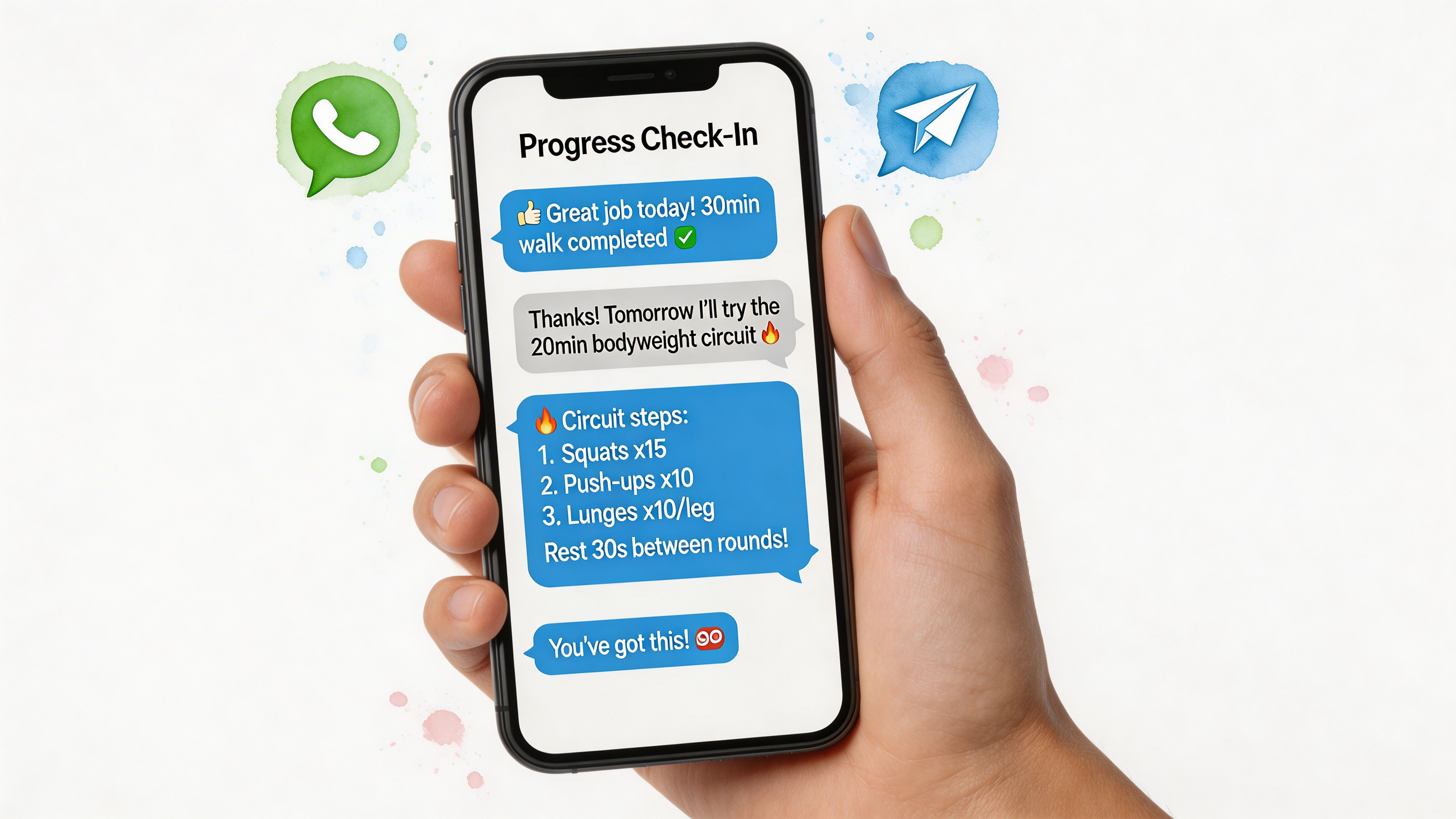
A weekly rhythm clients can follow
A strong chat-based prevention offer usually works best with fixed themes. The names matter because they create familiarity.
Here is a simple weekly cadence:
Mobility Monday
Post the week's short prep routine. Keep it brief and specific.
Example message:
Team, today's focus is ankle and hip control. Do the 8-minute reset before training or before your first walk of the day. Drop a check mark when done.
Form Check Wednesday
Ask for one video only. One. Not three.
Example message:
Form check day. Send one clip of your split squat from the front or side. I'll reply with one adjustment that matters most.
Win Friday
Celebrate completion and reinforce identity.
Example message:
Win Friday. What did you stay consistent with this week, even if the week was messy? Small wins count.
This works because the client does not need to guess what to do. Repetition reduces friction.
Group chat creates social proof
One of the biggest mistakes in remote coaching is making every prevention task private and invisible.
When clients post that they completed the warm-up, uploaded a form video, or adjusted a lift after feedback, the behavior becomes normal inside the group. That matters for youth teams, adult memberships, and sport-specific communities.
Use chat for:
- Proof of completion: check marks, short replies, or an emoji system
- Video review: one assigned clip per week
- Recovery reporting: simple self-report on soreness, readiness, or stiffness
- Peer reinforcement: encourage members to respond to each other's wins
The social side is often what turns an ignored protocol into a habit.
Keep your messages short enough to read
Long educational posts usually underperform in chat. Better delivery uses short prompts with one action.
Try a format like this:
- What to do today: "2 rounds of the shoulder prep"
- Why it matters: "This supports overhead work later in the week"
- Proof required: "Reply done when finished"
That is enough.
If you are deciding where to host a paid prevention community, this comparison of Telegram vs WhatsApp for paid communities is useful because the right platform depends on how much media, structure, and moderation your program needs.
A simple adherence ladder
Not every client needs the same level of contact. Build tiers inside the delivery itself.
| Client behavior | Coach response |
|---|---|
| Consistent and engaged | Light praise, occasional form cues |
| Misses one or two check-ins | Direct reminder and simplified task |
| Repeated drop-off | Private message, reduce complexity |
| Pain flare-up or confusion | Temporary modification and referral if needed |
This protects your time. It also helps you coach the core issue. Non-compliance is often not laziness. It is often confusion, overload, or poor fit.
Accountability works best when the next step gets easier, not louder.
What a good prevention coach sounds like in chat
Strong remote coaches sound calm, clear, and observant.
Not: "You need to do your corrective work."
Better: "Skip the full circuit today. Do the first two drills and send me your squat clip after."
Not: "Your knee valgus is problematic."
Better: "Your knee drifts inward on the left side. Let's shorten the range and own that position first."
Good chat coaching is not about constant presence. It is about timely interventions that keep the plan moving.
How to Price and Sell Your Prevention Programs
Coaches often underprice injury prevention because they compare it to a list of exercises. Clients compare it to interruption, frustration, lost progress, and recurring pain.
That difference is where your pricing power sits.
Sell outcomes, not correction libraries
A prevention offer becomes easier to sell when you stop describing it as "mobility and activation support."
That sounds optional.
Better positioning sounds like this:
- train with fewer setbacks
- improve movement confidence
- stay available during your season
- build a body that tolerates training better
- catch problems earlier through check-ins and video review
Clients do not buy preventive drills because they love preventive drills. They buy continuity.
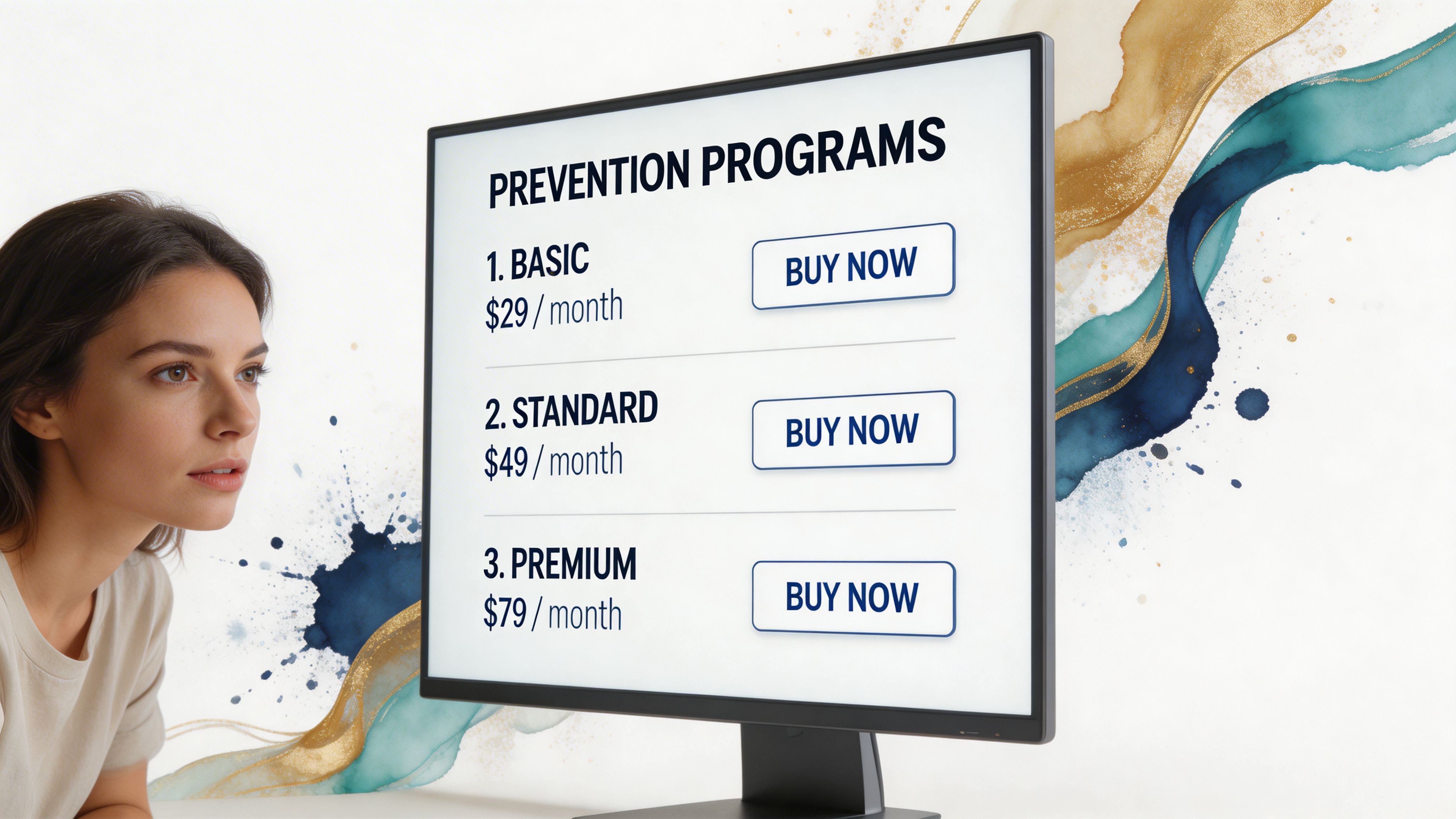
A tiered model that fits different buyers
A three-level structure works well because it gives clients an obvious entry point and a clear upgrade path.
Community tier
This is the lowest-friction option.
Include:
- weekly prevention prompts
- a basic resource library
- group chat accountability
- simple educational posts
This works for broad audiences, parents of youth athletes, and general fitness communities.
Group program tier
This is the core recurring offer for most coaches.
Include:
- structured weekly routines
- grouped by goal or sport
- scheduled video check-ins
- monthly movement review themes
- coach feedback inside chat. This tier offers the greatest scalability.
Premium 1 to 1 tier
This is for athletes with complex histories, higher performance demands, or clients who want direct support.
Include:
- intake review
- movement screen
- personalized progressions and regressions
- direct messaging access
- closer monitoring during high-load phases
This tier should feel meaningfully different. Not just the same group offer with a few extra messages.
Accessibility is a strong positioning strategy
A lot of injury prevention content assumes access to equipment, time, ideal facilities, and specialist support. That leaves a large underserved market.
The Prevention Institute notes that people of color and low-income populations are particularly at risk for unintentional injuries, and highlights barriers tied to resource access in prevention settings through its work on reducing unintentional injury. For coaches, that creates a practical business angle. Build offers that work with bodyweight drills, limited space, old equipment, or inconsistent schedules.
That is not a discount service. That is a better-designed service.
You can position an accessible prevention program for:
- youth clubs with limited budget
- amateur teams without full-time staff
- rural athletes with fewer specialist options
- adults training at home without much equipment
That market often values clarity and consistency more than polish.
Packaging examples that are easy to explain
Use plain-English names.
For example:
| Offer name | Best for | Main promise |
|---|---|---|
| Move Better Club | General fitness clients | Build durable training habits |
| Season Ready | Team sport athletes | Stay available through the season |
| Lift Without Setbacks | Lifters and gym clients | Improve control and reduce common flare-ups |
These names sell the result without sounding clinical.
A helpful resource if you want to structure and package digital coaching more clearly is this guide on how to sell a digital sport program.
A short walkthrough can also help clients understand what they are buying and why a membership model makes sense.
Make the offer easy to say yes to
The simplest sales path is usually one of these:
- add prevention as an upgrade to existing coaching
- sell it as an offseason or preseason package
- offer it as a standalone monthly membership for people not ready for full coaching
- create a parent-facing or club-facing version for youth sport
The key is to reduce ambiguity. People buy faster when they know who the program is for, what problem it solves, and how support happens.
Price the coaching around decision-making, accountability, and continuity. The exercises support the offer. They are not the whole offer.
Building a Resilient and Profitable Coaching Business
Building a prevention system turns scattered corrective advice into a stable coaching offer with recurring value.
Clients stay longer when training feels controlled, organized, and sustainable. Parents, teams, and adult fitness clients all notice the same thing. A coach with a clear prevention process solves fewer flare-ups in panic mode and delivers more steady progress over time. That improves retention, makes referrals easier, and gives the business a service people can understand and keep paying for.
It also sharpens the coaching itself.
Instead of rewriting the plan every time a shoulder gets cranky or a knee reacts to load, the work runs through a repeatable structure. Intake. Video screen. Template assignment. Weekly check-ins through chat. Adjustments based on compliance, symptom response, and training load. That kind of system is easier to scale because it depends on decisions you can repeat, not on constant improvisation.
Remote prevention becomes profitable when accountability is built into delivery. That is the gap many coaches miss. Exercise libraries are easy to create. Consistent follow-through is harder, and it is the part clients stay for. A simple chat-based model gives you a way to review form, answer questions, reinforce habits, and keep people engaged without adding hours of admin to every client.
Your energy matters too. A clean remote setup lets you coach more people at a high standard without spending the day chasing payments, links, and access requests. Tools built for paid coaching communities, including Join My Coach, can handle that side so you can spend more time reviewing videos, guiding members, and refining the program.
If you want to turn WhatsApp, Discord, or Telegram into a paid injury prevention coaching offer, Join My Coach makes the admin side simple with automated subscriptions, payments, and group access so you can focus on coaching.