
Bodyweight Training Workout: A Coach's Design Guide
Published on June 19, 2026 · Reading time: 18 min
You've felt this.
Your WhatsApp group or Discord server is active, clients like the convenience, and people want workouts they can do at home. But after a few weeks, the coaching starts to feel repetitive. You post push-ups, squats, lunges, planks, then another variation of the same thing. Members do a few sessions, enthusiasm dips, and you're stuck trying to make simple training feel premium.
That's where most coaches undersell bodyweight work.
A good bodyweight training workout isn't a backup option for people without a gym. It's one of the easiest coaching products to scale because clients can start fast, train almost anywhere, and get coached daily inside a chat-based community without friction. If you know how to program progressions, deliver cues clearly, and build accountability into the group, bodyweight training becomes a recurring membership, not a pile of random home workouts.
The Untapped Goldmine in Your Coaching Community
Most coaches think the value sits in complexity. More equipment. More programming layers. More fancy exercise names.
Online, the opposite is often true.
The best offer is the one clients can start today, with no shopping list, no gym commute, and no setup excuse. That's why bodyweight training works so well inside WhatsApp, Discord, and Telegram communities. The barrier to entry is low, but the coaching value can be high if the plan is structured.
Why this format fits subscription coaching
Clients don't join for a single workout. They join because they want a routine, a coach, and a reason to keep going.
Bodyweight training gives you all three:
- Routine is easy to establish because members can train in a living room, bedroom, office, or park.
- Coaching is easy to deliver because you can demo movements with short videos and written cues.
- Consistency is easier to maintain because clients don't have to solve logistics before every session.
That last point matters more than most coaches admit. A plan that's slightly less exciting but easier to follow usually keeps more people engaged.
Demand is already there
This isn't a niche trend. Bodyweight training ranked #3 in the American College of Sports Medicine's Worldwide Survey of Fitness Trends, and it stayed in the top 10 in subsequent years because of its affordability, low equipment needs, and broad appeal, as noted in this overview of bodyweight training as a leading fitness trend.
For an online coach, that matters for product design. You don't need to convince the market that bodyweight work is valid. You need to package it better than the average free challenge on social media.
Practical rule: If a client can begin within five minutes of joining your group, your offer is easier to sell and easier to keep.
Why coaches leave money on the table
The common mistake is selling access to workouts instead of selling a coaching system.
A random bodyweight circuit has low perceived value. A progressive plan with clear levels, weekly check-ins, feedback requests, and visible milestones feels like coaching. That's what members stay for.
Think about what makes bodyweight training profitable in a community model:
| Coaching asset | Why it scales well |
|---|---|
| Daily text prompts | Fast to write and easy to personalize |
| Exercise demos | One video can serve many members |
| Progressions and regressions | One session can fit beginners and advanced members |
| Group accountability | Members motivate each other between your check-ins |
| Low-friction delivery | No app learning curve for the client |
The strongest bodyweight communities don't win because the workouts are magical. They win because the coach removes friction and keeps people moving.
What clients are buying
Your members aren't buying air squats and push-ups.
They're buying:
- A clear path from their current level to the next.
- A coach who adjusts the plan when something feels too easy, too hard, or awkward.
- A group environment that makes consistency normal.
That combination is what turns a simple bodyweight training workout into a product people renew.
Foundational Principles of Bodyweight Program Design
Before writing sessions, get one thing straight. Fatigue is not the goal. Adaptation is.
A client can finish drenched in sweat and still make poor progress if the sessions don't match the result they want. That's where many bodyweight programs go wrong. They become endless high-rep circuits that feel hard but don't build much beyond tolerance for doing more reps.
Match the workout to the adaptation
Bodyweight training follows the same basic rule as any other training. The body adapts to the demand you impose.
If the plan asks for nonstop, light-effort repetitions, clients get better at enduring long sets. If the plan asks them to work near muscular failure with progressively harder variations, they build more strength and muscle.
That's why progression matters more than exercise variety.
A coach who understands progressions can get more results from five movement patterns than another coach gets from fifty novelty exercises.
Progressive overload is essential
For muscle growth, bodyweight training needs progressive overload aimed at a 6 to 12 rep failure range. Doing endless push-ups won't do the job. The exercise must become harder over time, such as progressing from standard push-ups to harder variations like archer push-ups, as explained in this breakdown of progressive overload in bodyweight muscle building.
That single idea changes how you coach.
Instead of saying, "Do more reps," you start asking better questions:
- Is the current variation too easy?
- Does the client reach meaningful fatigue in a useful rep range?
- Can we adjust mechanical advantage, tempo, or range of motion before adding volume?
- Is form still clean near the end of the set?
How to make bodyweight movements harder
You don't need dumbbells to create overload. You need better exercise selection.
Here are the main methods I'd use in a chat-based coaching group to increase difficulty:
- Mechanical advantage
Push-ups with feet raised are harder than standard push-ups. Archer push-ups bias more load to one side. Split squat variations challenge one leg more directly than bilateral squats. - Tempo manipulation
Slow eccentrics and pauses increase difficulty without needing extra equipment. A controlled lowering phase also gives you cleaner form videos from clients. - Range of motion
A deeper split squat or a deficit-style setup increases the demand if the client has the mobility to own that position. - Unilateral bias
Single-leg or single-arm variations quickly expose whether a client is ready for more intensity. - Rep quality
Better reps are progress. Cleaner depth, stronger lockout, less wobble, and more controlled tempo count.
If a client can do the movement forever, the movement is probably too easy for their main strength work.
The coaching decision tree
When a client tells you, "That was easy," don't default to adding another round.
Use this order instead:
- Check technique first
Many "easy" sets were rushed. - Adjust the variation
Change angle, stance, base of support, or unilateral demand. - Add a pause or slower lowering
This is one of the cleanest ways to increase challenge in remote coaching. - Then consider more volume
Volume matters, but it shouldn't be the first tool every time.
The movement buckets to program around
A simple bodyweight system works best when every session pulls from core categories:
| Movement pattern | Common examples |
|---|---|
| Push | Push-ups, incline push-ups, archer push-ups |
| Squat | Squats, split squats, pistol squat progressions |
| Hinge or bridge | Glute bridges, single-leg bridge variations |
| Core stability | Planks, hollow holds, side planks |
| Conditioning | Burpees, mountain climbers, squat thrusts |
This keeps your programming clean. It also makes progress easier to explain in chat.
Instead of giving a new client a giant library, you can say, "We're building your push, squat, hinge, and core patterns first. Then we'll progress each one."
What doesn't work well
A few traps show up again and again in online bodyweight coaching:
- Random daily burnout sessions
- High reps as the only progression
- Advanced moves given to beginners too early
- No distinction between strength days and conditioning days
- No clear standards for moving up a level
Bodyweight training looks simple. Programming it well isn't.
The coach who wins here is the one who keeps the structure simple for the client while making smart progression decisions behind the scenes.
Structuring the Perfect Bodyweight Training Workout
A strong bodyweight training workout should feel organized from the first minute. Clients should know how to start, what the main focus is, and when they're done.
That sounds basic, but it's one reason chat-based coaching works so well. A repeatable session format lowers decision fatigue. Members don't have to decode your programming every day.
The session blueprint
Most sessions work with three parts:
- Warm-up
- Main work
- Cool-down
That structure sounds obvious, but the details matter.
A good warm-up should prepare the joints and rehearse the patterns in the workout. It shouldn't become a workout of its own. The main block should have a clear priority, such as strength, work capacity, or mixed conditioning. The cool-down should help members shift out of training mode and finish with intention.
Warm-up that helps
Keep the warm-up short and specific.
A useful five-minute sequence often includes:
- Light pulse raiser such as marching, jogging in place, or fast step-ups on a stair
- Mobility prep for shoulders, hips, ankles, and thoracic rotation
- Pattern rehearsal using easier versions of the session's main exercises
If the workout includes push-ups and split squats, the warm-up should include a low-intensity push pattern and a squat or lunge pattern. This reduces awkward first sets and gives beginners one more form reminder before intensity rises.
Choosing the right main format
Different formats create different coaching experiences.
Circuits
Circuits are the easiest option for mixed-level communities. Everyone can move through the same sequence at their own pace while using individual regressions and progressions.
Use circuits when you want:
- broad accessibility
- efficient sessions
- easy delivery by text and short demo clips
EMOM
Every Minute on the Minute keeps people focused and adds structure. It's great when your group tends to drift, chat, or lose urgency.
Use EMOM when you want:
- cleaner pacing
- time boundaries
- simple accountability
AMRAP
As Many Rounds As Possible can create energy in a community, but it can also invite sloppy reps if the coaching isn't clear.
Use AMRAP when:
- clients already understand form standards
- the goal is work capacity
- you want a challenge-day feel
Coach cue: Speed counts after the rep standard is clear.
Sample Bodyweight Workout Templates
| Level | Warm-Up (5 min) | Main Workout (Circuit, 3-5 Rounds) | Cool-Down (5 min) |
|---|---|---|---|
| Beginner | March in place, arm circles, bodyweight good mornings, assisted squats, wall push-up rehearsal | Incline push-ups x 6 to 10, bodyweight squats x 8 to 12, glute bridges x 10 to 15, reverse lunges x 6 each side, front plank hold | Easy walking, chest stretch, hip flexor stretch, deep breathing |
| Intermediate | Jog in place, shoulder taps, squat-to-stand, split squat pulses, push-up rehearsal | Standard push-ups x 6 to 12, split squats x 8 each side, single-leg glute bridge x 8 each side, mountain climbers, side plank hold each side | Calf stretch, thoracic rotation, hamstring stretch, nasal breathing |
| Advanced | Fast feet, inchworms, dynamic lunges, scapular push-ups, hollow body prep | Archer push-ups x 6 to 12, pistol squat progression x 6 each side, bridge or hinge variation with feet raised x 8 to 12, burpees, hollow hold | Walking recovery, hip mobility, pec stretch, long exhale breathing |
How to coach the same workout to mixed levels
Many online coaches struggle here.
Don't write three separate daily sessions if the group doesn't need that. Write one main session and attach level options under each movement.
For example:
- Push movement
Beginner: wall or incline push-up
Intermediate: floor push-up
Advanced: push-up with feet placed higher or archer push-up - Lower-body movement
Beginner: assisted squat
Intermediate: split squat
Advanced: pistol progression - Core movement
Beginner: short front plank
Intermediate: longer plank or side plank
Advanced: hollow hold
That gives every member the feeling of being coached without doubling your admin load.
Rest is part of the design
A lot of bad bodyweight coaching comes from under-prescribing rest.
If you want better strength-focused sets, clients need enough recovery to perform quality reps. If you want density and breathing stress, then tighter rest makes sense. Decide which one you want before writing the workout.
Use simple guidance in the chat:
- Strength emphasis: rest until you can repeat clean reps
- Conditioning emphasis: keep moving, but slow down before form breaks
- Beginner rule: stop each set with a rep or two still looking strong
A clean post you can send to your group
This style works well in WhatsApp or Discord:
Today's bodyweight training workout
5-minute warm-up
4 rounds
A1 push-up variation x controlled reps
A2 squat variation x controlled reps
A3 bridge or hinge variation x controlled reps
A4 core hold
Rest as needed between movements
Goal: quality reps, not rushing
Reply with your variation choice and one note on what felt hardest
That last line matters. It gives you useful feedback for tomorrow's progression.
Building Long-Term Plans for Sustained Progress
A member joins your Discord on Monday, does the first workout, feels motivated, and posts a sweaty selfie. By week three, that same member is asking a different question. "How do I know I'm progressing?"
If your plan answers that clearly, retention improves. If it does not, the group starts to feel like random daily workouts instead of coaching.
Build the week before you build the month
For chat-based coaching, weekly structure does more of the heavy lifting than fancy periodization.
Three models work well because they are easy to explain, easy to moderate in a group, and easy to sell as clear tracks inside your community:
- Full body three times per week for beginners and general fitness members
- Alternating emphasis days such as upper-body strength, lower-body control, then conditioning
- Four-day split models for committed members who want more training frequency
The programming trade-off is simple. More variety feels exciting in week one, but clearer repetition produces better adherence, cleaner form videos, and faster coach feedback. In a WhatsApp or Discord group, that matters. You cannot scale good feedback if every member is doing a different plan.
A strong weekly rhythm usually looks like this:
| Day type | Main purpose |
|---|---|
| Strength-focused day | Harder variations, lower rep targets, more rest |
| Volume or technique day | Practice, cleaner positions, tempo work |
| Conditioning day | Simpler moves, sustained effort, less technical fatigue |
That structure also makes community management easier. Members start to recognize the flow of the week, and your check-in prompts become repeatable. If you are setting up channels by training day or member level, a Discord server structure for online coaching communities helps keep that organized.
Program for repeatability, not novelty
Long-term bodyweight coaching works best when joints stay calm, technique keeps improving, and members can tell why an exercise is in the plan.
That means building in pauses, slower eccentrics, isometric holds, and lower-impact sessions on purpose. Not because they look advanced, but because they let members train hard enough to improve without irritating wrists, shoulders, knees, or low backs every week.
A hollow hold, split squat hold, scapular wall slide, or slow push-up negative can all do useful work inside a month-long block. They improve position, expose weak links, and give you options for members who are not ready for harder dynamic reps.
The best long-term bodyweight plan is the one members can repeat for months, while still feeling challenged and still trusting their body.
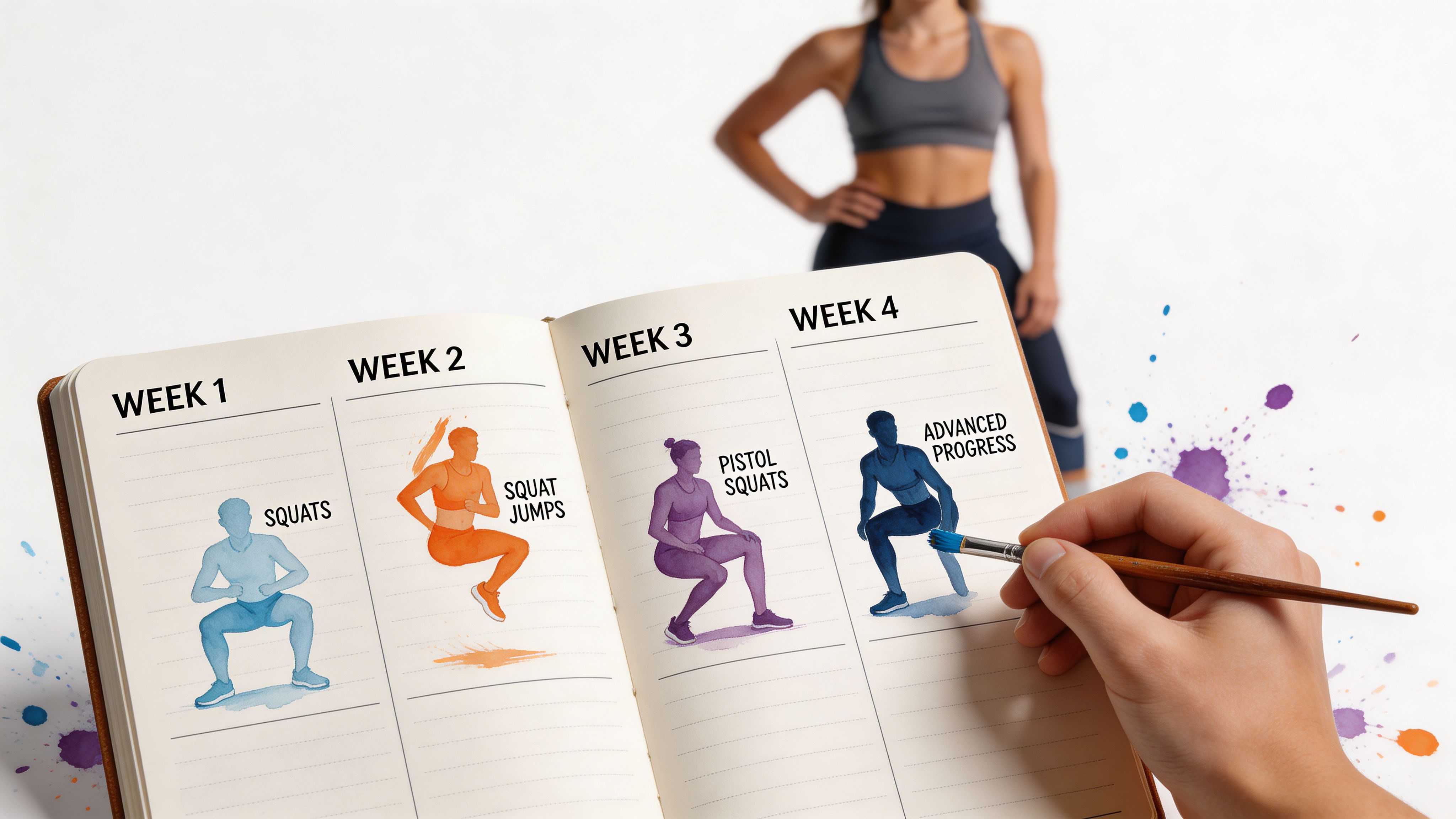
A simple four-week block
Most group programs do well with a four-week cycle. It is long enough to show progress and short enough to keep attention.
A practical structure looks like this:
- Week one
Set baselines. Lock in exercise choices, rep targets, and video standards. - Week two
Build volume or control. Add reps, add time under tension, or clean up range. - Week three
Push progression. Use a harder variation, denser format, or one extra round where appropriate. - Week four
Reduce fatigue. Cut total work, keep movement quality high, and let people recover.
Week four is where many coaches lose discipline. They keep pushing because they want members to feel they are getting value. In practice, deload weeks improve retention because people finish the block feeling capable instead of cooked.
This video gives a useful visual example of how to progress bodyweight movements across a short training block, which can help when you need to explain the month ahead inside your group:
What to include in long-term plans
A month that keeps members engaged usually includes four things:
- Skill targets such as cleaner push-ups, better squat balance, or longer hollow holds
- Lower-stress sessions that reduce impact and let sore members stay consistent
- Repeat benchmarks so progress is visible without needing max-effort tests
- Substitutions for common pain points like wrists, knees, shoulders, and low back discomfort
Those substitutions are part of the product, not an afterthought. In chat-based coaching, members stay subscribed when they know there is a next step and a backup option.
When to progress and when to hold
New week does not automatically mean new variation.
Keep a member at the same level if:
- rep speed falls apart
- range of motion gets shorter
- control disappears under fatigue
- joint discomfort shows up
- performance cannot be repeated across sessions
Progress a member when:
- target reps look clean
- positions stay stable
- recovery between sessions is solid
- confidence is improving
- they can explain what changed and why it felt easier
That last point matters in community coaching. If a member can say, "I used the same incline push-up but got 2 more clean reps and my shoulders felt better," you have proof of progress and language you can reuse in the group.
That is how a bodyweight training workout becomes a coaching system people keep paying for.
Digital Coaching Cues and Community Engagement
A member opens your WhatsApp group at 6:12 a.m., sees today's session, knocks it out before work, and posts a quick video of their split squat. By lunch, they have a cue they can use in the next session. By evening, they have seen three other members training the same pattern at different levels. That kind of contact keeps people training, and it keeps them paying.
Programming starts the sale. Delivery keeps the subscription.
In a chat-based bodyweight coaching business, the coach who wins is usually the coach who replies clearly, organizes feedback well, and makes each member feel noticed without turning the group into a full-time customer service job.
What accountability looks like in practice
You do not need a flashy app or a pile of automation to create accountability. You need a system members can trust.
The principle is simple. People stay longer when effort gets noticed and the next step is clear. A member who posts, gets a useful reply, and knows what to do tomorrow is far more likely to stay engaged than a member who gets a PDF and silence.
That matters even more with bodyweight training because the same exercise name can hide five different realities. One person's push-up is wall-assisted. Another person's push-up has their feet placed higher with a slow eccentric. Your coaching has to close that gap fast.
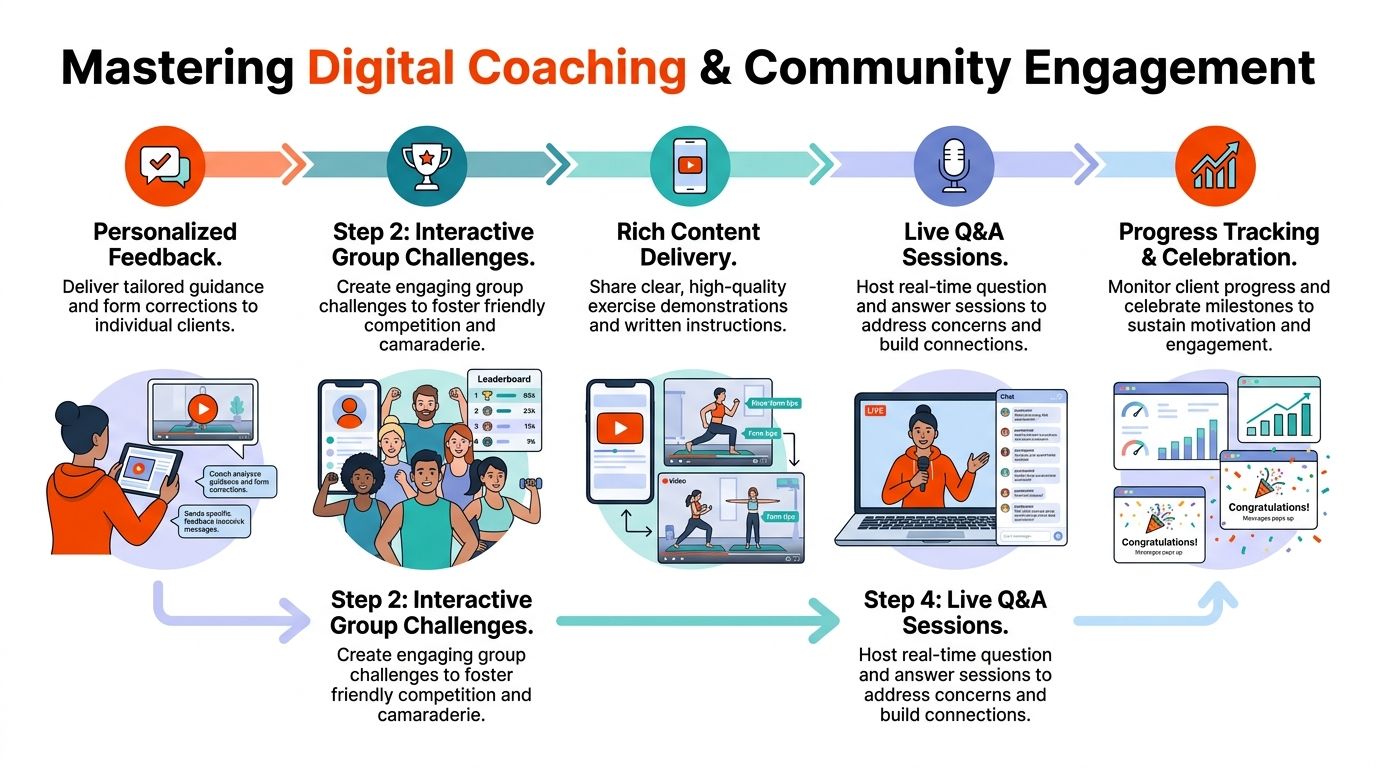
The daily communication rhythm
Good groups run on rhythm, not volume.
Use a repeatable cadence members learn quickly:
- Morning post
Session of the day, level options, one key coaching cue - Midday prompt
"Reply with the version you used and your hardest exercise" - Evening check-in
"What felt better than last time, and what still needs coaching?"
That structure does two jobs at once. It increases completion, and it gives you usable coaching data without asking members to write long updates.
Sample scripts you can use
These are simple on purpose. Clear messages scale.
Workout delivery post
Today is lower body and core.
Choose the version you can perform with full control.
Beginner: chair squat, split squat support hold, short plank
Intermediate: bodyweight squat, reverse lunge, side plank
Advanced: pistol progression, split squat with rear foot raised, hollow hold
Coaching focus: own the bottom position.
After the session, post "done" and the level you used.
Form feedback reply
Squat depth looks good. Slow the lowering phase and keep your ribs stacked over your hips on the way up. Stay on this version for one more session so we can repeat the quality.
Missed-session check-in
Missed yesterday is fine. Get the shortest version done today.
Pick one: 10 squats, 8 incline push-ups, 20-second plank for 3 rounds.
Reply when finished.
Encouragement that still coaches
You did not need more variety today. You needed clean reps and a completed session. That was the right call.
Use one main cue per message. Members rarely apply five corrections well in a chat setting. They usually apply one.
How to coach mixed ability levels without drowning in admin
A shared session needs a shared objective.
Build the day around one pattern or one training intent, then assign level-specific exercises under it. Push strength, single-leg control, trunk stiffness, low-impact conditioning. The theme stays the same. The entry point changes.
For example, a "horizontal push" day can include wall push-ups, incline push-ups, floor push-ups, or archer push-up progressions. Everyone is part of the same session. No one feels like they are on a random side plan.
That is what makes group coaching scalable. You are not writing twenty separate programs in the chat. You are coaching one training objective across several levels and giving each level the right cue.
Create a usable video feedback loop
Video review can either become your retention engine or your time sink.
Keep it tight:
- Member posts one set from one angle.
- Member includes one question.
- You reply with one correction, one confirmation, and one next action.
That format trains better clients. It also protects your time. If members post five angles and ask, "How does everything look?" you end up doing unpaid assessments all day.
A better script for members is:
Post one working set.
Ask one question.
Tell me where you felt unstable, rushed, or uncomfortable.
If you run your group on Discord, this guide on how to build a pro Discord server for coaching communities helps with channel structure for workouts, form checks, wins, and announcements.
Engagement that supports the product
Community posts should improve adherence or execution.
Use prompts like these:
- Technique thread
"Post your push-up setup before the first rep" - Pain-point check
"Any wrist, knee, shoulder, or low-back issues today? Reply with the movement that caused it" - Micro-win thread
"What got easier this week, even if you did not change exercises?" - Coaching challenge
"Hold the bottom of your squat for 15 seconds and post the version you used"
These prompts create conversation that feeds your coaching decisions. That is different from generic motivation posts that get reactions but no useful information.
Your advantage as the coach
Your advantage comes from this responsiveness.
If several members report wrist irritation on push-ups, you can post regressions, hand-position options, and fist or handle variations the same day. If beginners keep losing position in planks, you can film a 20-second demo and pin a tighter cue. If advanced members are underloaded, you can add tempo, pauses, range changes, or unilateral work without breaking the group structure.
That speed is part of the product.
In a chat-based community, members are not only paying for a bodyweight training workout. They are paying for quick interpretation, fast adjustments, and the feeling that a real coach is present.
Tracking Progress and Proving Value to Your Members
If clients can't see progress, they start judging the program by soreness, sweat, or scale weight. That's a weak position for any coach.
Bodyweight training gives you better markers than most coaches use. You need to track them consistently and report them back in a way members understand.
Use objective and practical markers
A randomized controlled trial published in the International Journal of Exercise Science found that inactive adults who completed 11 minutes of bodyweight training three times per week for 6 weeks improved VO2peak by a mean of 7%, with full compliance in the intervention group and no specialized equipment required, according to the full study on simple bodyweight training and cardiorespiratory fitness.
For a coach, that matters because it confirms something clients often underestimate. Simple, short, structured bodyweight work can produce measurable improvement.
What to track in a bodyweight coaching group
Don't rely on one metric.
Use a mix of training and lifestyle indicators:
| Metric type | What to track |
|---|---|
| Exercise progression | From incline push-up to floor push-up, from squat to split squat, from short plank to longer hold |
| Rep quality | Better depth, cleaner lockout, steadier core position |
| Density | Same work completed with less rest |
| Session consistency | Number of completed sessions each week |
| Client feedback | Energy, confidence, movement comfort, recovery |
Show the value back to the member
Tracking alone doesn't improve retention. Reflection does.
At the end of each week, send a short recap:
- what improved
- what stayed the same
- what you're changing next week
That message can be:
This week you kept all sessions consistent, your push-up control improved, and your split squat balance looked better. Next week we'll keep the same lower-body variation and make your push work slightly harder.
That's coaching. It translates effort into visible progress.
Progress check: If a client's movement got cleaner, more controlled, or more confident, that counts. Don't wait for dramatic visual changes to prove the program works.
Keep the tracker simple
A complicated tracker dies fast.
Use one shared Google Sheet, a basic PDF check-in form, or a pinned message template inside your group. Ask members to record:
- session completed
- exercise variation used
- hardest movement
- one win
That's enough information to guide progressions and remind members that their work is going somewhere.
From Workout Plan to Profitable Coaching Business
A solid bodyweight offer isn't built on exercise variety alone. It runs on structure, progression, communication, and proof of progress.
When you package those pieces well, your coaching stops being a stream of daily messages and starts becoming a real membership product. Members know what they're getting. They can follow it anywhere. They feel your presence even when you're coaching a group, not just one person.
The business upside comes from turning your method into a repeatable system:
- clear weekly training flow
- level-based exercise options
- form feedback process
- progress tracking
- recurring check-ins
That's the point where your time goes where it should. Coaching, not chasing payments or manually managing access.
If you're thinking about packaging this into a paid offer, this article on how to sell a digital sport program in 2026 is a useful next step for the business side.
If you want to turn your WhatsApp, Discord, or Telegram coaching into a paid membership without handling subscriptions and access manually, Join My Coach gives you a simple way to do it. You focus on the bodyweight training workout, the feedback, and the community. The platform handles payments, member access, and recurring subscriptions in the background.