
Online Workout Classes: Your Chat-Based Coaching Playbook
Published on July 3, 2026 · Reading time: 18 min
You finish coaching at the gym, answer DMs in the parking lot, send a few workout PDFs at night, and tell yourself you'll build your online offer "when things calm down." They usually don't.
That's the trap. A lot of coaches are already doing online coaching tasks, but in the least scalable way possible. They message people one by one, chase payments manually, resend links, and repeat the same instructions every week. It feels like service. It also feels like admin.
The better model is simpler than most coaches expect. Instead of building a giant course library or learning a complicated tech stack, package your coaching into online workout classes delivered through the apps your clients already use. For many coaches, that means WhatsApp or Discord. Short videos, clear training plans, check-ins, feedback, and live touchpoints beat an overbuilt platform that nobody logs into.
From Burnout to Business: The New Era of Online Workouts
A strength coach can fill a week and still feel stuck.
Morning clients. Evening small groups. Programming squeezed between sessions. A few remote clients on the side. Revenue comes in, but every extra dollar depends on another hour of work. If someone moves away, travels often, or can only train at odd times, the coach either bends the schedule again or loses the client.
That's why online workout classes changed the game for so many coaches. They didn't just create a new content channel. They created a way to coach beyond the room.

The demand is real, and it's not a side trend. The global virtual fitness market was valued at USD 16.4 billion in 2022 and is projected to reach USD 106.4 billion by 2030, according to Grand View Research's virtual fitness market report. That's a strong signal that online delivery is now a core part of fitness, not a temporary substitute for in-person work.
What changed for coaches
Clients got comfortable training at home, in small spaces, while traveling, and between work blocks. They also got used to messaging their coach instead of waiting for the next in-person session.
That matters because behavior drives business model. If clients are already opening WhatsApp, Discord, and Telegram every day, those apps become a practical coaching environment.
A coach doesn't need a polished app with dozens of hidden tabs. Most members want four things:
- A plan they can follow
- A coach who responds
- A place to ask questions
- A reason to keep showing up
Those needs fit chat better than many coaches think.
Why chat beats complexity
A lot of coaches stall because they assume online means filming a huge course, buying expensive software, and acting like a media company. That's usually the wrong first move.
Chat-based delivery works because it lowers friction on both sides.
- For the coach: You can post the workout, voice note the main focus, share a short demo, and answer form questions fast.
- For the member: There's no forgotten password, no complicated dashboard, and no hunting through folders.
- For the business: Recurring membership becomes easier to maintain when the coaching experience lives where attention already is.
Practical rule: If a client has to remember to visit your platform, engagement drops. If the coaching arrives where they already talk, engagement is easier to build.
The coaches doing well online usually aren't the ones with the fanciest setup. They're the ones with the clearest structure, the fastest feedback loop, and the simplest path from payment to participation.
Blueprint Your Program for Chat-Based Delivery
A good chat-based program doesn't look like a random stream of workouts. It feels organized, even if the delivery is simple.
The easiest mistake is posting whatever comes to mind that day. Members join with energy, then lose confidence because they can't tell what they're following. Structure fixes that.
Start with one clear training promise
Pick one result and one type of person.
For strength coaches, that might be:
- Busy adults who want three strength sessions per week
- Women returning to lifting after a long break
- Runners who need strength support without extra fatigue
- Beginners who want home-based resistance training
That promise shapes your content. It also keeps your online workout classes from becoming a messy mix of HIIT, mobility, powerlifting, fat loss, rehab, and yoga all in one feed.
If you coach multiple goals, split them into separate offers later. Start narrow.
Match your offer to proven demand
You still need your own niche, but demand matters. According to ClassPass's 2025 data, Pilates remains the most-booked workout globally for the third year in a row, with strength training and yoga also in the top three, as reported in Men's Journal's coverage of the ClassPass 2025 workout trends.
For a strength coach, that's useful in two ways.
First, it confirms that people actively book and repeat structured formats, not just random workouts. Second, it suggests strong partnership angles. A coach who primarily teaches strength can package:
- strength plus mobility,
- strength for runners,
- strength plus yoga recovery,
- or low-impact strength for deconditioned clients.
Build a weekly rhythm members can trust
Chat-based coaching works best when members know what lands and when. A weekly rhythm removes confusion and reduces content stress for you.
Here's a practical model.
A simple weekly content calendar
- Monday
Publish the week's training split. Include who it's for, what equipment is needed, and the main coaching focus. - Tuesday
Drop a short technique video. One lift, one common mistake, one correction cue. - Wednesday
Midweek check-in thread. Ask members what session they completed and what felt hard. - Thursday
Share a recovery or mobility piece. Keep it short and useful. - Friday
Run a live Q&A, office hour, or form check thread. - Weekend
Post wins, reminders, and next week's preparation note.
Not every day needs a full workout. The goal is momentum, not constant noise.
If members can predict your rhythm, they trust the program more and ask fewer confused questions.
Use formats that belong in chat
Don't force chat apps to behave like course platforms. Use the formats they handle well.
Best content types for WhatsApp and Discord
- Short demo videos
Keep them focused. One exercise, one angle, one teaching point. - PDF training plans
Give members a clean plan they can save, print, or screenshot. - Text coaching notes
A few lines are enough when the writing is specific. "Brace before you hinge" is better than a long lecture. - Voice notes
These work especially well for motivation, weekly recap, and quick feedback. - Pinned messages
Use them for start-here instructions, schedule, and program rules. Many coaches overcomplicate things in this area.
Package workouts for different attention levels
Not everyone consumes content the same way. In a chat-based program, give the same session in more than one format.
A lower body day might include:
- A PDF with sets, reps, rest, and substitutions.
- A short video demo for the first two lifts.
- A voice note explaining intent. Heavy, controlled, stop two reps before failure.
- A text reminder on common faults.
That one session now works for the member who likes reading, the member who watches, and the member who listens on the way to the gym.
Keep the pathway obvious
A member should never wonder what to do next. Every week needs:
- a starting point,
- a current workout,
- a place to ask questions,
- and a visible next step.
If you coach weight loss alongside strength, a useful model is to keep training and habit support connected but cleanly structured. This guide on how to structure a weight loss coaching online program shows the kind of clarity members respond to when coaching is delivered remotely.
The biggest design mistake
Coaches often build for ideal clients and forget real clients.
Real clients miss days. They travel. They train in crowded gyms. They lose motivation after a stressful week. Your programming needs a "bad week version" built in.
Use options like:
- full session,
- short session,
- no-equipment fallback,
- and recovery day substitute.
That's how chat-based delivery becomes scalable. Not by making everything perfect, but by making the program easy to follow when life gets messy.
Structuring Your Membership Tiers and Pricing
Most coaches undercharge online because they compare their offer to a content library. Members aren't paying only for videos. They're paying for access, coaching, accountability, and a system they'll use.
A tiered membership helps you sell to different levels of commitment without creating a custom package for every person who asks.
Keep the tiers simple
Three tiers are enough for most coaches. More than that usually creates confusion.
The structure below works because each step adds a different level of access, not just more files.
| Tier Level | Example Price | What's Included | Best For |
|---|---|---|---|
| Community Access | Lower-priced monthly membership | Group chat, weekly workout plan, resource library, announcements, basic accountability threads | People who want structure and motivation at an affordable level |
| Group Coaching | Mid-priced monthly membership | Everything in Community Access, plus live group sessions, group Q&A, and form feedback inside the chat | Members who want coaching contact and more accountability |
| Premium | Higher-priced monthly membership | Everything in Group Coaching, plus individual check-ins, deeper program adjustments, and closer support | Clients who want personalized oversight without fully private coaching |
What each tier should feel like
Community Access
This is your scalable base.
Members get the plan, the community, and the habit loop. For many strength coaches, this can be enough to create recurring revenue without a packed calendar of live sessions.
Keep the promise clear. This is not hands-on custom coaching. It's structured guidance in a shared environment.
Group Coaching
With this, your retention often improves.
Members don't just receive workouts. They interact with you. They can ask whether their deadlift setup looks right, whether they should swap split squats for step-ups, or how to handle a missed session.
That interaction increases perceived value fast.
Sell the support layer, not just the session count.
Premium
This tier needs boundaries.
Premium doesn't mean "message me anytime and I'll redesign your whole life." It means closer coaching with defined touchpoints. For example, one weekly check-in, one program adjustment window, and priority replies during set hours.
If you don't set limits, your highest tier can become your most exhausting offer.
Price by coaching load, not insecurity
Many coaches pick a number based on fear. "Will people pay this?" is the only question they ask.
A better filter is:
- How much time does this tier require each week?
- What level of expertise does it draw on?
- How quickly can I deliver it well?
- Can I sustain this with more members?
If your group tier includes weekly form feedback, that has a real coaching cost. Price needs to reflect that. If your base tier is mostly programming plus community prompts, you can keep it more accessible without draining yourself.
Avoid these pricing mistakes
- Charging one-off forever
One-off payments create constant selling pressure. Membership creates continuity. - Packing every feature into the cheapest tier
Leave real reasons to upgrade. - Customizing too early
If every member gets a bespoke plan, you've rebuilt one-to-one coaching inside a group product. - Naming tiers vaguely
"Silver," "Gold," and "Platinum" sound neat but say nothing. Clear names convert better.
A quick test for a healthy offer
Read each tier and ask: would a client know why this exists?
If the difference between tiers is fuzzy, fix the offer. If the difference is obvious, people self-select more easily.
The strongest online workout classes don't rely on complicated pricing psychology. They make the decision easy. Low-friction entry. Clear upgrade path. Strong boundaries. Recurring value.
Your Launch Plan and Smooth Member Onboarding
Most coaches don't need a loud public launch first. They need a clean small launch.
Start with the people who already know your coaching. Former clients, current PT clients, newsletter readers, and people who regularly reply to your Instagram stories are the best first members. They already trust your style. That means you can test the offer without performing for strangers.
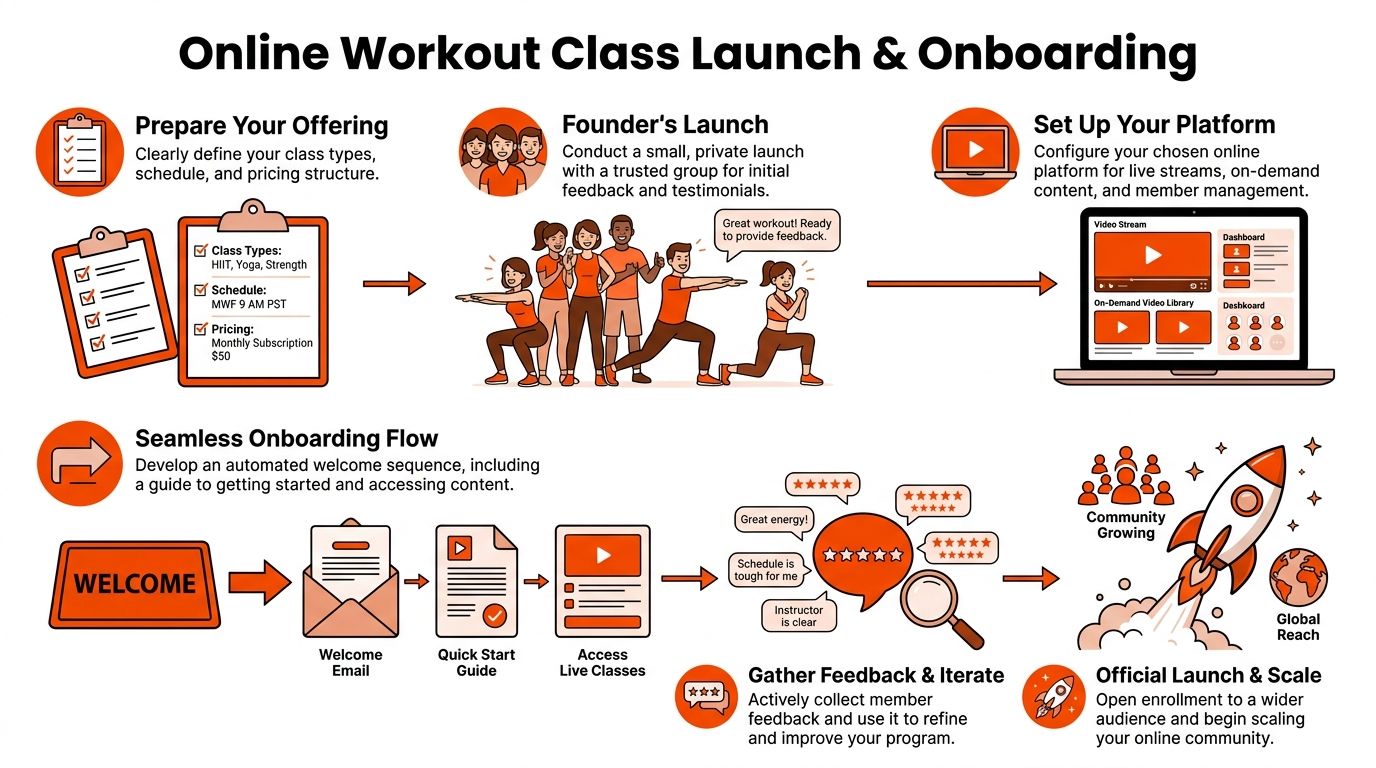
Run a founder's launch first
A founder's launch is a limited early version of your group. Keep it simple and personal.
Invite a small starting cohort and tell them they're joining the first round. In exchange for early access, they get a strong rate, close support, and the chance to shape the experience with feedback.
That approach helps in three ways:
- You learn fast
You'll spot confusing instructions, weak content formats, and onboarding gaps quickly. - Members feel invested
Early members often engage more because they know they're helping build the community. - You collect proof
Not fake testimonials. Real screenshots, questions, wins, and lessons from actual use.
The first 48 hours matter most
When someone joins and hears nothing, doubt creeps in fast. They wonder if they bought access to a quiet chat room and a few old files.
Your onboarding needs to remove that feeling immediately.
What a new member should receive right away
- Welcome message
Short, warm, and direct. Tell them where they are, what happens next, and what to do first. - Start-here post
This should be pinned. Include community rules, schedule, resource map, and how to ask for help. - First action
Don't say "explore the group." Give one specific instruction. Introduce yourself, choose your training track, or complete the first session. - Access to the current plan
Members should be able to train on day one, even if they joined midweek. - Equipment and modification guide
This cuts repetitive questions and lowers anxiety for beginners.
A practical onboarding flow
Here's a clean version that works.
Day 0
The member joins. They receive a welcome message and the pinned start-here guide. They can immediately view the current week's workouts and resource folder.
Day 1
Send a prompt asking one useful question. For example: what equipment do you have access to this week? That gives you context and gets the member talking.
Day 2
Invite them into a small action. Post your first session done. Ask one question. Share one goal for the month. Early participation matters more than long explanations.
New members don't need more information. They need a clear first win.
Keep the space tidy
Onboarding breaks when the group looks chaotic.
Use pinned messages well. Organize channels if you're on Discord. On WhatsApp, keep a clear posting rhythm and label important resources in a way people can find again. Name files properly. "Upper Body A Week 1" is better than "final_version_NEW2."
Don't overteach at the start
A coach's instinct is often to explain everything. Resist that.
A new member doesn't need your whole philosophy on progressive overload, energy systems, and recovery theory in the first hour. They need confidence that they joined the right group and can start without stress.
Launching wider after the test round
Once the founder's round is active, listen hard.
Notice:
- which posts get replies,
- which workouts cause confusion,
- what members skip,
- and what questions repeat.
Then refine before you open enrollment more broadly. Better onboarding usually comes from removing friction, not adding more material.
A polished experience feels simple from the member side. That simplicity takes work, but it's the kind of work that makes growth easier later.
Keeping Your Community Active and Retaining Members
A quiet group loses members even if the programming is good.
That's the uncomfortable truth about online workout classes. Content alone rarely keeps people subscribed. Members stay when they feel guided, noticed, and accountable. The coach's active presence is not decoration. It's part of the product.

The data backs that up. A remote training study found that supervised livestreaming reached a 93.3% adherence rate, compared with 86% for unsupervised video and 74% for written programs, according to the study published on PubMed Central. For coaches, the message is straightforward. Real-time interaction and visible accountability help people stick with training.
Why passive delivery falls flat
A PDF can tell someone what to do. It usually can't get them to do it.
Pre-recorded content has value, especially for replay and scheduling flexibility. But when a member starts slipping, passive content won't ask where they went. It won't tell them to scale the workout after a bad night of sleep. It won't notice that they always disappear after week two.
That's where community management becomes retention work.
The forms of interaction that matter most
- Daily check-in prompts
Keep them easy to answer. "What are you training today?" works better than long reflection exercises. - Weekly live touchpoints
A short livestream, office hour, or group form check creates momentum. - Direct feedback
Members remember when you answer their squat video or modify their session for a sore knee. - Visible progress culture
Celebrate consistency, not just dramatic transformations.
Members don't need constant entertainment. They need regular proof that someone is paying attention.
The best retention tools are usually small
You do not need to become a full-time community manager. You need repeatable habits.
Tactics that keep a group moving
- Use recurring post themes
Monday plan post, Wednesday check-in, Friday win thread. Familiarity helps people participate. - Spotlight member effort
Thank the person who trained during a work trip. Highlight the member who adapted sessions instead of quitting for the week. - Run short challenges
A simple consistency challenge works well because everyone understands it. - Keep coaches visible
Even a voice note can change the feel of the room. Text alone can feel distant over time.
One useful decision early on is picking the chat environment that matches your style. If you're weighing simplicity against channel organization, this breakdown of Telegram vs WhatsApp for paid communities helps clarify what kind of interaction each setup supports best.
Use live moments without building your whole offer around them
Live sessions matter because they sharpen accountability. They also create urgency and give members a reason to show up now instead of later.
A short example helps here.
You don't need daily livestreams. For many coaches, one or two live touchpoints a week are enough when the rest of the system is active. That could be:
- a live workout,
- a technique review,
- an open Q&A,
- or a programming walkthrough for the week.
Watch for the early warning signs
Retention problems usually show up before cancellation.
Look for members who:
- stop reacting,
- stop posting completed sessions,
- stop attending live events,
- or go quiet after missing a week.
That's the moment to re-engage. A simple message works: "Saw you've had a quiet week. Want the short-session option for the next few days?" That kind of outreach keeps people connected to the plan instead of feeling behind.
What doesn't work
Some tactics sound good but don't hold members for long.
- Endless motivational quotes with no training direction.
- Huge challenge calendars that feel like homework.
- Generic "great job" replies to every post.
- Overposting so members mute the group.
Strong retention comes from a steady mix of coaching, accountability, and usability. The member should feel that the group is alive, but not noisy. Supported, but not watched. Guided, but not overwhelmed.
Scaling Your Chat-Based Fitness Business
Scaling doesn't start when you hit a certain number of members. It starts when you stop rebuilding the business every month.
That means watching a few basic signals. If members stay, participate, and upgrade, you have something scalable. If they join and drift, you have a leaky system no matter how many new people you attract.
The numbers worth tracking
You don't need a huge dashboard. You do need visibility.
Watch:
- Churn rate
How many members cancel in a given period. - Customer lifetime value
How much a member is worth over the full time they stay. - Engagement
Who checks in, attends live sessions, posts questions, and uses the program. - Upgrade patterns
Which members move from base access into deeper coaching.
These numbers help you decide whether to improve delivery, tighten onboarding, or add a new offer.
Grow by going narrower
A lot of coaches think scale means broadening their message. In practice, growth often comes from building more focused groups.
A strength coach might expand into:
- strength for runners,
- beginner barbell foundations,
- post-injury return to training,
- or strength and mobility for desk-based professionals.
Each offer can live inside the same general business, but with clearer positioning and better fit for members.
Inclusive fitness is a real opening
One of the strongest overlooked niches is accessible programming. A major untapped market is inclusive fitness for people with disabilities, who are often underserved by mainstream apps. With 15% of the world's population having some form of disability, creating accessible online workout classes can become both meaningful and commercially strong, as noted through LimbPower's adapted live classes page.
That doesn't mean pretending to serve everyone. It means designing responsibly if you have the expertise, the lived understanding, or the willingness to build with care. Seated options, clear verbal coaching, equipment alternatives, and audio-friendly instruction can make a program more usable for more people.
The strongest niche offers often come from seeing the people generic fitness content ignores.
Increase reach without losing quality
Once your system works, your next step might be:
- adding a premium small-group tier,
- hiring another coach to handle form checks,
- creating a separate group for a specific training goal,
- or building a stronger resource library around your most successful program.
This is also where admin becomes a bottleneck. Payments, renewals, failed charges, and manually adding people to groups can consume coaching time. Tools that automate subscriptions and access control are useful here because they remove repeat admin and let you stay focused on programming, support, and growth.
A chat-based business scales well when the experience feels personal but the operations aren't manual.
Your Questions Answered
Do I need a custom app to sell online workout classes
No. Most coaches should start far simpler than that. WhatsApp or Discord can handle delivery, community, feedback, and live coordination very well. Your members already know how to use them, which removes friction from day one.
How do I compete with free workouts on Instagram and YouTube
Free content gives information. Paid coaching gives structure, accountability, context, and response. People don't join because exercises are secret. They join because they want a plan, a coach, and a reason to stay consistent.
What if I'm not technical
You don't need to be technical. You need a clear offer, a reliable posting rhythm, and a simple onboarding process. Most coaches struggle less with software than they expect. They struggle more with trying to build too much too early.
What should I include first if I'm launching small
Start with one training promise, one weekly schedule, one chat space, and one live touchpoint. Add complexity later. A focused offer with real support beats a giant resource library that feels empty.
What if members cancel early
Some will. Don't treat that as proof the model doesn't work. Look for patterns. If people cancel after joining, improve onboarding. If they cancel after missing a week, improve re-engagement. If they say they were confused, simplify the structure.
Can strength coaches really scale this model
Yes, if they stop treating every client like a separate custom project. The scalable version is structured group coaching with selective personalization. That keeps quality high without tying income only to one-to-one hours.
If you want to turn WhatsApp, Discord, or Telegram into a paid coaching space without juggling subscriptions and manual member access, Join My Coach gives you a simple way to set up recurring offers, automate payments, and manage access while you focus on coaching.