
Unlock Growth: Scale Your Nutrition Coaching Business
Published on March 30, 2026 · Reading time: 18 min
You love helping people. It's why you got into nutrition coaching in the first place. But if you’re only doing one-on-one sessions, you're likely stuck trading every single hour for money, and that's a model that will burn you out long before it builds a real business.
This isn't just a theory. It's a trap that countless talented nutritionists and coaches fall into.
This guide will show you how to deliver meal plans, consultations, and coaching services online while scaling beyond 1-to-1 sessions. You'll learn how accountability groups and structured communities can improve client results and retention in your nutrition coaching practice.
The Broken Model of 1-to-1 Nutrition Coaching

Let's tell a story I see all the time. Meet Sarah, a brilliant dietitian. Her calendar is a solid wall of back-to-back client calls, starting at 7 AM and running late into the evening. She’s crafting personalized meal plans, answering one-off questions via text, and delivering amazing results for her clients.
On paper, she’s killing it. A full client roster is the dream, right? But behind the scenes, Sarah is running on fumes. She's hit a hard income ceiling—there are only so many hours in a day. That idea she had for a specialized marathon nutrition program? It feels like a pipe dream, buried under an endless mountain of client work.
The Relentless Cycle of Repetition
Worse yet, Sarah’s days are all starting to feel the same. She finds herself repeating the exact same advice on a loop: how to read a nutrition label, why hydration matters, simple meal prep hacks. This advice is gold for each new client, but for Sarah, the constant repetition is sucking the life and creativity out of her work.
She feels less like an expert and more like a broken record. This is the grind that defines the traditional 1-to-1 coaching model. You pour all your energy into individual sessions, leaving absolutely nothing in the tank for building systems or scaling your business.
This is the fundamental problem:
- Your Income Is Capped: The only way to earn more is to work more. That’s not a business strategy; it’s a one-way ticket to exhaustion.
- Your Impact Is Limited: You can only serve the handful of people who can afford your premium rates and squeeze into your packed schedule.
- Burnout Is Almost Guaranteed: When you trade all your time for dollars, there's no space left for your own life, let alone for building a bigger future.
The real shift happens when you realize your clients need more than just a meal plan. They need community, shared motivation, and consistent accountability—things that are incredibly difficult to scale in a one-on-one setting.
What Clients Truly Crave Beyond the Meal Plan
A perfect meal plan is a great start, but it's rarely the thing that guarantees long-term success. Real, lasting transformation happens when clients feel supported day-to-day—through the challenges, the small wins, and the questions that pop up long after their session with you is over.
In a 1-to-1 model, you become the only source of that support, and that's an overwhelming burden. A client might feel totally alone when they have a moment of weakness or a small victory they want to share right now. Waiting a week for the next check-in can feel like an eternity and kill their momentum.
This is where the power of community changes everything. When clients are part of a group, they get something far more powerful:
- Shared Motivation: Seeing someone else push through a tough week is way more inspiring than a simple text from their coach.
- Peer-to-Peer Support: A member struggling with late-night snacking can get instant, practical advice from someone who just beat that same habit.
- Constant Accountability: The group itself creates a positive pressure to stay on track. No one wants to be the only one who didn't show up.
When you shift from being a solo practitioner to a community builder, you create a stickier, more supportive, and more effective environment for your clients. This doesn't just get them better results; it frees you from the endless, soul-crushing cycle of trading hours for dollars. It’s the first real step toward scaling your impact without sacrificing your life.
How to Design Your Signature Group Program
Moving from 1-to-1 coaching to a group model is a total game-changer. It’s the point where you stop repeating the same advice over and over and start building a repeatable system that works for you 24/7. Your unique expertise is the core of this, and a signature program is how you package that knowledge into a high-value, scalable experience.
This is your chance to stop trading all your time for money and build an asset that serves clients even while you sleep.
The first move is to plant your flag with a core coaching philosophy. What’s your unique approach to nutrition? Don't try to be the coach for everyone. Your real power is in your specific point of view.
Are you the go-to expert for simplifying macros for athletes? Maybe you specialize in plant-based eating for busy professionals, or your focus is on intuitive eating and healing relationships with food. This core belief is the foundation for everything you create.
Define Your Unique Coaching Angle
Your specific angle is what makes you stand out in a crowded market. It’s the difference between a generic "eat healthy" plan and a specialized system that solves a painful problem for a very specific group of people. This clarity is what attracts the right clients—the ones actively searching for exactly what you offer.
A focused approach also makes creating content a thousand times easier. For example:
- The Macro-Focused Coach: You’d build guides on carb cycling, protein timing for muscle growth, and how to track macros while eating out.
- The Plant-Based Coach: You would create resources on finding complete protein sources, supplementing key nutrients like B12, and cooking delicious vegan meals the whole family actually enjoys.
- The Intuitive Eating Coach: Your program might feature workshops on recognizing hunger cues, overcoming food guilt, and finding joy in movement without obsessing over the scale.
Specializing like this doesn't just build your authority; it gives you clear guardrails so you always know what content to create next.
The demand for this kind of specialized online coaching is absolutely exploding. The global nutrition coaching market is projected to hit $15,200 million by 2025 and is only expected to keep growing. This surge is driven by clients who want customized strategies delivered through accessible online platforms—proving that a well-designed group program is exactly what the market wants.
Build Your Foundational Program Assets
Once you’ve nailed down your philosophy, you can start creating the core materials that every single member receives. These assets guarantee a consistent, professional experience and save you from the stress of creating things on the fly. They are the essential building blocks of your scalable nutrition coaching program.
Think of them as your evergreen resources—high-value content that you create once and that works for you over and over again.
A strong set of foundational assets sets the tone for your entire program. It immediately shows clients they've invested in a professional, structured system, not just a casual chat group. This builds trust from day one and validates their decision to join.
Here are the non-negotiable assets you need to create:
- A Polished Welcome Kit (PDF): This is your client's first impression, so make it count. It should outline the program structure, explain how to use WhatsApp or Discord, and set crystal-clear expectations. Be sure to include group rules and a schedule of key events like weekly Q&A calls.
- Your Signature Recipe E-book: Gather your best, most popular recipes into a beautifully designed e-book that perfectly aligns with your coaching philosophy. This becomes a high-value resource clients will come back to again and again.
- A Library of Pre-Recorded Videos: Think about the questions you get asked constantly and turn the answers into short, easy-to-digest videos. Topics like "Mastering Your Weekly Meal Prep," "How to Read Nutrition Labels Like a Pro," or "Healthy Snacking on the Go" are perfect candidates. Host them privately and share the links in your group.
These assets create a self-service library that empowers clients to find answers on their own. This frees you up to focus on the high-touch coaching and community engagement that they're really paying for.
Designing a structured online program can feel like a huge task, but starting with these key pieces simplifies the whole process. If you want more specific guidance, our guide on structuring a weight loss coaching program can be a huge help. By front-loading the work to create these core materials, you build a robust and scalable foundation for your group coaching business.
Alright, you've got your program mapped out. Now, where is this community actually going to live? This isn't a decision about fancy tech; it's about picking the right home for your clients and your specific coaching style.
The good news is you really only need to decide between two heavy hitters everyone already knows: WhatsApp and Discord. Let's break down which one is the perfect fit for your new group nutrition coaching business.
WhatsApp for Simplicity and Direct Access
WhatsApp is simple, direct, and just about everyone on the planet has it on their phone. This near-zero barrier to entry is its absolute superpower. Clients don't have to download a new app, create another login, or figure out a complex layout. They just tap to join your group and are instantly in the loop.
This kind of simplicity is perfect for programs that are all about daily check-ins, quick motivational boosts, and fast-fire questions. The single-chat format keeps the conversation flowing in one place, which can create a really tight-knit, lively vibe. If your coaching is built on personal connection and straightforward communication, WhatsApp is a fantastic choice.
But its biggest strength can also be its biggest weakness. A single, super-active chat can get chaotic, fast. Important resources, recipes, and Q&A gems can easily get buried in an avalanche of messages, making it a pain for members to find anything later on.
Discord for Structure and Scalability
If your program involves more structured content—think different weekly topics, resource libraries, and dedicated discussion zones—then Discord is your best bet. It's less like a single chat room and more like a fully organized digital community center.
You can create separate, dedicated channels for absolutely everything. Picture a setup like this:
- #welcome-and-rules: A static channel where new members get their bearings.
- #weekly-wins: A space dedicated purely to celebrating member progress.
- #meal-ideas: A channel just for members to share recipes and food photos.
- #ask-the-coach: The designated spot for members to ask you questions directly.
- #resource-library: A permanent home for all your PDF guides, video links, and other evergreen content.
This level of organization is what stops your members from feeling overwhelmed. It empowers them to find exactly what they need, right when they need it. This structure is the very cornerstone of a scalable nutrition program, ensuring a great experience for both you and your clients. For a deeper look at the platforms, you can learn more about how Discord compares to other tools and find the best fit for your specific needs.
This decision tree visualizes how your core coaching philosophy can guide your program design, which in turn points you toward the platform that will work best for you.
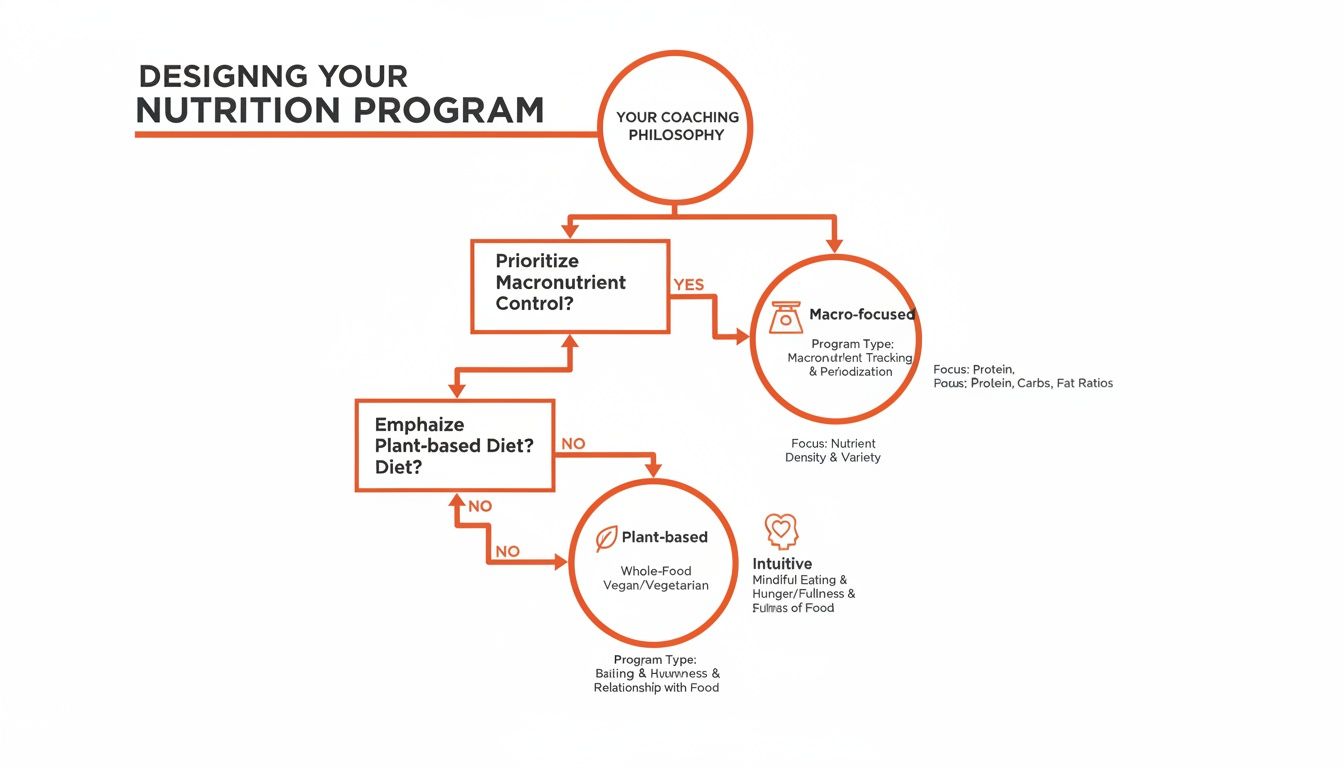
As you can see, a highly specialized program, like a macro-focused one with lots of data and specific resources, really benefits from the tidy channels of Discord. On the other hand, a coaching philosophy centered on broad-based support and daily motivation might thrive in the direct, always-on communication of WhatsApp.
WhatsApp vs Discord for Your Nutrition Community
Still on the fence? This table breaks down the core differences to help you choose the platform that best aligns with your program's goals and your members' needs.
| Feature | WhatsApp Groups | Discord Server |
|---|---|---|
| Simplicity | Extremely high. Almost no learning curve for new members. | Moderate. More features mean it takes a little getting used to. |
| Organization | Low. A single chat stream where content can get lost. | High. Create unlimited channels to organize topics, resources, and chats. |
| Content Discovery | Poor. Members must scroll endlessly to find old information. | Excellent. Dedicated channels make it easy to find what you need. |
| Best For | Daily accountability, motivation, and simple Q&A. | Structured programs, resource libraries, and tiered content access. |
| Scalability | Limited. Can become chaotic and hard to manage as the group grows. | High. Built to handle large communities with thousands of members. |
Ultimately, the best platform is the one that makes your members’ lives easier and helps you deliver value without burning out.
Making the Final Call
Look, there’s no single "right" answer here. There’s only what’s right for your program and your clients.
Your choice of platform should reduce friction, not create it. The goal is to make it as easy as possible for your members to get support, find information, and engage with the community.
Let's boil it down:
- For maximum simplicity and accessibility, you can't beat WhatsApp.
- For ultimate organization and scalability, Discord is the clear winner.
No matter which one you pick, the key is to set clear rules, post a killer welcome message, and establish a consistent content rhythm. Whether that means "Motivation Mondays" in your WhatsApp group or a dedicated #weekly-challenge channel on Discord, consistency is what will keep your members engaged. This is how you transform a simple chat group into a thriving, supportive community that drives incredible client results.
Pricing Your Group Program for Profit and Impact
Alright, let's talk money. This is the part where so many incredible nutrition coaches get stuck. You know the transformation you can deliver is life-changing, but putting a price tag on that value feels awkward and a little uncertain.
The secret is to stop charging for your time. Seriously. You need to shift your mindset and start pricing based on the outcome you provide. That's the difference between just earning a living and building a genuinely scalable, profitable business.
When you sell access to a proven system, a supportive community, and a clear result, you're no longer capped by the number of hours in your day. I'm going to walk you through a simple, effective tiered pricing structure that makes perfect sense for you and your clients.
The Power of Tiered Pricing
Slapping a single price on your program is a huge missed opportunity. Your potential clients are all at different stages—they have different budgets, different needs, and want different levels of access to you. A tiered structure lets you meet them exactly where they are.
This makes your program accessible to a much wider audience while still giving you a premium option for those who crave more direct support. It's a total win-win. Clients get to choose their investment level, and you get a clear path to maximizing revenue and building a predictable income stream. This is a core strategy for any successful nutrition coaching community.
And believe me, the market for this is massive. Within the wider health coaching world, nutrition coaching is the undisputed leader, making up a huge 32.4% of the entire market in 2023. The total health coach market topped $16.1 billion last year and is on track to hit $32.3 billion by 2033. For coaches like you offering specialized programs on modern platforms, this is all the validation you need. You can check out more insights on this booming market at market.us.
Building Your Three-Tiered Structure
Let's get practical. Here is a proven three-tier model you can steal and adapt for your own program. It’s designed to be dead simple to explain and manage, with clear value at each level and an obvious upgrade path for your members.
Tier 1: Community Access
This is your entry-level, high-volume offer. It’s perfect for the self-starters who want your core system and the energy of a community but don't need constant hand-holding.
- What’s Included: Access to your private WhatsApp or Discord group, the Welcome Kit, your recipe e-book, and the full library of pre-recorded videos.
- Price Point: Think somewhere in the $49-$99 per month range.
- The Value: This tier offers insane value for a low price, creating a powerful sense of community and accountability that keeps people engaged.
Tier 2: Coaching Plus
This will likely be your sweet spot and most popular offer. It takes everything from Tier 1 and adds a layer of direct access to you, which massively boosts its perceived value.
- What’s Included: Everything in Community Access, plus a live weekly group Q&A call hosted by you.
- Price Point: A natural step up, usually around $149-$249 per month.
- The Value: That weekly live call is a huge draw. It gives members a dedicated time to get their personal questions answered, creating a perfect blend of community support and expert guidance.
Tier 3: VIP Hybrid
This is your premium, high-ticket offer. You should limit the number of spots available. It combines the scalability of your group program with the high-touch personalization of 1-to-1 coaching. It’s for the client who wants the absolute best of both worlds.
- What’s Included: Everything in Coaching Plus, plus one or two private 15-minute 1-to-1 check-in calls with you each month.
- Price Point: This is where you charge a premium, often from $399-$599+ per month.
- The Value: This hybrid model lets you serve your most committed clients at a top-tier rate without completely filling your calendar with 1-to-1 sessions.
Pricing based on transformation means you charge for the solution, not the minutes. A client is paying for the confidence, the energy, and the sustainable habits you help them build—a result that is far more valuable than an hour of your time.
By setting up this structure, you create multiple income streams from a single program. It gives you the confidence to charge what you're worth while building a business that can actually grow with you. For more ideas on generating revenue from your groups, check out our coaching community monetization guide for more strategies.
Automating Your Operations to Finally Scale
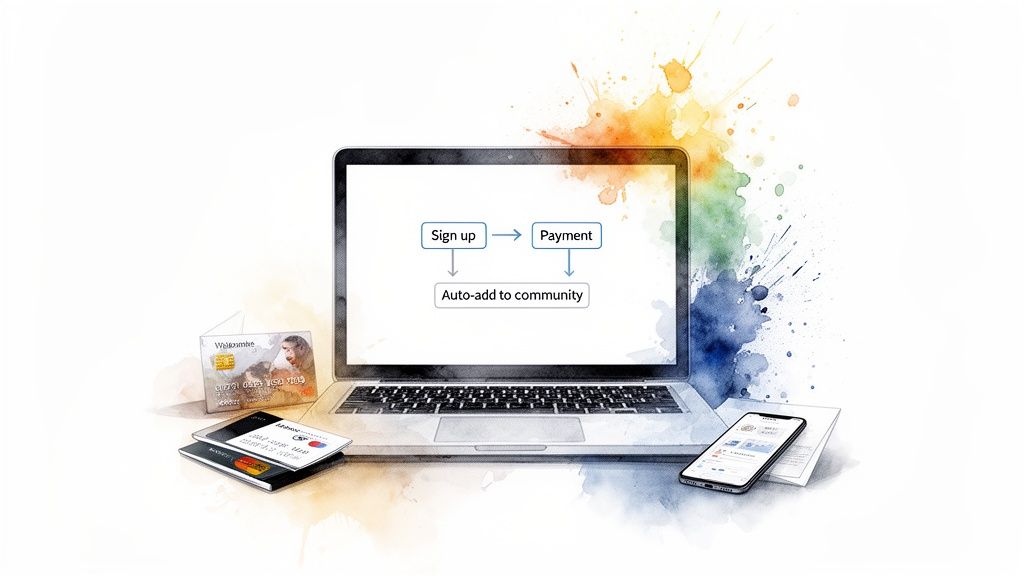
You’ve designed a killer program and picked the perfect home for your community. Now for the part that separates the coaches who get stuck from the ones who actually build an empire: automation. This is how you win back your time from soul-crushing admin and get back to doing what you love.
Scaling a group nutrition coaching business isn’t about working more hours. It's about building a smart, hands-off system that basically runs itself. This system takes over all those repetitive, boring tasks that will absolutely bury you as your group grows. Think about it—manually tracking payments, adding new members to your WhatsApp group, and kicking people out when they cancel is a direct path to burnout.
Automation is the engine that lets you serve hundreds of clients with the same energy it once took to handle just a handful.
From Manual Mayhem to Automated Magic
Let’s look at a real-world scenario. Meet Alex, a nutritionist whose group program is finally taking off. In the beginning, managing 15 members was a piece of cake. He’d get a payment notification, hunt for the client's name on a spreadsheet, and then manually add them to his private WhatsApp group. A little clunky, but it worked.
Then 15 members blew up to 50. All of a sudden, Alex was spending hours every week just playing admin. He was chasing down failed payments, cross-referencing names, and trying to figure out who needed to be removed. He was so bogged down in busywork that he barely had time to actually coach. His members felt the dip in his energy, and the vibe of the community started to suffer.
This is the exact spot where so many great coaching businesses fall apart. Alex realized his manual process wasn't just slow—it was a bottleneck, actively holding him back. He needed a system to handle the grunt work so he could be a coach again.
Creating a Seamless Client Journey
The goal here is a completely hands-off experience from the second a client decides to join you. The system should be so slick it feels like magic to them, while giving you total peace of mind.
Here’s what that ideal, automated journey looks like:
- Simple Sign-Up: A potential client taps a single link in your social media bio or on your website.
- Effortless Payment: They land on a clean, simple page to pick their tier (like "Community Access" or "Coaching Plus") and pay securely through a trusted processor like Stripe.
- Instant Access: The second their payment goes through, they are automatically dropped into your designated WhatsApp group or Discord server. No waiting, no manual invites from you.
- Hands-Free Management: If a member’s payment fails or they cancel their subscription, the system automatically removes them from the group.
This automated flow wipes out 100% of the administrative friction. No more chasing payments, no more updating spreadsheets, and zero awkward conversations about removing people. It just works.
When you automate your operations, you're not just saving time. You're buying back the mental energy you need to create amazing content, engage with your members, and deliver the incredible results they signed up for.
This isn’t some complicated dream that needs a team of developers. In fact, this is precisely what focused, simple tools are built for. A platform like Join My Coach, for example, is designed to connect your Stripe account directly to your WhatsApp or Discord community. It acts as the automated bridge, handling the entire payment and access management process for you.
By setting up this kind of system, you unlock the freedom to focus on the high-impact stuff that actually grows your business. You can finally stop being the bottleneck in your own success and start building a nutrition coaching empire that's both profitable and sustainable.
Common Questions About Group Nutrition Coaching
Making the jump from 1-on-1 coaching to a group model is a big step. It's natural to have some hang-ups. The biggest one I hear? The fear that you'll lose that personal touch that makes your coaching so effective.
Let's get into the nitty-gritty and tackle the most common questions coaches have. My goal here is to give you the practical answers you need to feel confident about scaling your impact without sacrificing quality.
How Can I Give Personalized Attention in a Group?
This is the number one question, and for good reason. The answer isn't about working harder; it’s about having smarter systems in place. Personalization in a group isn't about being stuck in DMs all day.
You can deliver incredible, personalized value by:
- Hosting weekly "Office Hours" or live Q&A sessions. This is your dedicated time to answer specific, individual questions live where everyone can benefit.
- Using super-detailed intake forms. Your onboarding is your secret weapon. Understand each member's goals, struggles, and dietary history from day one.
- Creating dedicated channels like
#ask-the-coachin your Discord server. This lets you provide targeted feedback that the entire community can learn from.
Your role shifts from being a constant advisor to a community facilitator. You'll be surprised how often one person's question sparks a breakthrough for ten others. The community itself becomes an incredible, self-sustaining support system.
What Legal Basics Do I Need to Cover?
Let's be clear: protecting yourself and your clients is non-negotiable. When you're running a group nutrition coaching program, you have to operate firmly within your scope of practice and set crystal-clear professional boundaries.
Always have a rock-solid disclaimer on your sign-up page, in your welcome materials, and pinned in your community rules. This needs to state that you provide education and coaching, not medical advice.
Your client agreement must be explicit: members should consult a doctor for any medical conditions or before making major dietary changes.
It's also a smart move to check that your professional liability insurance covers online group coaching. Transparency and clear boundaries don't just protect you legally; they establish you as a credible, trustworthy expert.
How Do I Keep Members Engaged and Reduce Churn?
An engaged community is a sticky one. Your top priority after getting members in the door is creating a space they never want to leave. Engagement is your single best defense against churn.
Create a simple content calendar to keep the conversation going. This doesn't need to be complex. Daily prompts are a brilliant way to spark interaction:
- Motivation Monday: Members post their goals for the week ahead.
- Foodie Friday: Everyone shares a picture of a healthy meal they made.
- Win Wednesday: A dedicated space to celebrate small victories together.
You can also run simple monthly challenges, like a 7-Day Hydration Challenge, to keep the momentum high. Actively celebrating wins—no matter how small—makes your members feel seen and valued. The goal is to make your group an essential, positive part of their daily health routine.
Ready to automate the busywork so you can focus on building your community? Join My Coach connects your Stripe account to WhatsApp or Discord, handling all your payments, subscriptions, and access management for you. Create your first subscription page for free and see how simple scaling can be.