
Online Yoga Trainer: Launch Your Coaching in 2026
Published on July 15, 2026 · Reading time: 16 min
If you're a yoga trainer right now, there's a good chance your week looks busy on paper and unstable in real life. You teach a few classes, answer student messages, maybe fill in at another studio, maybe record a short flow for Instagram, and still wonder why the income never feels steady.
That tension is common. Yoga teaching can be meaningful, but the old model often leaves teachers with little control over pricing, programming, and student relationships. The better path for many coaches isn't more classes. It's building a beginner-friendly online accountability program that gives students support between sessions, not just during them.
Moving Beyond the Traditional Studio Model
The studio model still has value. It gives you space, local visibility, and real-time energy.
But for many yoga trainers, it also creates a ceiling. You follow someone else's schedule, teach someone else's format, and often earn too little for the preparation, travel, and emotional labor involved.
According to Bee Umana's review of yoga teaching economics, only 29% report teaching as their primary income source, 85% earn below $2,000 monthly from yoga, and 53% feel underpaid by studios. That doesn't mean teaching yoga isn't viable. It means relying on studio classes alone often isn't enough.
Why the old setup wears teachers down
Studios usually pay for the hour you teach. They rarely pay for:
- Class design: Sequencing, music, theme planning, and modifications for mixed levels
- Admin work: Reminders, follow-up, and answering private student questions
- Brand building: The time you spend attracting students often benefits the studio more than you
- Relationship depth: Students know your class time, but not always your full coaching offer
A yoga trainer who wants to help beginners consistently runs into the same issue. One class a week isn't enough contact to change habits. A student may love your flow on Tuesday and disappear by Friday because no one checked in.
Practical rule: If your students only hear from you during class time, you're teaching sessions, not coaching change.
What works better online
A chat-based coaching model fixes a specific problem. It keeps support alive between classes.
Instead of trying to replace in-person teaching, use digital coaching to add a second layer:
- Short guided practices
- Daily check-ins
- Habit prompts
- Q&A support
- Community accountability
That changes your role. You're no longer only the teacher at the front of the room. You're the guide students keep in their pocket.
For beginners, that matters. They don't usually fail because they hate yoga. They stop because they forget, feel awkward, get confused, or lose momentum after a missed day.
Recurring income comes from continuity
A recurring membership is more stable than hoping enough people show up for drop-ins. It also gives you room to coach in a more human way.
You can run a simple monthly structure with group support and optional premium layers. That makes your income less dependent on room capacity, commuting, or whether the studio changed your slot again.
If you're building this side of your business from scratch, this guide on how to start an online coaching business is a useful next read.
The strongest online yoga offers don't sell access to videos. They sell consistency, support, and a reason to come back tomorrow.
Designing Your Signature Chat-Based Program
Most online yoga offers are too broad. "Join me for yoga" isn't a program. It's an activity.
A beginner joins faster when the result feels specific and manageable. Your signature offer should solve one clear problem for one clear type of student.
Start with a real beginner need
Pick a group you understand well. Not a demographic on paper. A real person you can picture.
Examples:
- Office workers with stiff hips and tight shoulders
- Busy parents who want short morning routines
- Women returning to movement after a long break
- Men who feel intimidated by studio culture
- Students who need gentle structure at home
Research discussed by YogaUOnline on making yoga accessible to marginalized and minority populations found that engagement improves when teachers give personalized home practice tips and remove barriers like lack of beginner-friendly or individualized instruction. That's exactly where chat coaching shines.
Build around three pillars
A good beginner program needs more than flows. It needs a small system people can stick to.
Accessible movement
Keep practices short and repeatable.
That might look like:
- A morning mobility flow
- A desk-break stretch sequence
- A gentle evening downregulation class
- A simple posture drill students can repeat all week
For beginners, complexity is usually the enemy. A yoga trainer gets better results from a few well-taught patterns than from constantly changing sequences.
Simple habits
Movement alone won't hold the program together. Add tiny daily actions that support the practice.
Use habits like:
- Drink water before morning practice
- Sit for two quiet minutes after class
- Step outside after lunch and breathe slowly
- Log one word about energy level each evening
These are easy wins. Easy wins keep beginners in motion.
Community accountability
This is the part most video libraries miss.
Your students need a place to say:
- "Done."
- "I only had five minutes but I showed up."
- "My wrists hurt in plank. What should I change?"
- "I missed yesterday. Starting again today."
That shared rhythm builds retention better than a pile of content.
A beginner-friendly program should feel easy to rejoin after an imperfect week.
A simple offer structure
Use a promise that feels grounded, not dramatic.
| Program element | Example |
|---|---|
| Who it's for | Desk workers new to yoga |
| Main outcome | Build a steady home practice without overwhelm |
| Time demand | Short daily practices and check-ins |
| Support style | Group chat, habit prompts, feedback |
| Content mix | Video, audio, PDFs, weekly reflection |
You don't need a huge curriculum to begin. You need a clear path.
Name the transformation in plain language
Good names are specific and calm. They sound like help, not hype.
Examples:
- Morning Reset Yoga
- Desk Break Mobility Club
- Beginner Home Yoga Habit
- Calm Body Evening Practice
A strong name tells people what they'll do and how they'll feel. That's enough.
Crafting Routines and Content for a Chat Format
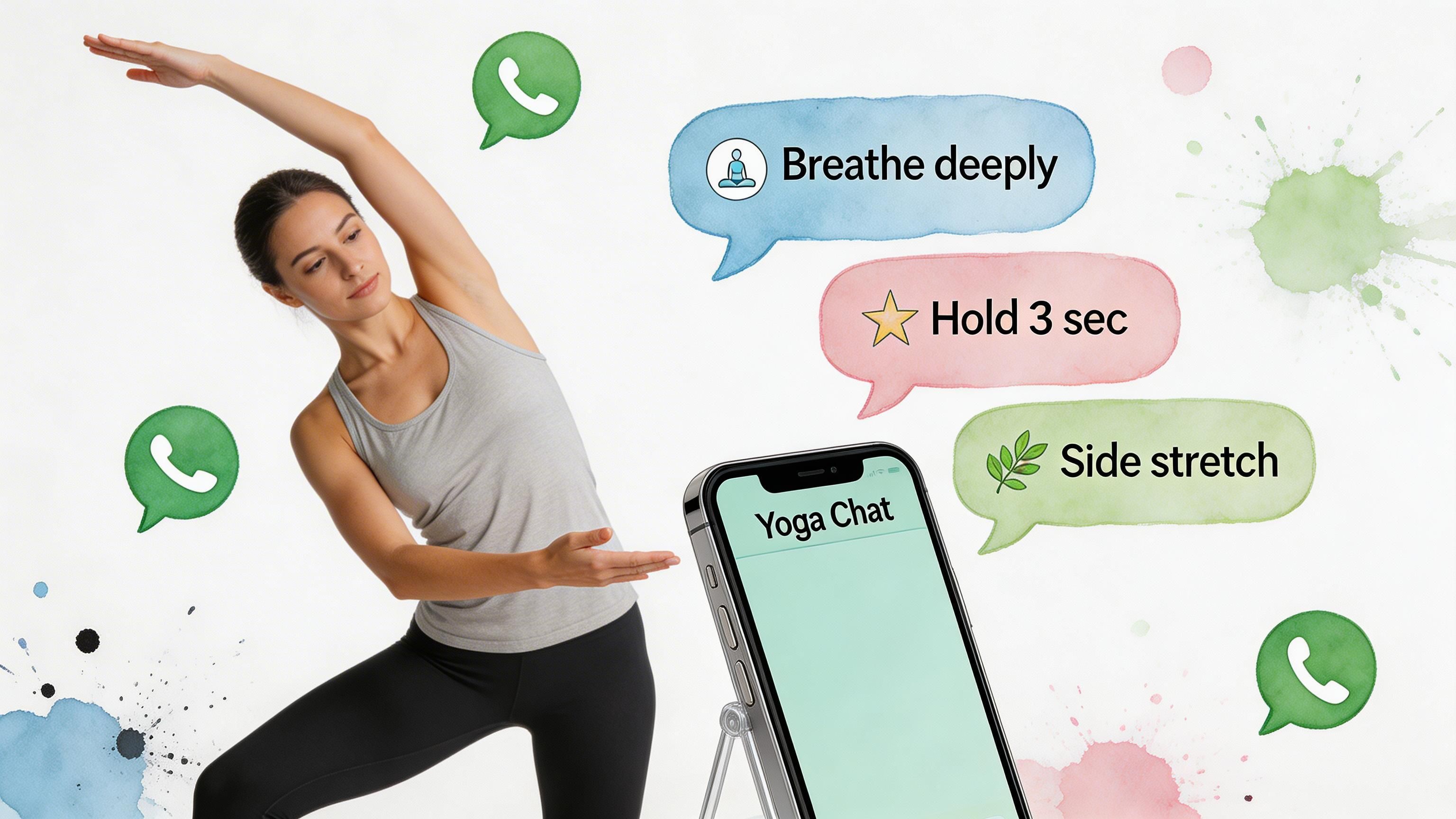
Chat coaching works when the content is light enough to consume quickly and clear enough to use without you standing beside the student. A beginner shouldn't open your message and wonder where to start.
A yoga trainer in chat isn't sending long lectures. You're creating a steady rhythm of prompts, instruction, and response.
Clarity beats quantity
Practitioner trust depends heavily on how clearly you teach. In this review of yoga intervention research, 64% of yoga students prioritized clear instructions, while 60% of studies failed to specify the trainer's qualifications. Students notice clarity. They also notice when guidance feels vague or generic.
That matters even more in an asynchronous format. Your student can't raise a hand in the middle of the room. Your written cue has to do more work.
Keep each message focused
A good chat post usually does one job:
- Introduce today's practice
- Explain one alignment point
- Ask for a check-in
- Offer one modification
- Prompt a reflection
Bad chat coaching overloads the student. Good chat coaching reduces friction.
A weekly rhythm that feels supportive
You don't need to post constantly. You need to post predictably.
A simple week might look like this:
- Monday: Welcome message and short grounding flow
- Tuesday: Pose breakdown PDF with one common mistake and one easy modification
- Wednesday: Audio breathwork or short meditation
- Thursday: Mobility session and community check-in poll
- Friday: Reflection prompt and win sharing
- Saturday: Optional longer flow
- Sunday: Rest, reset, and next-week intention
If you also teach meditation or want to blend it into your offer, this guide to a meditation coaching business connects well with a yoga accountability model.
Message templates you can actually use
Here are examples that fit chat apps well.
Good morning. Today's practice is a 7-minute hip and spine reset. Move slowly. If you're short on time, do the first 3 minutes and reply with "done."
Midday check-in. Notice your shoulders right now. Lift them, roll them back, soften your jaw, take 5 slow breaths. Reply with one word for how your body feels.
Evening reflection. What helped you show up today? A short answer is enough. If you missed practice, no stress. Tell the group when you'll restart.
These messages work because they're direct. They don't ask for a big emotional essay. They invite action.
Use a mix of media
Different content formats solve different teaching problems.
| Format | Best use |
|---|---|
| Short video | Demonstrating flow, pace, and transitions |
| PDF guide | Pose setup, modifications, common errors |
| Voice note | Tone, encouragement, breath pacing |
| Poll | Fast engagement and habit tracking |
| Text prompt | Daily accountability |
Here's a good example of how concise visual instruction can support teaching in a digital format:
Document what you're teaching
For a yoga trainer, professionalism online isn't about fancy branding. It's about making your coaching easy to follow and safe to repeat.
Use consistent labels on your content:
- Beginner
- Gentle
- Wrist-sensitive option
- Standing only
- No props
- 5 minutes
- 10 minutes
That small layer of structure builds confidence fast.
Setting Up Your Pricing and Onboarding Flow
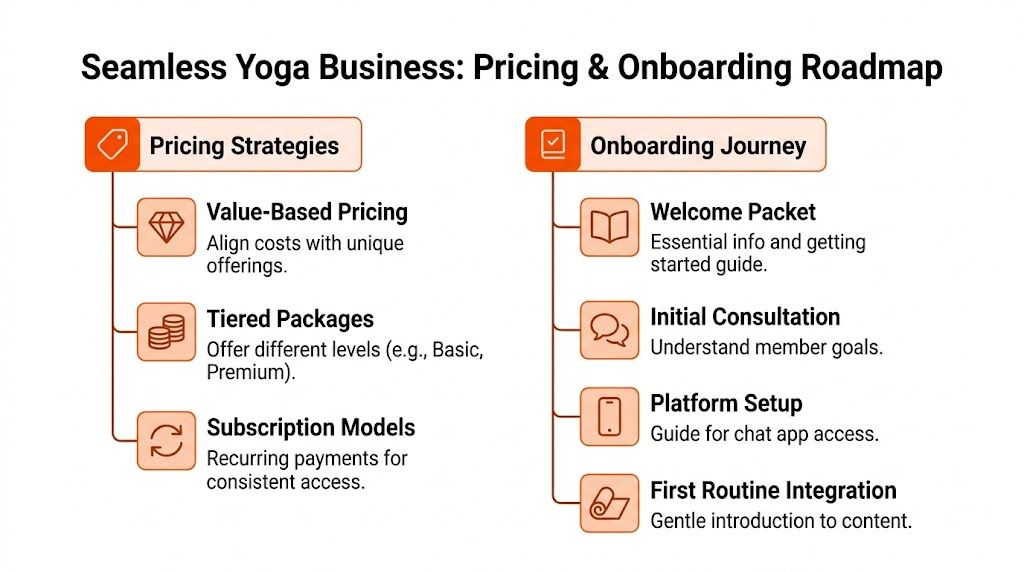
A strong program can still struggle if the pricing is confusing or the first few days feel messy. People don't just buy yoga content. They buy clarity, ease, and confidence that they'll know what to do next.
Choose a pricing model that matches the experience
A beginner accountability offer works best when pricing reflects support level, not just file access.
Three common models work well.
Simple monthly membership
This is the cleanest starting point. Members join, stay in the group, and receive ongoing practices, prompts, and accountability.
Best for coaches who want recurring income and an active community.
Tiered membership
This works well when your audience has mixed budgets and commitment levels.
A sample structure:
| Tier | What it includes | Best for |
|---|---|---|
| Community | Group chat, daily prompts, shared accountability | Students who want consistency |
| Program | Community plus full content library and weekly teaching themes | Students who want more structure |
| Premium | Program access plus private check-ins or feedback | Students who want personalized support |
One-time challenge or starter program
This lowers entry friction. It's useful if your audience doesn't know you well yet.
The trade-off is obvious. It's easier to sell, but it doesn't build recurring income on its own unless you lead people into an ongoing membership.
Pricing lens: Charge for access, guidance, and responsiveness together. Beginners often value accountability more than content volume.
What not to do with pricing
A few mistakes show up often:
- Underpricing premium attention: Private feedback takes real energy
- Bundling everything into one low-ticket offer: It limits your upside
- Hiding the difference between tiers: People need an easy comparison
- Changing prices every month: It makes the offer feel unstable
You don't need a complicated pricing page. You need a clean offer ladder.
Onboarding should feel calm and personal
The first week determines whether a member settles in or drifts out. Good onboarding removes awkwardness fast.
Use a short sequence.
Day one welcome
Send a message that includes:
- What the program is
- Where to start
- How often to check in
- What kind of wins count
- Group expectations
Quick intake
Ask a few practical questions:
- What's your experience level?
- Any injuries or movement limits?
- What time of day do you usually practice?
- What would make this membership feel successful after a month?
First action
Don't send the entire library first. Give one simple starting point.
For example:
- Intro video
- 5-minute reset flow
- beginner pose guide
- first check-in prompt
New members stay longer when the first action is obvious and small.
A welcome message template
You can adapt this quickly:
Welcome. You're in the right place if you want a simple, sustainable yoga routine. Start with the Intro Flow pinned at the top, then reply with your first name, your experience level, and the best time of day for your practice. Showing up for a few minutes counts here.
That last sentence matters. It lowers pressure without lowering standards.
Growing Your Community and Keeping Members Motivated

Marketing and retention aren't separate jobs in this kind of business. When your community feels alive, members stay longer and talk about it more naturally. A healthy group becomes your proof.
The audience is there. George Watts' yoga statistics roundup notes over 300 million yoga practitioners globally, and 85% of U.S. practitioners sometimes practice at home. A yoga trainer doesn't need to reach everyone. You need to reach the right small group and serve them well.
Attract members without sounding salesy
Beginners respond to reassurance more than performance.
That means your marketing should show:
- What a real day inside the program looks like
- How short the practices are
- How you support missed days
- What kind of person the group is for
- Why chat support works better than passive watching
A few low-pressure methods work well.
Run a short free challenge
A free challenge lets people experience your tone and structure before committing. Keep it simple and time-bound.
Examples:
- 3 days of morning mobility
- 5 days of evening wind-down yoga
- beginner breath and stretch reset
Use the challenge to teach your coaching style, not to dump content.
Share student language
When members describe what changed, pay attention to the words they use.
They usually won't say, "My kinetic chain improved." They'll say things like:
- I finally practiced three days in a row
- I don't feel intimidated anymore
- The short videos made it easier to start
- The group helped me stay on track
That language sells better because it sounds real.
Retention comes from momentum
People stay when they feel seen and capable. Not when they're buried in resources.
Here are practical retention habits that work:
- Celebrate small wins: Praise consistency, not only dramatic progress
- Use polls often: Quick responses keep quieter members involved
- Create weekly themes: A simple focus makes the group feel coherent
- Invite peer support: Let members respond to each other, not only to you
- Normalize restarts: People need permission to come back after missing days
Community retention improves when members feel safe being imperfect in public.
Build rituals, not noise
The strongest groups have familiar rhythms. Members know what happens on certain days.
For example:
| Day | Community ritual |
|---|---|
| Monday | Intention check-in |
| Wednesday | Midweek support poll |
| Friday | Win of the week |
| Sunday | Reset and recommit |
A yoga trainer can scale that kind of structure more easily than constant live teaching. It supports the student without demanding your presence every hour.
Collaborations can bring aligned members
Partner with people who already serve your audience.
Good collaboration partners include:
- Nutrition coaches
- Breathwork teachers
- Therapists or wellness educators
- Desk ergonomics specialists
- Local fitness or recovery professionals
Keep the collaboration practical. A joint live session, a mini challenge, or a shared Q&A usually works better than a vague cross-promotion post.
The Simple Path to Automation and Scale
The digital model only helps if it doesn't turn into another admin-heavy job. If you're manually chasing payments, sending links one by one, and checking who should still be inside the group, you'll recreate the same burnout in a new format.
The demand is there. According to Aura Wellness Center's discussion of yoga teaching opportunities outside studios, Google searches for "yoga WhatsApp groups" were up 65% year-over-year in 2025, and a 2025 ICF report showed 70% of independent trainers earn over half their income from online communities. The opportunity isn't the problem. The setup usually is.
What to automate first
A yoga trainer doesn't need to automate the teaching voice. You should automate the repetitive logistics.
Start with:
- Member payments
- Subscription renewals
- Access to private groups
- Removal after cancellation or failed payment
- Delivery of core resources after signup
That gives you more room to coach properly.
Keep your stack simple
You don't need a complicated software pile. A small business can run smoothly with a few connected systems.
For scheduling private sessions alongside your membership, it can help to use booking software designed for sports coaches. That's especially useful if you offer premium check-ins or 1:1 support on top of a group program.
Automation should protect your energy, not add another dashboard you resent opening.
Scale by narrowing, not expanding wildly
The easiest way to grow is often to make your offer more focused.
A tighter niche helps you:
- Speak more clearly
- Create faster
- Attract better-fit members
- Retain people longer
- Build referrals around a known result
You don't need a huge content empire. You need a clean offer, a steady rhythm, and systems that let people join without friction.
The online yoga business that lasts usually looks simple from the outside. That's the point.
If you're ready to turn your WhatsApp, Telegram, or Discord community into a paid coaching offer without wrestling with manual admin, Join My Coach gives you a simple way to automate subscriptions, payments, and member access so you can focus on teaching and supporting your students.